

Quick Answer
P0183 means Fuel Temperature Sensor “A” Circuit High. The controller detected an electrical input above its calibrated limit. “High” describes the circuit signal, not proof that the fuel is too hot. Save the complete scan, identify the correct sensor and test its connector, signal and return circuits before replacing parts. A Peugeot/Citroën P2541 companion code needs its own manufacturer-specific interpretation.
What Does the P0183 Code Mean?
A P0183 code reports an electrical fault in the fuel-temperature measurement circuit. The engine controller uses fuel temperature as one input in its management strategy. The exact sensing arrangement varies: a temperature element may be separate or integrated into another fuel-system component. Identify the arrangement from service information before searching for a replacement part.
In a common thermistor circuit, an open sensor or disconnected return can let the signal rise toward its pull-up supply, producing an implausibly cold displayed temperature. That is an example of circuit behavior, not a universal diagnosis. Other designs and scan-data translations require different interpretation; check the wiring diagram and the manufacturer’s resistance/temperature specification.
The letter “A” is part of the diagnostic designation. It does not universally identify a left-hand sensor, a particular connector pin or a component at the fuel tank. Do not confuse the fuel-temperature sensor with the coolant-temperature, intake-air-temperature or fuel-pressure sensor simply because their connectors look similar.
P2541 has a different generic definition: Low Pressure Fuel System Sensor Circuit Low. When it appears alongside P0183, record the full manufacturer wording, any suffix and the reporting control unit. Shared wiring or a component assembly may connect two symptoms on a particular vehicle, but the two code numbers are not interchangeable.
P0183, nearby temperature codes and P2541
| Code | General description | Key distinction |
|---|---|---|
| P0183 | Fuel temperature sensor A circuit high | Identify why the input exceeds the calibrated circuit limit. |
| P0182 | Fuel temperature sensor A circuit low | The opposite circuit direction; not the same diagnostic result. |
| P0181 | Fuel temperature sensor A range/performance | Plausibility or performance must be assessed under the specified conditions. |
| P2541 | Low pressure fuel system sensor circuit low | Read the exact vehicle-specific description and circuit diagram. |
Scope of this guide: The general P0183 diagnosis applies only after confirming the vehicle’s code definition. The retained Peugeot/Citroën example below illustrates one reported repair; it does not establish a universal replacement procedure or prove that every P2541 comes from a temperature sensor.
Video case: Citroën C5 Aircross with P0183 and P2541
In the linked video, SA Diagnostic's identifies a 2019 Citroën C5 Aircross 2.0 diesel and discusses a sensor fault alongside P0183 and P2541. The presenter points out the component and recommends checking voltage. This short demonstration does not show a complete electrical test record or a completed post-repair monitor. Use it for case context and visual orientation, then follow the service procedure for your VIN.
Video credit: SA Diagnostic’s — Peugeot / Citroen P0183 P2541 Fuel Temperature Sensor. The presenter’s parts preference is not evidence that all aftermarket sensors fail.
P0183 Symptoms and Likely Causes
P0183 may appear with only a warning light. Rough running or a no-start condition needs wider investigation because a temperature-circuit code does not explain every fuel-system symptom. Record what actually happened before the scan.
A circuit monitor may set the code without a noticeable change in performance.
A fixed extreme or abrupt jump can guide circuit testing, if the PID is supported and correctly identified.
Hard starting, hesitation or stalling may involve companion fuel-pressure or supply faults.
A disturbed plug, poor terminal contact or damaged harness may be relevant after nearby work.
Practical cause-checking order
- Loose or damaged connections: inspect the correct sensor plug for incomplete engagement, damaged seals, corrosion, contamination and terminals that do not retain contact.
- An open or high-resistance circuit: broken conductors or poor return connections can affect a thermistor signal. Follow the specific diagram to establish which wire and failure direction apply.
- A short toward a supply circuit: harness damage or incorrect prior repairs may drive the input high. Trace the relevant circuit rather than assuming the sensor is internally faulty.
- Sensor failure or incorrect replacement: test the sensing element or integrated assembly against its specification and verify the correct part number.
- A shared circuit or control-unit issue: use companion codes to investigate shared supplies and returns. Controller replacement is a final conclusion after the specified external tests, not a starting point.
A displayed temperature or voltage PID is controller-reported data. It is not a direct multimeter measurement at the sensor connector. A missing PID also does not establish that the sensor has failed.
How Serious Is P0183, and Can You Drive?
With normal operation, no fuel odor or leak, and no critical warning, arrange diagnosis promptly and follow the owner’s manual. Avoid using a general article to choose a safe mileage limit. A code that returns immediately needs attention even if the engine still starts.
If P0183 appears with low-pressure fuel codes and the vehicle stalls or will not start, investigate those symptoms before attempting a road test. A stable temperature reading after a reset does not prove that fuel delivery is reliable.
Stop and arrange a tow if there is a fuel leak, strong unexplained fuel odor, smoke, repeated stalling, a no-start condition in an unsafe location or a critical engine warning. Switch off safely and arrange professional assistance.
Fuel work requires the manufacturer’s pressure-relief, cleanliness and fire precautions. Do not disconnect a pipe or lever a retaining clip simply because a short video appears to make it easy. Never loosen high-pressure diesel lines to look for a fault, and keep ignition sources away from spilled fuel.
How to Diagnose P0183 in the Right Order
-
Save the exact codes and operating conditions
Record P0183 and every companion code, their status, freeze frame and the reporting control unit before clearing. Note whether the fault followed a fuel-filter change, wiring repair, battery event or sensor replacement. Keep the complete manufacturer description of P2541 if present.
Record the vehicle year, engine code and VIN for parts and service-information matching. Generic descriptions are a starting point; the manufacturer’s circuit assignment controls the repair.
-
Locate the correct fuel-temperature circuit
Use the wiring diagram and component-location information to identify the sensing element, connector pins, supply or pull-up arrangement and return path. Determine whether the sensor is separate, combined with another sensor or part of an assembly.
Inspect accessible wiring and connectors before disturbing the fuel system. Look for stretched conductors, chafing, poor repairs and contamination. A connector that looks attached may still have a terminal that is not making reliable contact.
-
Compare supported temperature data with conditions
After an appropriate cold soak, compare supported fuel-temperature data with ambient conditions and other available temperature readings. Exact equality is not required: fuel location, residual heat and environmental exposure influence temperatures. Use the manufacturer’s plausibility limits.
Observe whether the value is fixed at an extreme, moves normally or changes abruptly with a safe harness inspection. Check PID identity, units and tool coverage before interpreting an unfamiliar value. Do not convert a strange graph directly into a parts diagnosis.
-
Test the connector, signal and return circuits
Following the OEM test, use a suitable meter and approved probes to measure the specified circuits. Compare the physical reading at the connector with what the controller reports. Test continuity or resistance only in the de-energized configuration required by the procedure.
Do not bridge unidentified terminals, apply battery voltage to a signal wire or use a test lamp on a sensitive circuit without explicit service instructions. If a harness fault is found, repair it with the approved terminal or splice method and recheck the signal.
-
Test the sensor and interpret P2541 separately
Where the design permits an isolated sensor test, compare measured resistance or output with the specified temperature curve. Confirm the test conditions and part number. An integrated assembly may require a different procedure; do not invent a standalone resistance test.
For a Peugeot/Citroën with both codes, follow each manufacturer diagnostic path and examine any shared connections. A single repair may resolve both on that vehicle, but prove this by testing and rescanning. A video example cannot replace the required circuit evidence.
-
Repair the proven fault and verify operation
Repair the connector or wiring, or replace the verified faulty sensor/assembly using the correct seals and service method. Check for leaks using the prescribed procedure after any fuel-system disturbance. Clear resettable codes only after retaining the original diagnostic record.
Confirm plausible data from a cold start through suitable operating conditions, then rescan for current and pending faults. Follow the vehicle’s monitor requirements; a brief idle or a universal fifteen-minute drive is not a guaranteed completion test.
Specifications are vehicle-specific. There is no universal P0183 voltage cutoff, resistance value, cold-soak temperature difference or drive-cycle duration that applies to every vehicle. Use the exact sensor design, temperature curve, connector diagram and monitor conditions for the VIN.
P0183 Repairs and Typical Costs
The repair may be a connector or wire repair, a temperature sensor, or a larger assembly that contains the sensing element. Ask the workshop to explain what test failed and why the quoted part addresses it. A recurring code after a replacement should prompt a circuit review rather than another identical part.
Choose a correctly specified component with a reliable source and appropriate warranty. A manufacturer part may be required by a particular repair procedure, but a blanket claim that every aftermarket sensor fails is not supported by a single video.
| Possible path | Current US estimate |
|---|---|
| Initial circuit diagnosis | Request the shop’s diagnostic rate and agreed testing scope. |
| Connector or harness repair | Quote depends on damage, access and required terminals. |
| Sensor or integrated assembly | Use the VIN-specific part number and local labor quote. |
| Fuel-system service and verification | Include required seals, safe leak checks and any associated service items. |
A single nationwide sensor price would be misleading across the different P0183 designs and Peugeot/Citroën markets. Ask whether the estimate includes diagnosis, parts, labor, seals and taxes, and whether further work requires approval. Do not assume the price of a small temperature element covers replacement of an integrated assembly.
Using iCarsoft CR Ultra P for P0183
The iCarsoft CR Ultra P can support code reading and available live-data review on covered vehicles. Save the complete scan, compare supported temperature and fuel-system PIDs, and check the result after the confirmed repair.
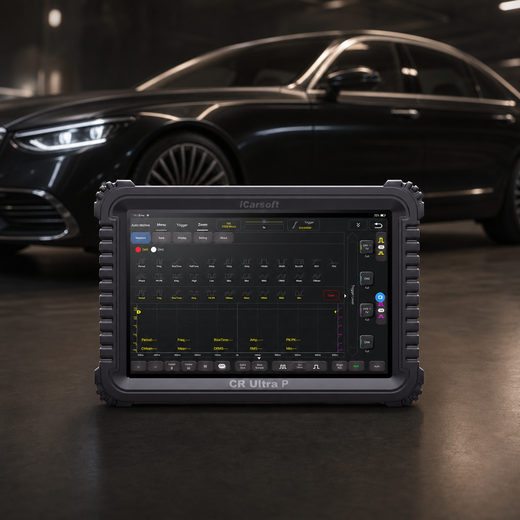
Save evidence before choosing a repair
iCarsoft CR Ultra P
Use supported engine codes and live data to preserve the P0183 evidence before disturbing the sensor or fuel system.
Check current CR Ultra P price and availabilityCheck CR Ultra P compatibility by VINConfirm year, engine, market and control-unit coverage before relying on manufacturer-specific wording or a particular PID. A generic code reader may display the code while providing less detail than the vehicle-specific system. Product ownership does not guarantee every temperature parameter is accessible.
Know the measurement boundary. The scanner does not physically measure connector voltage, resistance, fuel pressure or leakage. Use suitable test equipment and service procedures; a bidirectional function is not a substitute for an electrical or fuel-system test.
Verify the P0183 Repair
Save a final scan and compare it with the original report. Check that P0183 and relevant companion codes do not recur, the supported temperature signal remains plausible, and any fuel-system work is dry and secure. Reproduce the original conditions only when it is safe.
If the vehicle reports an emissions-related permanent DTC, it cannot be erased on demand with a scan tool or battery disconnect. The vehicle must recognize the successful repair through its monitoring process. Distinguish that retained record from an active fault and from incomplete readiness.
A permanent P0183 can remain immediately after a successful repair. If the vehicle stores it as a permanent DTC, a scan tool or battery disconnect cannot erase it. Once current and pending faults are absent, the OBD system removes the permanent record only after the applicable monitor reruns and passes.
Related fuel-system Code Guides
P0183 Frequently Asked Questions
Does P0183 mean the fuel is too hot?
No. The standardized description refers to a high circuit input. On some thermistor systems, an open circuit can instead produce an implausibly cold displayed value. Confirm the design and test the electrical circuit.
Are P0183 and P2541 the same fault?
No. Their generic definitions differ. They may share a cause on a particular Peugeot/Citroën application, but the exact manufacturer descriptions, wiring and measured evidence must establish that connection.
Where is the P0183 fuel-temperature sensor?
Its location and integration depend on the vehicle and engine. Use the service component locator and connector diagram; the Citroën video location should not be assumed for every diesel or gasoline vehicle.
Can I replace the sensor without testing the wires?
Doing so risks replacing a good part. Check connector condition and the specified signal/return circuits first. Fuel-system access also requires the correct pressure-relief, sealing and leak-check procedures.
Can iCarsoft clear a permanent P0183 code?
A supported tool can clear resettable codes after repair. A genuine permanent emissions DTC remains under the vehicle’s control until its required monitoring confirms the repair; erasing memory is not a substitute.
What if P0183 returns after sensor replacement?
Check the exact replacement part, terminal contact, harness routing and return circuit. Review any companion faults and repeat the manufacturer test. A new part does not prove the circuit is healthy.
Technical and cost references
- Volkswagen Golf/GTI Quick Reference Specification Book — January 2014; DTC definitions
- California Bureau of Automotive Repair — OBD test reference and permanent DTC guidance
- SA Diagnostic’s — Peugeot/Citroën P0183 and P2541 video case
Product information: Official iCarsoft CR Ultra P page.
Editorial note: Use current manufacturer instructions for your VIN and qualified help for work beyond your training. A code identifies a test result, not a confirmed failed part.


