

Quick Answer
P205C means Reductant Tank Temperature Sensor Circuit Low. The controller detected a lower-than-allowed electrical signal in the diesel exhaust fluid (DEF) tank temperature sensing circuit. The code does not prove the DEF is hot or that the tank assembly needs replacement. Save the scan report, read the dashboard warnings and inspect the circuit using the vehicle wiring diagram.
What Does the P205C Code Mean?
DEF is the reductant used by a selective catalytic reduction (SCR) system to control diesel exhaust emissions. Its tank temperature signal helps the controller manage functions such as cold-weather operation. P205C concerns the electrical signal used to measure that temperature; it is not a DEF level, fluid-quality or exhaust-temperature diagnosis.
A short to ground is one possible cause, but the fault can also originate inside a sensor assembly, at a contaminated connector, or in another part of the circuit. The actual design matters: some vehicles use a directly wired thermistor, while others combine sensing functions in a tank module. Identify the fitted system before interpreting voltage or resistance.
On an NTC thermistor circuit, falling sensor resistance can be interpreted as rising temperature. That explains why an electrical fault may produce an implausibly hot reading. It does not make a particular displayed temperature universal. The controller or scan software may substitute a fallback value after detecting a fault.
Ford's 2023 diesel OBD summary documents P205C as a circuit-low monitor with application-specific conditions. Its voltage criterion is an example for the systems covered by that document, not a specification for every Ford, Ram, GM or European diesel. Use the current VIN-specific service procedure for pass/fail values.
P205C versus other DEF faults
| Code | General description | Key distinction |
|---|---|---|
| P205C | Tank temperature circuit low | Investigate the electrical signal and circuit. |
| P205B | Tank temperature range/performance | Check plausibility and response under specified conditions. |
| P203B / P20E8 | Level-sensor performance / reductant pressure low | Follow the separate level or pressure diagnosis. |
A low electrical signal is not the same as low DEF temperature. Adding DEF, thawing the tank or clearing the code cannot establish which electrical component failed.
P205C Symptoms and Likely Causes
Symptoms vary with the vehicle and whether other SCR faults are present. Record the exact warning text and when it appeared; a dashboard countdown changes the urgency even if the engine still runs normally.
The vehicle may log P205C with other reductant-system faults.
A cold tank may show an unlikely reading or a fixed substitute value.
Some vehicles may impose a speed, restart or distance restriction.
Normal acceleration does not confirm that the sensing circuit is healthy.
Practical cause-checking order
- Harness damage: inspect areas near tank straps, frame brackets and exhaust heat, especially after tank or underbody work.
- Connector trouble: moisture, damaged seals, bent terminals, poor terminal grip or contamination can affect the circuit.
- Sensor or integrated module failure: consider this after the external circuit passes the specified tests.
- Shared circuit or supply problems: companion codes may point to a common reference, ground, supply or communication fault.
- Application-specific contamination or control issues: investigate only when the history, inspection and applicable service information support that path.
Stellantis case S1425000019 REV. A (January 2025) discusses certain DEF faults associated with hydrocarbon contamination. It does not mean every P205C vehicle needs a tank flush or complete SCR replacement.
How Serious Is P205C, and Can You Drive?
Check the owner's manual and dashboard first. A steady MIL with normal operation may allow a short trip for diagnosis if the vehicle instructions permit it. Arrange repair promptly: an SCR fault can eventually trigger restrictions on some vehicles, and clearing the code does not reliably cancel them.
Do not assume a specific number of remaining starts or miles from P205C alone. Photograph any countdown and tell the repair shop before arrival. If a restriction is close to expiring, confirm the service and transport plan rather than relying on repeated restarts.
Stop and arrange a tow Stop safely for overheating warnings, smoke, a significant fluid leak, unsafe power loss or an instruction to stop the engine. Arrange recovery if the vehicle cannot be operated safely or its restart restriction prevents travel.
Let exhaust components cool before underbody inspection. Use suitable lifting equipment and stands; never work under a vehicle supported only by a jack. Switch the ignition off before disconnecting connectors as directed by the service procedure. Keep DEF away from electrical terminals and follow the handling instructions.
How to Diagnose P205C in the Right Order
-
Save the full scan and identify the system
Record all modules' codes, their status and available freeze-frame data before clearing anything. Note battery voltage, ambient conditions, DEF temperature and the warning message. Check for supply, communication, level-sensor and heater codes that could change the diagnostic order.
Match the VIN, engine and tank assembly to current service information. Confirm which module reports the code and whether the temperature sensor is directly wired or integrated. Check applicable bulletins, campaigns and warranty coverage by VIN before ordering parts.
-
Compare temperature data after a cold soak
With the vehicle safely parked and sufficiently stabilized, compare the available tank temperature reading with ambient conditions and other relevant temperature data. A large unexplained difference supports investigation; it does not prove an internal sensor short.
Record units, PID name and whether the value is current, unavailable or substituted. A tank exposed to sun or recently refilled may not match intake-air or coolant temperature exactly. Use the manufacturer's plausibility limits rather than inventing a universal temperature difference.
-
Inspect the tank connector and harness
With ignition off, inspect accessible wiring without pulling on the wires. Look for pinching after tank replacement, missing clips, abrasion, melted insulation, road-salt intrusion and damaged connector locks. Photograph the damage before moving the harness.
Inspect terminal fit and seals using the approved method. An apparently clean connector can still have poor contact. If moving a supported harness changes the reading during an approved test, locate and confirm the fault rather than treating the movement itself as a repair.
-
Perform the specified circuit-isolation test
Disconnect the sensor or tank module only when the wiring diagram and diagnostic procedure call for it. Reconnect scan equipment and observe the specified PID or fault response under the prescribed key state. Some systems require a fresh sample or ignition cycle.
A changed reading can help locate the fault, but an unplug test alone does not prove that every wire is good. A fixed reading may be a software fallback. Do not use a universal “hot means wiring, minus forty means sensor” rule, and do not short terminals to simulate a sensor without an approved procedure.
-
Measure the circuit and test the sensor
Use a suitable meter, breakout leads and the correct pin identification to check the specified signal, reference, supply and ground paths. Check voltage drop or circuit integrity as instructed; a simple continuity result may miss a poor connection under load.
Resistance tests require the circuit to be de-energized and isolated as specified. Compare sensor resistance with the correct temperature chart only if the design permits that test. Never apply a thermistor resistance test to module electronics. Escalate to a qualified technician if connector access or circuit identification is uncertain.
-
Repair the confirmed fault and complete required setup
Repair damaged wiring and terminal seals to the manufacturer's standards, restoring clips and heat protection. Replace a temperature sensor, sender or integrated assembly only after testing identifies it and the parts catalog confirms how it is serviced.
If the system has contamination, follow the applicable inspection and cleanup procedure; topping up DEF is not a circuit repair. After parts replacement, perform only the initialization, priming or service routines required for that vehicle and supported by the diagnostic equipment. Then verify the electrical signal and monitor result.
Specifications are vehicle-specific. There is no universal P205C voltage threshold, tank-temperature display, resistance value, connector pinout or unplug-test result. Use specifications for the exact VIN, engine and controller.
P205C Repairs and Cost Factors
The least expensive correct repair is the one supported by the tests. A damaged connector may need terminals and seals; an abraded wire needs an approved, sealed repair and protection from the original cause. Replacing a tank while leaving a pinched harness in place can reproduce the same fault.
An integrated temperature sensor can make a larger assembly necessary on some vehicles. Confirm the part number, supersession and included components before approving replacement. Ask the shop to distinguish diagnosis, part cost, access labor, DEF handling and any required setup on the estimate.
| Possible path | US quote requirements |
|---|---|
| Connector or harness repair | VIN-specific quote after locating the defect |
| Separate sensor or integrated tank assembly | Quote the correct serviceable part and access labor |
| Contamination investigation or cleanup | Only if confirmed; scope depends on the affected system |
For a US repair estimate, provide the VIN, mileage, code report and warning text. A generic tank-sensor price can be misleading because some sensors are not sold separately and tank access differs considerably. Obtain a written local quote rather than treating a broad online range as a diagnosis.
Warranty coverage also depends on the vehicle, component, model year, jurisdiction and applicable warranty booklet or campaign. P205C does not establish an automatic federal 8-year/80,000-mile warranty for the DEF temperature sensor or tank. Ask the dealer to check the VIN and failed component before authorizing work.
Using iCarsoft CR MAX BT for P205C
On a supported vehicle, read the reporting module, record related faults and review available live data. Save the initial report so you can compare temperature behavior and code status after repair. The product page lists diagnostic and live-data functions; available PIDs depend on the vehicle and software.
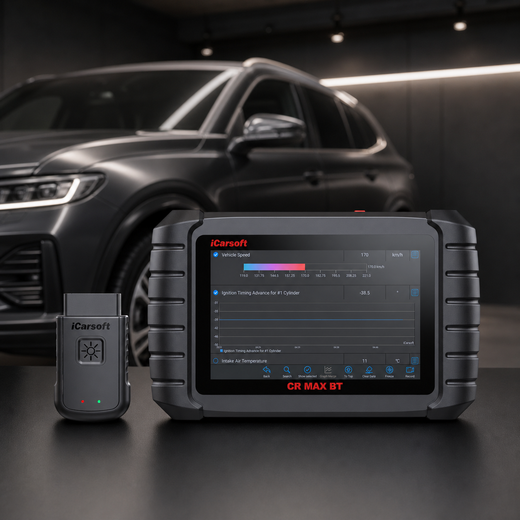
Save evidence before choosing a repair
iCarsoft CR MAX BT
Use the iCarsoft CR MAX BT to save fault evidence and review supported DEF temperature data before deciding which circuit needs testing. Confirm coverage for your exact diesel vehicle.
Check current CR MAX BT price and availabilityCheck CR MAX BT compatibility by VINWireless access can make it easier to observe supported data from a safe inspection position. A DEF output test, initialization or reset is available only where that exact ECU and software support it. Check compatibility before purchasing for a particular service routine.
Know the measurement boundary. A scan tool reports controller data. It does not physically measure voltage, resistance, terminal grip or fluid contamination, and it cannot prove a sensor is defective from one PID alone.
Verify the P205C Repair
Reconnect and secure the harness, then confirm that the tank-temperature signal is plausible for the actual conditions and responds as the service procedure expects. Check that companion supply or communication faults have also been addressed. Save a post-repair scan rather than relying solely on an extinguished warning lamp.
Clear faults only after repair and run the prescribed monitor or operating conditions safely. Distinguish current, pending, history and permanent codes. A permanent emissions code may remain until the controller completes and passes its own verification; repeated clearing is not evidence of success.
Recheck the dashboard for the original DEF warning or countdown. If it persists, follow the vehicle's documented recovery procedure and inspect remaining faults. Record the tested circuit, replaced part if any, and successful monitor result for future service.
A permanent P205C can remain immediately after a successful repair. If the vehicle stores it as a permanent DTC, a scan tool or battery disconnect cannot erase it. Once current and pending faults are absent, the OBD system removes the permanent record only after the applicable monitor reruns and passes.
Related DEF and SCR Code Guides
P205C Frequently Asked Questions
Does P205C mean the DEF tank is overheating?
No. It identifies a low circuit signal, which may be interpreted as an implausible temperature. Confirm the actual temperature and circuit operation instead of diagnosing overheating from the displayed number.
Can I diagnose P205C by unplugging the sensor?
Only as part of the correct circuit procedure. The expected response depends on the sensor topology and controller. Substitute values and delayed updates can make a simple unplug test misleading.
Will adding fresh DEF fix P205C?
Adding fluid may correct a separate low-level condition, but it does not repair a short, damaged connector or failed sensing circuit. Investigate contamination only when there is supporting evidence.
Do I have to replace the entire DEF tank?
Not automatically. First test external wiring and connectors. If the failed sensor is integrated, use the VIN-specific parts catalog to identify the serviceable assembly.
Is P205C always covered by emissions warranty?
No blanket coverage follows from this code. The failed component, vehicle warranty booklet, mileage, location and any applicable campaign determine coverage. Request a VIN-based check.
Why is the code still present after repair?
The repair may be incomplete, the monitor may not have run, or the scanner may show a history or permanent code. Review status and the required verification conditions before replacing more parts.
Technical references
- Ford 2023 MY Diesel OBD System Operation Summary — revision August 25, 2023
- Stellantis S1425000019 REV. A — DEF hydrocarbon contamination guidance, January 2025
Product information: Official iCarsoft CR MAX BT page.
Editorial note: Use current manufacturer instructions for your VIN and qualified help for work beyond your training. A code identifies a test result, not a confirmed failed part.


