

Quick answer
P0760 identifies a malfunction in the OEM-defined Shift Solenoid C control path. Many scan tools display “Shift Solenoid C Circuit” or “Shift Solenoid C Malfunction,” but the five-character code does not reveal the valve's physical location, affected gear or exact failure type. Save the complete OEM description and fault status, identify the transmission by VIN, then prove the shared supply, driver, external and internal wiring, connector and solenoid load before considering a valve body or control module.
P0760 can appear on several electronically controlled gearbox types. “Solenoid C” is a standardized functional label, not a universal third solenoid. Its clutch or selector assignment and whether it is separate or integrated into a valve body or mechatronic assembly depend on the transmission.
What Does the P0760 Code Mean?
The safe base interpretation is “Shift Solenoid C Malfunction.” It tells you which functional control path needs diagnosis, not which part must be replaced. Some vehicle-specific failure-type data narrows P0760 to an open circuit, while other manufacturers use a separate electrical descriptor. Preserve the complete scan-tool wording rather than reducing it to the five-character code.
The neighboring codes define the boundary: P0761 is performance/stuck off, P0762 is stuck on, P0763 is the explicit generic electrical descriptor, and P0764 is intermittent. Later implementations may use P0979 for circuit low and P0980 for circuit high. More than one can be stored without proving one failed part.
| Stored descriptor | First diagnostic emphasis |
|---|---|
| P0760 — Shift Solenoid C malfunction / circuit, as displayed by the application | Save OEM subtype; test the control path |
| P0761 — Performance or stuck off | Command versus hydraulic/shift response |
| P0762 — Stuck on | Unwanted hydraulic/shift response |
| P0763 / P0764 — Electrical / intermittent | Circuit integrity and repeatability |
Do not infer a gear, pin, wire color or resistance from the letter C. Use the VIN, transmission identification and current OEM connector views. The same label can describe different hardware in a 6-speed, 8-speed, CVT, hybrid e-CVT or dual-clutch system.
How the Shift Solenoid C Monitor Works
A typical chain begins at a protected supply and TCM/PCM driver, then crosses external wiring, the case connector and an internal harness or conductor plate before reaching the coil. The driver may monitor current or voltage continuously. A separate functional monitor can compare command with input/output speed, ratio, pressure-switch or clutch response during a valid shift.
Manufacturers map results differently. One current Ford implementation attaches an open-circuit failure type to P0760 and uses separate low, high and functional codes; other lists emphasize P0763 for electrical faults. The OEM failure type, module description and transmission code therefore matter.
Common P0760 Symptoms
The MIL or transmission warning may be the first sign when the fault is intermittent or the controller has not yet commanded a protective mode.
The controller may inhibit some shifts, increase line pressure or hold a limited gear strategy to protect the transmission.
An unavailable solenoid command can change clutch timing, but the affected shift and direction vary by transmission.
Some applications may lose a needed range, fail to move normally or, in a narrowly defined service case, refuse to shift out of Park.
Engine or input speed may rise without the expected output-speed change when a companion performance fault is present.
Multiple paths setting together raises suspicion of a common feed, ground, connector, internal harness or controller supply.
No single symptom is guaranteed. Claims that every vehicle locks in or loses third gear ignore different clutch and gear assignments.
What Can Cause P0760?
Because the base code identifies a control path, begin with the circuit and packaging actually used by the vehicle:
- an open, short, high-resistance or rubbed-through section of the external harness;
- a loose lock, backed-out terminal, weak pin tension, water, corrosion or ATF intrusion at the TCM or case connector;
- a damaged internal harness, conductor plate, lead frame or valve-body connection;
- an open, shorted or heat-sensitive Shift Solenoid C coil;
- a failed fuse, relay, protected feed or ground shared by several solenoids;
- low system voltage, poor TCM power/ground or a communication problem;
- an integrated solenoid body, valve body or mechatronic assembly fault;
- a TCM/PCM driver fault after supply, wiring and load pass; or
- application-specific software, configuration or part-matching issues documented for the exact VIN.
Fluid, valve, pressure, clutch or mechanical faults become more relevant with P0761, P0762, pressure, ratio or slip evidence. Dirty fluid is not the default explanation for an electrical-path P0760, and service cannot repair an open wire or failed driver.
Do not jump the solenoid with 12 volts. Many modern circuits use PWM, current regulation or low-resistance loads. Direct battery power, grounding a module-controlled terminal or using an incandescent test light can damage the solenoid or controller.
How Serious Is P0760, and Can You Drive?
Diagnose a current P0760 promptly even if the vehicle initially drives normally. An intermittent connection can become permanent, and driving through slip or overheating can turn a circuit repair into transmission damage.
Stop in a safe place and arrange towing if the vehicle slips, bangs into gear, loses Drive or Reverse, will not select a needed range, overheats, leaks heavily, smells burnt, makes abnormal mechanical noise or remains in failsafe. Follow the owner's manual for towing method; some drivetrains require a flatbed.
There is no universal safe mileage. A history code with normal operation still needs inspection and a rescan, but it differs from a current code with slip. Do not repeatedly road-test a severe fault.
How to Diagnose P0760 Step by Step
-
Save the complete fault record
Before clearing, scan all modules. Record code status, full OEM wording/failure type, freeze frame, battery voltage and companion transmission, supply, network, speed, pressure and ratio codes.
-
Identify the exact transmission and Solenoid C
Use the VIN and transmission ID. Confirm the OEM name, clutch assignment, control method, pins and whether the solenoid is separate, packaged or integrated.
-
Decide whether testing is safe
Do not road-test no engagement, severe slip, overheating, a large leak, burnt fluid or noise. Active tests can apply a clutch and rotate raised wheels; follow the prescribed restraint and lift procedure.
-
Check shared electrical foundations
For several solenoid/module codes, test the 12V supply, TCM feeds, grounds, fuse and relay paths first. Use the OEM loaded test; unloaded voltage alone can hide resistance.
-
Inspect the external path
Examine wiring near mounts, heat, brackets and recent work. Check locks, seals, terminal tension, corrosion, water or fluid, rubbed insulation and backed-out pins. Do not pierce sealed wiring unless directed.
-
Compare supported scan data
Review exposed command, driver status, current/duty, fluid temperature, gear, ISS, OSS, ratio, pressure switches and clutch status. A missing PID does not prove a failed circuit.
-
Run only an approved active test
If the ECU and tool support it, meet every prerequisite and stop for harsh engagement, noise, heat or movement. The result supports but does not replace circuit or hydraulic testing.
-
Test the circuit with the correct load and limits
With modules protected as directed, test supply, voltage drop, continuity and shorts using the specified breakout/load. Use only the exact temperature-based resistance value; there is no universal ohm figure.
-
Separate external, internal and module layers
After the external path passes, test the case connector, internal harness/conductor plate and coil. Consider the driver only after feed, ground, wiring and load pass.
-
Expand to hydraulics only when evidence supports it
If command/feedback pass but performance, pressure, ratio or clutch evidence remains, verify fluid by the OEM method and follow the specified pressure and mechanical tests.
-
Repair, configure and confirm
Complete required identification, characterization, programming or relearn. Verify fluid level, repeat the prescribed monitor and confirm normal engagement, shifts, temperature and command/feedback.
DIY boundary: Saving scan data and inspecting an accessible external connector may be reasonable for an experienced owner. Live output testing, back-probing a TCM, internal harness work, hydraulic pressure tests, valve-body removal and programming generally require service information, rated equipment and a transmission professional.
How to Fix P0760
Repair chafed wiring, a connector seal, damaged terminal, pigtail, shared feed or ground with the approved terminal and sealing method. Load-test the repaired path.
Replace only the proven internal lead, conductor plate, serviceable Solenoid C or solenoid pack. Use the specified fluid and installation procedure.
Some transmissions package the solenoid inside a calibrated assembly. Replace the correct part only when the VIN-specific test plan and part information require it.
Repair or replace a TCM/PCM only after its power, ground, harness and load pass. Update or configure software only under an applicable bulletin or setup procedure.
Address fluid, pump, valve, clutch or gearbox damage only when pressure, ratio, slip, debris or teardown evidence proves that separate layer.
Complete fluid-temperature/level checks, programming, solenoid characterization, initialization and adaptive learning exactly as required for the repaired transmission.
A successful repair restores agreement, not just a dark warning light. The command, electrical feedback and resulting shift behavior must remain correct during the OEM confirmation conditions with no current or pending P0760.
Using iCarsoft CR Eagle P for P0760
On supported vehicles, CR Eagle P can access the transmission controller, save the full-system code report, status and freeze frame, and graph available command, driver/current, fluid-temperature, gear, ISS, OSS, ratio, pressure-switch or clutch PIDs. Supported bi-directional tests, service functions and adaptations can help compare a command with the response, but availability varies by VIN, ECU and software version.
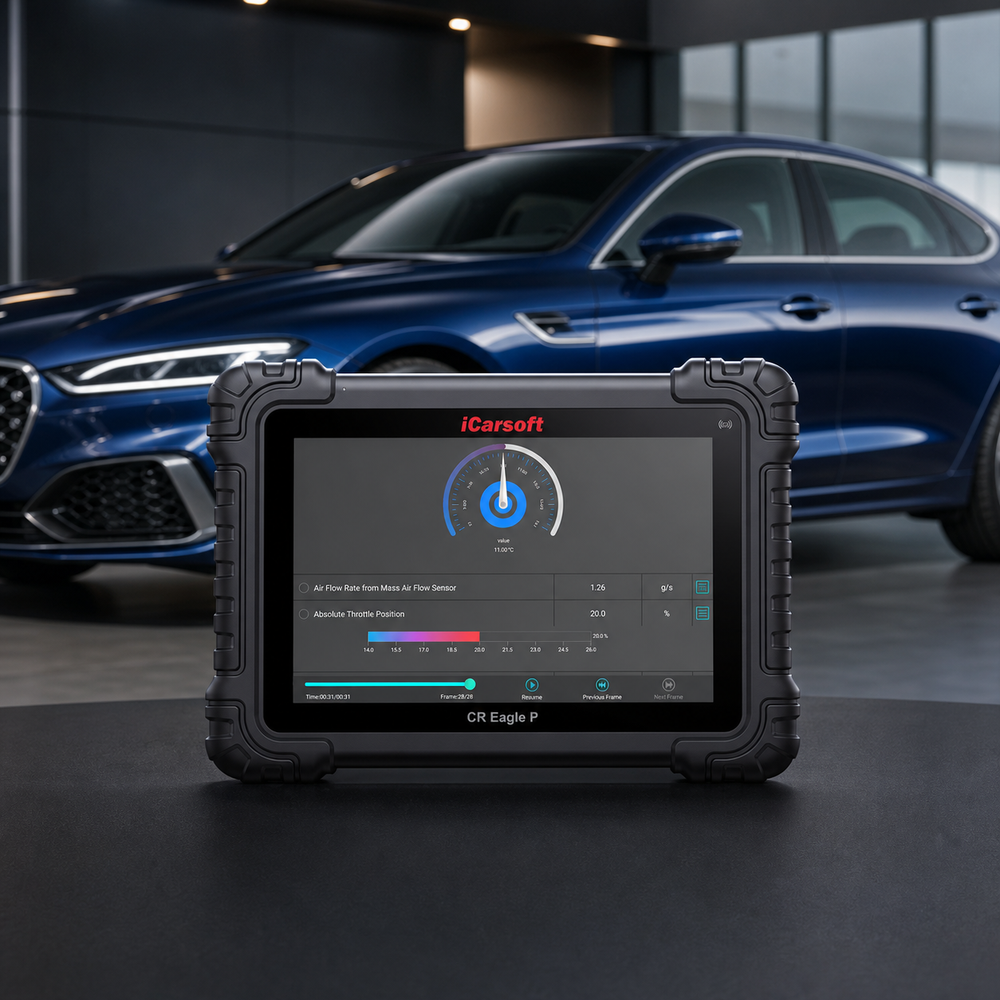
Recommended diagnostic platform for P0760
iCarsoft CR Eagle P
Preserve the full fault record, graph supported transmission command and response data, and use available active tests or relearns while confirming the electrical path with the required physical tools.
Check current price & availability · lifetime Wi-Fi updates
View CR Eagle PCheck compatibility by VINTool boundary: CR Eagle P cannot identify a universal Solenoid C location, physically measure circuit load, coil resistance or hydraulic pressure, inspect an internal harness, or replace a DVOM, scope, current probe, pressure gauge, wiring diagram and OEM test plan. Confirm the required TCM access, PIDs, active tests and adaptations for the exact VIN before purchase.
How Much Does It Cost to Fix P0760?
The ranges below are 2026 US planning estimates for separate confirmed repair paths, not a quote and not a list to add together. Transmission design, access, a separate solenoid versus an integrated pack, correct fluid, programming, adaptation, local labor, taxes and collateral damage can change the total materially.
| Confirmed repair path | Typical US planning range |
|---|---|
| Professional transmission diagnosis and data capture | $120–$300 |
| Correct fluid/filter service, only when condition and the OEM procedure justify it | $180–$650 |
| Connector, pigtail or local harness repair | $150–$800 |
| Serviceable Shift Solenoid C or solenoid-pack replacement | $400–$1,500 |
| Valve body or mechatronic assembly, including fluid/setup where required | $900–$3,500 |
| Transmission rebuild or replacement, only after internal damage is proven | $3,000–$10,000+ |
Ask whether the estimate includes diagnosis, fluid, filter or pan components, seals, programming, solenoid characterization, adaptive learning, cooler service, taxes and a post-repair road test. Check warranty, recall and service-campaign coverage before authorizing a major assembly.
Prevention and Repair Confirmation
Electrical failures cannot all be prevented, but correct battery support, prompt repair of leaks, intact harness clips and connector seals, and avoiding pressure washing near electrical connections reduce avoidable problems. Use the specified transmission fluid and level procedure; universal additives and power flushing are not preventive repairs for P0760.
After repair, confirm normal battery and module voltage, no terminal heating or fluid intrusion, stable command and feedback, correct engagement and shifting, and a valid fluid level at the prescribed temperature. Complete programming or learning before judging shift quality. Rescan after the confirmation drive and verify that P0760 is neither current nor pending and that no new ratio, pressure, speed or network code has appeared.
Related Transmission Diagnostic Guides
P0760 Frequently Asked Questions
What does code P0760 mean?
P0760 identifies a malfunction in the OEM-defined Shift Solenoid C control path. The base code does not reveal the valve's physical location, affected gear or exact electrical failure type, so save the complete OEM description and failure data.
Is P0760 the same as P0763?
No. P0760 is the base Shift Solenoid C malfunction or circuit code as displayed by the application, while P0763 is the generic electrical descriptor. Some manufacturers add failure-type details to P0760, so use the exact vehicle's scan description and service information.
Where is Shift Solenoid C located?
There is no universal location. Solenoid C may be a separate valve, part of an internal harness or integrated into a solenoid body, valve body or mechatronic assembly. Identify it by VIN and transmission code.
Can I drive with P0760?
There is no universal safe distance. Tow the vehicle if the code is current with slipping, harsh engagement, loss of Drive or Reverse, overheating, a heavy leak, burnt smell, abnormal noise or failsafe operation.
Can low transmission fluid cause P0760?
Low or incorrect fluid can affect shift response and may accompany performance, pressure or ratio codes, but it does not repair an open wire, failed connector, coil or driver. Check fluid only by the exact OEM temperature and level procedure.
How much does P0760 cost to repair?
Plan about $120-$300 for professional diagnosis. A confirmed local wiring repair may cost $150-$800, a serviceable solenoid path $400-$1,500, a valve body $900-$3,500, or a proven rebuild or replacement $3,000-$10,000 or more.
Can CR Eagle P diagnose P0760?
On supported vehicles, CR Eagle P can access the TCM, save codes and freeze frame, graph available command and response PIDs, and run supported active tests or relearns. Physical circuit and pressure measurements still require separate tools.
Technical, product and cost references
- BMW official SAE P-code list and Ford 2024 OBD System Operation Summary – base descriptors, Ford-specific failure types and the distinction between electrical and functional monitoring.
- Hyundai 20-AT-001H and Hyundai 20-AT-008H – different Solenoid C assignments and application-specific external/internal harness and service paths.
- Ford SSM 54595 and Honda 2023 CR-V Hybrid bulletin – narrowly scoped valve-body/software examples that must not be generalized to other VINs.
- Official iCarsoft CR Eagle P product page – current product identity, all-system diagnostics, supported data/active-test context and coverage limitations.
- Current US cost anchors from RepairPal electrical diagnosis, transmission-fluid service, transmission replacement and ConsumerAffairs transmission-cost guidance.
Editorial note: This article provides general educational guidance, not a substitute for the service information, wiring diagrams, lifting instructions, hot-fluid precautions and test limits for a specific VIN. A transmission can engage unexpectedly during active or hydraulic testing. Prices are US planning ranges and can change. Confirm product coverage, repair procedures and local pricing before work begins.


