
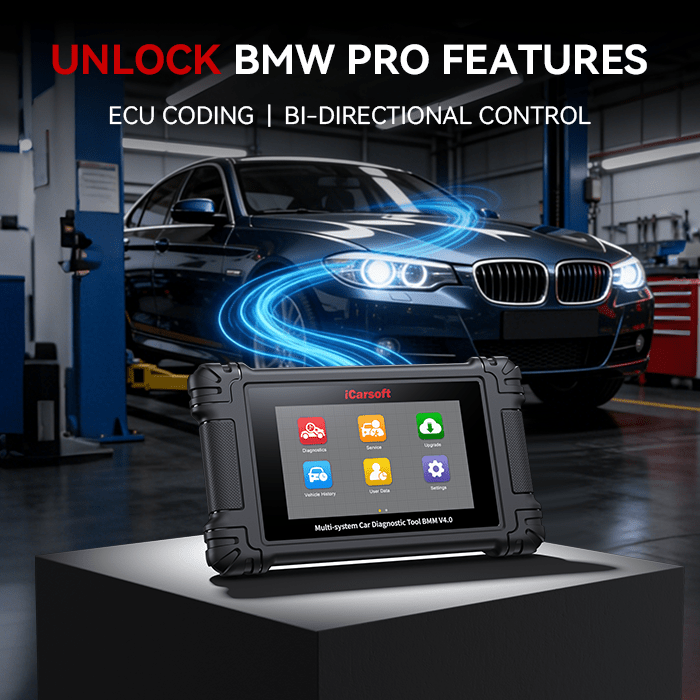
For the dedicated BMW enthusiast or semi-professional mechanic, simply reading a fault code is not enough. True troubleshooting requires the ability to interact with the vehicle's complex network of modules.
In our previous review, we covered basic diagnostics. In our DIY guide, we covered routine maintenance. Today, we are diving deep into the advanced capabilities that set the iCarsoft BMM V4.0 apart from entry-level scanners: Bi-Directional Control and ECU Coding.
 1. The Power of Bi-Directional Control (Active Tests)
Most scanners are "passive"—they only listen to the car. The BMM V4.0 is "active." It allows you to send commands to the car's modules to actuate components. This is the only way to definitively diagnose many mechanical issues without tearing the car apart.
Real-World BMW Applications:
- Electric Water Pump Test (N52/N54/N55 Engines): BMW electric water pumps are notorious for failing without warning. Use the BMM V4.0 to command the pump to run at 50% or 100% speed while the engine is off. If you can't hear it humming, you've found your problem.
- Fuel Pump Control Module (EKP): Is it the fuel pump or the control module? Command the fuel pump on directly to isolate the issue.
- VANOS Solenoids: Actuate the intake or exhaust VANOS solenoids to check for proper clicking operation.
- Body Components: Roll windows down, fold mirrors, or cycle door locks to rule out switch failures vs. motor failures.
2. Demystifying ECU Coding & Adaptation
This is perhaps the most misunderstood feature in BMW diagnostics. It's crucial to understand what the BMM V4.0 can (and cannot) do.
Crucial Distinction: Programming vs. Coding
Programming (Flashing): Loading entirely new software onto a module (e.g., updating the DME software version). The BMM V4.0 does NOT do this, as it requires specialized power supplies and carries high risk.
Coding (Adaptation/Configuration): Configuring an existing module's settings or teaching it new parameters after a part replacement. The BMM V4.0 EXLELS at this.
Essential Coding Functions Supported:
- Fuel Injector Coding: When replacing injectors on direct-injection BMWs (like the N54 or N63), you must "code" the new injector flow rates into the DME for the engine to run smoothly.
- Steering Angle Sensor (SAS) Calibration: Required after any suspension alignment or if the steering wheel is removed.
- Transmission Adaptations: Resetting the learning values after changing transmission fluid, allowing the gearbox to relearn your driving style.
- Register New Components: Telling the car that a new module (like a headlight ballast or FRM module) has been installed.
3. Future-Proofing: ADAS and CAN FD
Modern BMWs (G-Series and newer F-Series) are fundamentally moving computers. The BMM V4.0 is equipped to handle this new architecture.
- ADAS Calibration Support: Advanced Driver Assistance Systems like radar cruise control and lane-keep assist cameras often require calibration after simple bumper repairs or windshield replacements. The BMM V4.0 supports necessary static calibration procedures.
- CAN FD Protocol Ready: Newer vehicles use faster communication protocols. The V4.0 hardware native supports CAN FD, ensuring it communicates quickly and reliably with the newest models on the road today.

Advanced Technical FAQ
Is it possible to "brick" my ECU using the Coding function?
It is extremely unlikely with this tool. Because the BMM V4.0 performs "Adaptation" and configuration rather than "Flashing" new firmware, the risk to the module is minimal. It is designed to be safe for advanced DIY use.
Does this support "hidden feature" coding (e.g., folding mirrors with key fob)?
The BMM V4.0 focuses on repair and maintenance coding (replacing parts, calibrating sensors). While it has some personalization capability, it is not specialized for enabling "hidden" cosmetic features like BimmerCode might be. Its strength lies in deep diagnostics and repair procedures.
I have a 2023 BMW X5. Does it support the latest models?
Yes. Thanks to its support for the latest protocols like CAN FD and lifetime free updates, the coverage includes recent G-chassis vehicles.
How does the "Auto VIN" feature work on newer BMWs?
On most BMWs post-2005, the tool will automatically communicate with the CAS or FEM module to retrieve the VIN instantly, ensuring it loads the exact software protocols for your specific chassis and engine combination.
Unlock the Full Potential of Your BMW
Equip your garage with professional-grade capabilities. Get the iCarsoft BMM V4.0.
Upgrade to Pro Level Now


