

 By iCarsoft Official Store Technical Team, Automotive Diagnostics Editors · Updated September 27, 2026 · Technical sources checked
Quick Answer
The C0037 code identifies the left rear wheel speed sensor in the cited chassis-code reference. It does not prove the sensor itself has failed. Confirm the full suffix, preserve the ABS record and inspect the correct rear sensor’s mounting and electrical path. Follow the vehicle-specific tests before choosing a replacement.
What Does the C0037 Code Mean?
NHTSA Appendix K lists C0037 as Left Rear Wheel Speed Sensor with a subfault. Use this guide only when the complete OEM description for the reporting module agrees. The full fault record determines the test branch.
The left-rear wheel-speed input depends on the installed sensor arrangement, its electrical connection and the rotating reference it detects. A sensor can be electrically connected yet incorrectly mounted, while a correctly seated sensor can still have a wiring problem. Establish which part of that path the complete fault record directs you to test instead of treating every rear-wheel warning as the same defect.
Separate mounting evidence from electrical evidence. A visible installation concern deserves correction by the proper procedure, but it does not automatically account for every stored circuit fault. Save the full code and the test conditions so that a supply problem, damaged lead or different rear-wheel channel is not overlooked once an obvious physical issue has been found.
Ford SSM 49727 describes certain 2021 Ranger vehicles built January 15 through February 26, 2021 with a traction-control warning and C0037 and/or C003A. It identifies an improperly seated rear wheel-speed sensor as a possible cause and calls for checking its fit against the axle mating surface. The bulletin’s build limits matter; persistent faults still require the applicable Workshop Manual diagnosis.
If the warning follows axle or rear brake work, document the work area and compare the sensor’s installation with the prescribed method. Do not infer correct seating from the presence of a retaining fastener alone. Equally, do not scrape or modify a mounting surface without the approved instructions. Keep the original fault record and inspect before changing the evidence.
Preserve the module wording and suffix before clearing.
Separate C0037 from adjacent fault families
| Code | General description | Key distinction |
|---|---|---|
| C0037 | Left Rear Wheel Speed Sensor | Sensor path; the full fault type determines the checks. |
| C0036 | Left Rear Tone Wheel | Rotating-reference family in the cited mapping. |
| C0038 | Left Rear Wheel Speed Sensor Supply | Supply branch needs electrical evidence. |
| C003A | Right Rear Wheel Speed Sensor | Opposite rear channel; avoid location confusion. |
Record the complete C0037 description. Use the exact module, suffix and OEM procedure to select the test path.
C0037 Symptoms and Likely Causes
Record C0037 symptoms and fault status; symptoms alone cannot identify a failed part.
Check whether companion faults share a proven cause.
A warning can accompany a stored left-rear sensor record. Record the exact message, module and status; different vehicles may display different assistance warnings.
Supported live data may help identify a left-rear input concern under suitable test conditions. An unsupported channel or an incomplete recording must not be labeled a failed sensor.
Recent axle, brake, bearing or sensor work provides inspection context. Document what was moved, disconnected or replaced rather than assuming the new component is defective.
Dragging, pulling, fluid loss, wheel looseness or an unfamiliar pedal response takes priority over scan testing. Secure the vehicle if braking safety is uncertain.
Practical cause-checking order
- Match the full fault record: Confirm the left-rear definition and complete suffix against current OEM information. Do not mix C0037 with a right-rear sensor record.
- Inspect mounting correctly: Review the sensor seating and retention using the exact installation procedure, especially after rear service or when an applicable bulletin directs that check.
- Check the electrical route: Inspect connectors, intermediate connections and the accessible cable route for damage, moisture evidence or strain. A secure outer connector shell does not establish terminal integrity.
- Assess the rotating reference: If signal evidence directs it, inspect the actual encoder or tone-wheel arrangement and relevant wheel-end condition. Do not invent a universal air gap or bearing-play limit.
- Verify the remaining branch: Continue to controller-input diagnosis only when the required external and supply checks support it. A rear sensor code alone cannot identify an internal module failure.
Did C0037 appear after recent rear sensor, axle, brake, bearing or suspension work? Recheck the documented connections, parts and setup steps affected by that work. Record battery and software history; a post-repair code does not prove the new part is defective.
How Serious Is C0037, and Can You Drive?
Arrange prompt brake diagnosis and follow the owner manual. Do not assume ABS or stability assistance remains available. Abnormal pedal effort, pulling, fluid loss, dragging or a red brake warning requires stopping safely and arranging recovery. The code cannot establish a safe driving distance.
Record brake warnings, pedal changes, fluid loss and recent service. Do not induce wheel slip or emergency braking to test assistance on public roads; warning-state assessment comes before any functional verification.
Stop and arrange a tow if braking changes, pedal effort or travel is abnormal, a wheel drags, fluid leaks or a red brake warning appears.
Follow the exact shutdown and pressure-release procedure before accessing brake components. Support a raised vehicle securely, keep clear of moving parts and never energize unidentified circuits. Do not perform public-road emergency-stop experiments.
How to Diagnose C0037 in the Right Order
-
Capture the complete left-rear event
Save the ABS controller’s C0037 record with its suffix, current or history status and available event information. Note companion rear-wheel, supply and communication faults. Record whether the warning began after service or first appeared during movement. Do not erase the baseline before the fault family is established, and stop diagnostic driving when a brake or wheel-security concern is present.
-
Identify the rear sensor layout and bulletin scope
Use the VIN and actual rear-axle or suspension arrangement to locate the left-rear sensor and its connector. Confirm the full OEM description and the appropriate test procedure. Check any bulletin against its vehicle, build date and stated symptom. The Ranger example is an application-limited inspection path; it does not establish a universal rear sensor position or replacement instruction.
-
Inspect seating without destroying evidence
With safe support and access, document the sensor mounting and area affected by recent work. Follow the specified procedure to assess seating and retention. Do not use the retaining bolt to force an uncertain installation into place or modify the sensor to fit. If a mounting concern is corrected, retain its evidence and continue any separate electrical checks required by the full fault.
-
Check wiring and required circuit conditions
Inspect the relevant wiring and connector retention, then perform the sensor-type-specific circuit checks directed by the service information. Record test locations and connection states. Do not apply an assumed voltage or resistance limit to an unidentified sensor. Protect sealed terminals and avoid powering circuits with jumper wires; a damaged test connection can create a new intermittent fault.
-
Compare the rear signal under an approved test
Compare supported left-rear wheel-speed information with the other wheels using the approved safe test conditions. Record the state of the vehicle and the exact event rather than saving only a still value. Differences while turning or while a wheel is stationary need context. Where necessary, use the specified signal measurement to distinguish controller data interpretation from an actual sensor-path fault.
-
Verify the installation and original failure condition
After repairing the established defect, restore mounting, connector seals and routing, and complete any required setup. Establish safe braking and wheel condition before the manufacturer’s confirmation procedure. Save post-repair data and fault status. If C0037 returns, compare the complete failure type and conditions with the original record, and continue diagnosis rather than repeating the same replacement without new evidence.
Specifications are vehicle-specific. Use the exact VIN specifications, approved test points and required operating state. No generic value or drive cycle can replace the applicable procedure. Manufacturer examples here do not establish specifications for other applications.
C0037 Repairs and Cost Planning
A C0037 repair must address the demonstrated failure. Do not replace an assembly from the code alone.
Recheck installation and required setup after repair. The correct reference for left rear is the vehicle’s defined corner, not the side visible in a generic photograph. Verify the sensor location, connector and scan-data channel together. Rear axle and independent-suspension arrangements can differ, so use the exact build information before deciding which component must be removed or whether a sensor, bearing or another part is separately serviceable.
Ask which failed measurement justifies each repair.
Authorize diagnosis before parts while the cause remains uncertain.
| Possible path | Quote basis |
|---|---|
| Repair the connector or harness after a documented circuit failure | VIN-specific quote |
| Correct the demonstrated physical or installation fault | VIN-specific quote |
| Replace only the component that fails its prescribed test | VIN-specific quote |
| Complete required setup and safe functional verification | VIN-specific quote |
Request an itemized, VIN-specific quote for the proven repair, setup and verification. Check applicable warranty coverage.
Using iCarsoft CR Pro S for C0037
On a supported vehicle, iCarsoft CR Pro S can save accessible faults, available freeze frame, live data and diagnostic reports. Preserve the C0037 evidence before clearing.
Compare available brake-controller records before and after repair. The report supports diagnosis but cannot replace the OEM physical and functional checks.
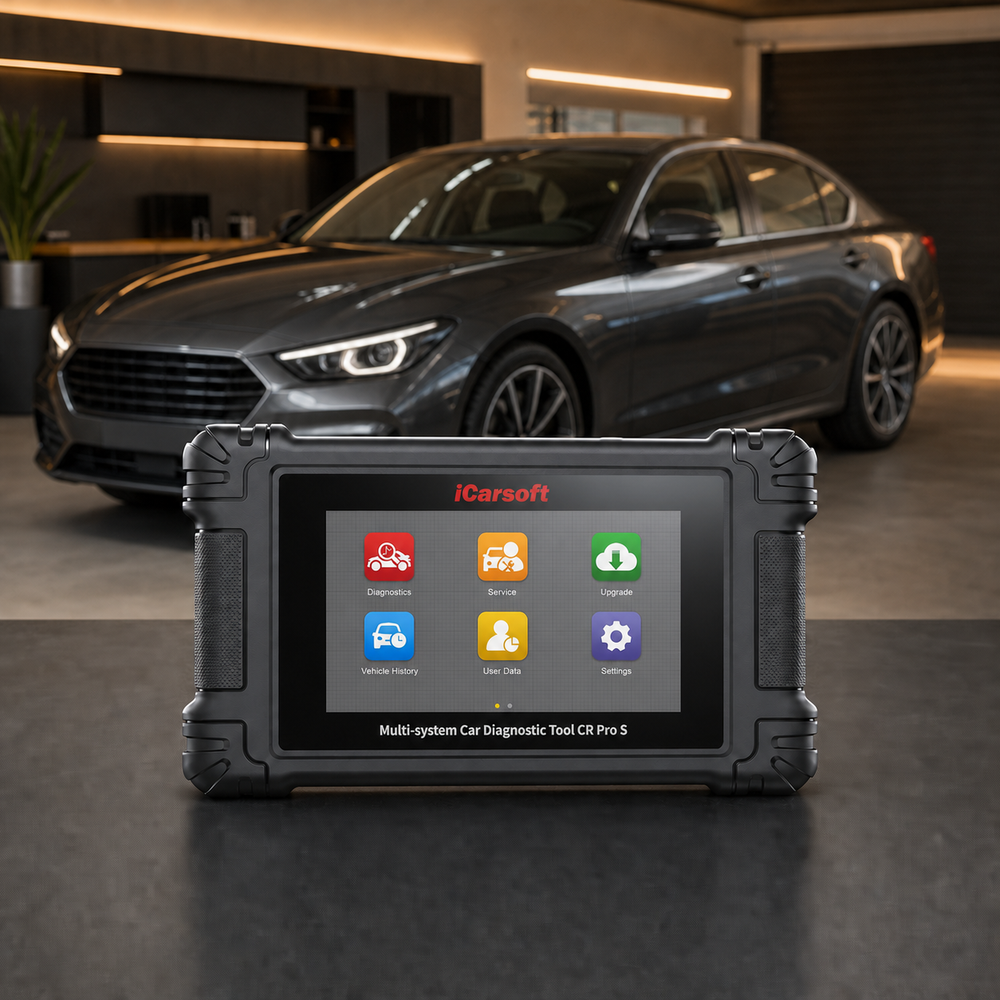
Preserve the left-rear wheel-speed sensor diagnosis evidence
iCarsoft CR Pro S
Review supported codes and relevant live data together. Confirm the exact VIN, controller access, PIDs and any requested active test with iCarsoft before purchase; generic product capabilities do not guarantee a C0037-specific function.
Check current CR Pro S price and availabilityCheck CR Pro S compatibility by VINThe official product page describes supported full-system diagnostics, available live data, freeze frame and diagnostic reports; exact controller coverage and active tests depend on the VIN and software. Confirm the requested function by VIN before purchase. Follow OEM prerequisites and stop for abnormal operation.
Know the measurement boundary. Scan data describes ECU-provided information; it does not directly prove the physical condition of the left-rear wheel-speed sensor diagnosis. Use the prescribed independent measurements when required.
Verify the C0037 Repair
After repair, verify connectors, harness clearance, setup and controller supply. Save post-repair findings, then clear only erasable records through the approved procedure. Battery disconnection is not a repair.
Run the manufacturer's applicable verification conditions in a safe workshop or route. Compare the original operating state with current data for the left-rear wheel-speed sensor diagnosis, and check current and pending faults in related modules. One clean start or idle period does not prove that every conditional monitor has completed.
Compare baseline and final scans, required setup and fault confirmation. Record whether the original event returned.
If C0037 returns, compare its suffix, status, failure order and operating conditions with the saved baseline before replacing another part. Revisit the failed branch and inspect anything disturbed. Confirm the prescribed brake-system verification separately from code clearing.
Stored and Active brake-control faults require different decisions. Preserve the original record and follow the OEM confirmation procedure. A cleared display does not prove restored assistance or safe braking.
Related Left-Rear Wheel-Speed Sensor Diagnosis Code Guides
Use each related code's own diagnostic procedure.
C0037 Frequently Asked Questions
Can incorrect sensor seating cause a C0037 warning?
It can in a matching application: Ford SSM 49727 identifies a rear sensor seating concern on specified 2021 Ranger builds. That does not establish the cause on every vehicle. Confirm applicability and the full OEM fault type, then check mounting, wiring and signal evidence by the relevant procedure.
What should I check first for C0037?
Save every module's codes and freeze frame before clearing. Confirm the full definition, suffix and VIN architecture. Then inspect recent rear sensor, axle, brake, bearing or suspension work, connectors and shared supplies. Those facts determine whether the next test needs the specified multimeter, oscilloscope and approved brake-system test equipment or a manufacturer-specific functional procedure.
Can I drive with the C0037 code?
Arrange prompt brake diagnosis and follow the owner manual. Do not assume ABS or stability assistance remains available. Abnormal pedal effort, pulling, fluid loss, dragging or a red brake warning requires stopping safely and arranging recovery. The code cannot establish a safe driving distance.
Why did C0037 return after a part was replaced?
If a warning returns after the sensor was reseated or replaced, compare the returning failure type with the saved baseline. Check the repaired connector, routing and required installation details first, then continue the matching diagnostic branch. The fact that a published bulletin mentions seating does not make a second seating adjustment the right answer when the evidence now points to an electrical defect.
What should a C0037 repair estimate include?
Request failed-test evidence and itemized diagnosis, parts, labor, setup and verification costs. The code cannot determine the price.
Can CR Pro S diagnose and clear C0037?
On a supported vehicle, CR Pro S can organize available faults, freeze frame, live data and reports, and can clear erasable records after repair. Confirm exact ECU coverage. It cannot establish safe braking from an erase command or replace physical measurements for the left-rear wheel-speed sensor diagnosis.
The iCarsoft Official Store Technical Team maintains the store's fault-code library. This guide organizes published technical references and verified product information; it does not document a hands-on test of a particular vehicle or claim an individual engineer's review.
Technical and cost references
- NHTSA DOT HS 812 574 — Hydraulic Braking System Appendices. March 2018; Appendix K, Table K-2 provides selected chassis-code labels. It does not replace current VIN-specific service information.
- Ford SSM 49727 — 2021 Ranger. Limited to specified January–February 2021 builds and reported rear sensor condition; normal workshop diagnosis remains necessary if the condition persists.
Product information: Official iCarsoft CR Pro S page.
Editorial note: General diagnostic education, not a substitute for the owner's manual, current VIN-specific service information or professional inspection. Test limits, procedures, coverage and costs vary. Related articles provide context; apply only the specifications and repair procedures that match the vehicle. No universal failure rate, repair price or outcome is implied.


