

 By iCarsoft Official Store Technical Team, Automotive Diagnostics Editors · Updated October 8, 2026 · Technical sources checked
Quick Answer
The C0039 code identifies the right rear tone-wheel path in the cited SAE mapping. It does not prove a particular part has failed. Save the full suffix, identify the installed rotating target, and compare its physical condition with sensor and circuit evidence. Vehicle-specific tests determine whether contamination, position, damage or another defect requires repair.
What Does the C0039 Code Mean?
The selected SAE-code table in NHTSA report DOT HS 812 575 identifies C0039 as Right Rear Tone Wheel with a subfault. Confirm that the reporting module uses this definition before applying the guide. The full fault record determines the test branch.
A tone wheel or encoder supplies a rotating reference from which the wheel-speed sensor produces usable information. The reference may be associated with a bearing, hub or axle arrangement, depending on the vehicle. The code name does not establish its construction or whether it is separately serviceable. Confirm the actual right-rear assembly before ordering a conventional toothed ring for a magnetic-encoder application.
The rotating reference and the sensor form a measurement path, but they are different repair targets. A clean-looking sensor cannot certify the entire circumference of an encoder, and a visible ring defect does not explain a separate supply fault without testing. Record which part of the path each observation addresses. This prevents a useful inspection finding from turning into an unsupported diagnosis of every warning on the scan.
Ford SSM 50296 addresses certain 2021 Ranger and Bronco vehicles built June 15 through August 15, 2021. For the listed rear-wheel faults, it calls for inspecting the rear ABS tone ring for movement or damage. The axle-shaft service path applies only when that condition is found; otherwise the bulletin returns the technician to normal diagnosis. It is not a blanket axle replacement instruction.
JLR SSM71883, revised February 29, 2016 for the listed Range Rover L405 and Range Rover Sport L494 applications, distinguishes C0039-38, a signal-frequency condition, from C003A-76, a sensor-mounting condition. It discusses contamination in the sensor-to-tone-wheel area. Use the applicable workshop procedure for access and cleaning; do not transfer its disassembly or road-test instructions to an unidentified vehicle.
Separate C0039 from adjacent fault families
| Code | General description | Key distinction |
|---|---|---|
| C0039 | Right Rear Tone Wheel | Rotating-reference family; retain the full suffix. |
| C003A | Right Rear Wheel Speed Sensor | Sensor-path family; not automatically the same repair. |
| C003B | Right Rear Wheel Speed Sensor Supply | Supply diagnosis needs its own electrical evidence. |
| C0036 | Left Rear Tone Wheel | Opposite rear corner in this selected mapping. |
Record the complete C0039 description. Use the exact module, suffix and OEM procedure to select the test path.
C0039 Symptoms and Likely Causes
Record the actual warning and the storing module. Assistance may be limited, but the exact fallback strategy and conventional brake condition cannot be established from C0039 alone.
Where supported, a captured trace may show a missing or inconsistent channel. Compare it with the test conditions and other wheels; a single still value cannot isolate the rotating target.
A bearing, axle or sensor installation provides a useful inspection starting point. Record part numbers and the work performed without treating timing alone as proof of workmanship or component failure.
Looseness, dragging, unusual noise, pulling or changed pedal behavior requires a safety assessment before operational testing. Do not keep driving merely to obtain another fault record.
Practical cause-checking order
- Confirm the exact failure type: Match the complete C0039 suffix and description to current OEM service information. A historical generic label does not establish the monitored frequency, mounting or electrical condition for every controller.
- Inspect the rotating reference: Look for the documented contamination, damage or displacement condition on the actual target where safe access permits. Do not assume every encoder can be assessed by the same visual method or cleaning technique.
- Check installation and geometry: Verify part compatibility, encoder orientation where relevant, sensor seating and assembly requirements after wheel-end service. Use specified bearing or axle checks rather than inventing a universal air gap or play limit.
- Separate sensor and circuit evidence: Follow the required sensor-type-specific wiring, supply and signal tests. A tone-wheel label does not rule out a sensor-path defect, and a sensor resistance reading cannot establish the condition of its rotating reference.
- Escalate only after external proof: Consider controller interpretation or an internal module concern only when the prescribed external tests support that branch. Complete code information, a wiring diagram and measured evidence are needed before an expensive module decision.
Did C0039 appear after recent rear bearing, axle-shaft, sensor, brake or suspension work? Recheck the documented connections, parts and setup steps affected by that work. Record battery and software history; a post-repair code does not prove the new part is defective.
How Serious Is C0039, and Can You Drive?
Arrange prompt brake diagnosis and follow the owner manual. Do not assume ABS or stability assistance remains available. Abnormal pedal effort, pulling, fluid loss, dragging or a red brake warning requires stopping safely and arranging recovery. The code cannot establish a safe driving distance.
Record brake warnings, pedal changes, fluid loss and recent service. Do not induce wheel slip or emergency braking to test assistance on public roads; warning-state assessment comes before any functional verification.
Stop and arrange a tow if braking changes, pedal effort or travel is abnormal, a wheel drags, fluid leaks or a red brake warning appears.
Follow the exact shutdown and pressure-release procedure before accessing brake components. Support a raised vehicle securely, keep clear of moving parts and never energize unidentified circuits. Do not perform public-road emergency-stop experiments.
How to Diagnose C0039 in the Right Order
-
Preserve the complete right-rear fault
Save the ABS module record, full C0039 suffix, status and available event information before clearing. Include companion sensor, supply and communication faults. Note whether the warning appeared on first movement, after service or under a repeatable condition. Record physical brake or wheel concerns separately. If the vehicle is unsafe, recovery and inspection take priority over collecting a moving-vehicle trace.
-
Identify the installed target and applicable guidance
Use the VIN, axle or suspension configuration and current parts information to locate the right-rear rotating reference. Confirm the sensor technology and correct component names. Check any bulletin against its exact model, production range and stated condition. The Ford and JLR examples explain why physical inspection can matter; neither supplies universal test values, a universal target location or a repair instruction for every C0039 vehicle.
-
Inspect the right-rear assembly safely
Support and secure the vehicle using the approved procedure. Document accessible sensor seating, cable routing and the target area before disturbing them. Where service information permits, inspect for debris, damage or movement and assess related bearing or axle condition. Do not pry at an encoder, grind a mounting surface or remove axle hardware simply because another model's bulletin used that access route.
-
Separate target evidence from electrical evidence
Use the wiring diagram and failure-type decision tree to choose supply, connection and signal checks appropriate to the sensor. Record test points and required connection states. Do not power an unidentified sensor with a jumper wire or apply an arbitrary resistance limit. If a target concern is visible, keep that evidence while completing any separate electrical tests required by the full fault pattern.
-
Compare the signal under approved conditions
Compare available wheel-speed traces under the manufacturer's safe test conditions, using suitable external signal equipment when the procedure calls for it. Differences during turns, wheel lift or stopped-wheel conditions need context. A repeating irregularity can direct further inspection but does not, on its own, identify a particular damaged tooth, magnetic pole or controller. Correlate scan information with the actual physical and electrical observations.
-
Verify the proven repair and restored operation
Repair the established defect and restore the correct assembly, seals, routing and required hardware. Complete prescribed setup and establish safe wheel and brake operation before functional confirmation. Repeat the failed test, save the final scan and compare the full code status with the original event. If original conditions cannot be reproduced safely, document the incomplete verification rather than declaring the fault eliminated.
Specifications are vehicle-specific. Use the exact VIN specifications, approved test points and required operating state. No generic value or drive cycle can replace the applicable procedure. Manufacturer examples here do not establish specifications for other applications.
C0039 Repairs and Cost Planning
Recheck installation and required setup after repair. A repair estimate should identify the actual serviceable assembly and required one-time-use hardware from the VIN parts information. Some applications require more than changing an exposed ring, while others permit a different service approach. Compare the proposed part with the proven defect and the applicable instructions. Do not assume that an axle-shaft action in a Ford bulletin establishes the correct repair for a different hub or bearing design.
| Possible path | Quote basis |
|---|---|
| Repair the connector or harness after a documented circuit failure | VIN-specific quote |
| Correct the demonstrated physical or installation fault | VIN-specific quote |
| Replace only the component that fails its prescribed test | VIN-specific quote |
| Complete required setup and safe functional verification | VIN-specific quote |
Request an itemized, VIN-specific quote for the proven repair, setup and verification. Check applicable warranty coverage.
Using iCarsoft CR Pro S for C0039
On a supported vehicle, iCarsoft CR Pro S can save accessible faults, available freeze frame, live data and diagnostic reports. Preserve the C0039 evidence before clearing.
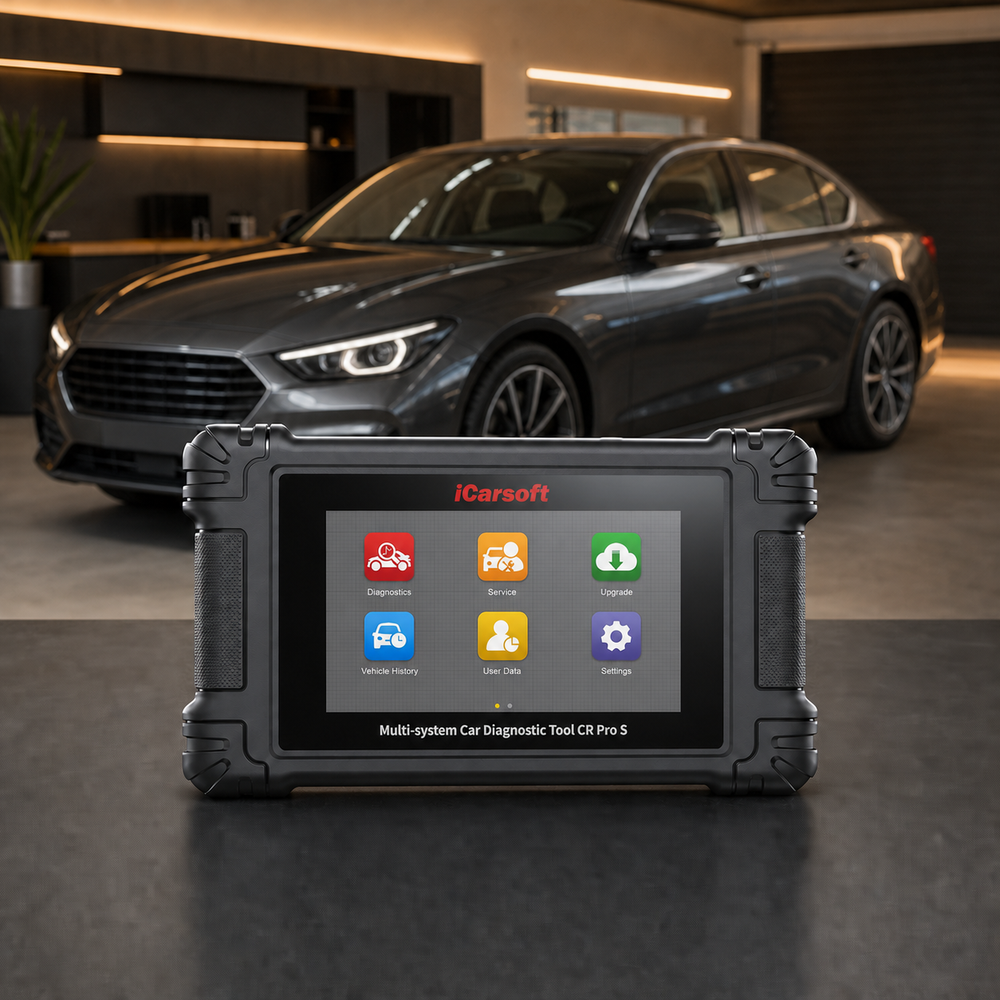
Preserve the right-rear tone-wheel and encoder diagnosis evidence
iCarsoft CR Pro S
Review supported codes and relevant live data together. Confirm the exact VIN, controller access, PIDs and any requested active test with iCarsoft before purchase; generic product capabilities do not guarantee a C0039-specific function.
Check current CR Pro S price and availabilityCheck CR Pro S compatibility by VINConfirm the requested function, VIN and software with iCarsoft before purchase. Follow OEM testing prerequisites; stop for abnormal operation.
Know the measurement boundary. Scan data describes ECU-provided information; it does not directly prove the physical condition of the right-rear tone wheel or encoder. Use the prescribed independent measurements when required.
Verify the C0039 Repair
After repair, verify connectors, harness clearance, setup and controller supply. Save post-repair findings, then clear only erasable records through the approved procedure. Battery disconnection is not a repair.
Run the manufacturer's applicable verification conditions in a safe workshop or route. Compare the original operating state with current data from the right-rear wheel-speed path, and check current and pending faults in related modules. One clean start or idle period does not prove that every conditional monitor has completed.
If C0039 returns, compare its suffix, status, failure order and operating conditions with the saved baseline before replacing another part. Revisit the failed branch and inspect anything disturbed. Confirm the prescribed brake-system verification separately from code clearing.
Stored and Active brake-control faults require different decisions. Preserve the original record and follow the OEM confirmation procedure. A cleared display does not prove restored assistance or safe braking.
Related Brake and Wheel-Speed Code Guides
Use each related code's own diagnostic procedure.
C0039 Frequently Asked Questions
Does C0039 mean I need a new axle or wheel bearing?
No. The correct repair depends on the proven defect and the actual assembly. Ford SSM 50296 describes an axle service path for its limited application when tone-ring movement or damage is found. Other evidence may require a different action. Confirm the VIN, full suffix and inspection results before authorizing a major part.
What should I check first for C0039?
Save every module's codes and freeze frame before clearing. Confirm the full definition, suffix and VIN architecture. Then inspect recent rear bearing, axle-shaft, sensor, brake or suspension work, connectors and shared supplies. Those facts determine whether the next test needs the specified multimeter, oscilloscope and approved brake-system test equipment or a manufacturer-specific functional procedure.
Can I drive with the C0039 code?
Arrange prompt brake diagnosis and follow the owner manual. Do not assume ABS or stability assistance remains available. Abnormal pedal effort, pulling, fluid loss, dragging or a red brake warning requires stopping safely and arranging recovery. The code cannot establish a safe driving distance.
Why did C0039 return after a part was replaced?
If C0039 returns after sensor replacement, compare its suffix and conditions with the baseline. Recheck disturbed wiring, installation and the rotating target. Neither a new sensor nor a new bearing proves correct encoder orientation, compatible parts or sound final assembly. Verify these requirements before replacing another component.
What should a C0039 repair estimate include?
Request failed-test evidence and itemized diagnosis, parts, labor, setup and verification costs. The code cannot determine the price.
Can CR Pro S diagnose and clear C0039?
On a supported vehicle, CR Pro S can organize available faults, freeze frame, live data and reports, and can clear erasable records after repair. Confirm exact ECU coverage. It cannot establish safe braking from an erase command or replace physical measurements for the right-rear tone-wheel and encoder diagnosis.
The iCarsoft Official Store Technical Team maintains the store's fault-code library. This guide organizes published technical references and verified product information; it does not document a hands-on test of a particular vehicle or claim an individual engineer's review.
Technical and cost references
- NHTSA DOT HS 812 575 — Functional Safety Assessment of a Generic Electric Power Steering System. August 2018; Appendix L, Table L-2 supplies selected SAE J2012 interface-code labels, not current VIN repair specifications.
- Ford SSM 50296 — 2021 Ranger/Bronco rear ABS tone-ring concern. Specified June 15–August 15, 2021 builds only; inspection evidence determines the service branch.
- JLR SSM71883 — Right First Time repair for listed wheel-speed DTCs. February 29, 2016 revision; listed L405/L494 applications and full suffixes only.
Product information: Official iCarsoft CR Pro S page.
Editorial note: General diagnostic education, not a substitute for the owner's manual, current VIN-specific service information or professional inspection. Test limits, procedures, coverage and costs vary. Related articles provide context; apply only the specifications and repair procedures that match the vehicle. No universal failure rate, repair price or outcome is implied.


