

 By iCarsoft Official Store Technical Team, Automotive Diagnostics Editors · Updated October 12, 2026 · OEM technical references checked
Quick Answer
C0526 describes steering angle sensor module in the documented application. It does not prove a failed steering-angle sensor, bad alignment or a clock-spring replacement. Save the original scan, confirm VIN scope and use the matched approved steering-angle live data, scan access and the VIN-specific centering/setup procedure before choosing a repair.
What Does the C0526 Code Mean?
For the documented application, C0526 concerns steering angle sensor module. Confirm the vehicle, reporting module and full wording before using this guide. The full fault record determines the test branch.
The steering-angle module supplies a vehicle-dynamics input used by steering and stability controllers. The base descriptor names the module path, not a universal sensor design, connector, calibration routine or replacement instruction. The MINI bulletin is unusually narrow: it names F60 Countryman PHEV vehicles produced from March 1 through June 30, 2017 with I-level F056-17-03-50x. Its example can follow transport mode or terminal changes without steering operation, and the remedy is an ISTA driving-readiness/software path. That evidence does not prove that every C0526 vehicle has the same operating state, software level or module integration. On another VIN, C0526 may require a different full suffix, communication test, centering procedure or service assembly. Preserve the exact vehicle build and I-level before using the bulletin.
C0526 names a steering-angle module path; it is not a wheel-speed or alignment code and does not order a clock-spring replacement.
MINI SI M32 01 17 identifies SAE fault C0526 on specified 2017 F60 PHEV vehicles. Its example follows transport-mode or terminal-change conditions and directs a driving-readiness/software path. It is narrow application evidence and cannot be generalized to every C0526 vehicle.
C0526 can follow a setup or operating-state event without proving hardware failure. Preserve the full suffix, reporting module and steering history; distinguish centering, communication, software and sensor branches. Treat terminal 30 history and steering centering as separate facts. Do not rotate a clock spring outside its centering procedure, clear a restraint-related fault casually or call an alignment issue a module failure. The final result must include valid steering-angle data through movement and the required EPS/ABS/stability verification, not just a successful ISTA routine or an extinguished lamp.
Save the full module wording and suffix before clearing; they can change the test path.
Separate C0526 from adjacent fault families
| Code | General description | Key distinction |
|---|---|---|
| C0526 | Steering Angle Sensor Module | This guide’s documented application; retain the full suffix. |
| U0121 | Lost communication with ABS controller | A communication or network condition is different from a particular sensor or actuator fault. |
| P0562 | System voltage low | Check a documented shared-supply issue without assuming it caused every stored code. |
Record the complete C0526 description. The suffix, reporting module and companion faults can change the diagnostic path. Use the manufacturer's full wording and test procedure for the exact vehicle.
C0526 Symptoms and Likely Causes
Record C0526 symptoms and fault status; symptoms alone cannot identify a failed part.
Check whether companion faults share a proven cause.
Record the exact warning, when it appeared and whether it changes with the monitored function. It is evidence to investigate, not proof of a failed part.
Compare the saved report with supported live data and operating conditions. A displayed value can be stale, invalid or unavailable without identifying the cause.
Preserve the service history and inspect the disturbed branch first, while keeping timing as a clue rather than proof.
Save every module’s codes and status. A related communication, voltage, warning or performance code can change the diagnostic order.
Practical cause-checking order
- Power, ground, connector or wake-state problem affecting the steering-angle module and its data path: Transport-mode or terminal-change state in the documented MINI application
- Open, shorted, corroded, chafed or water-damaged wiring in the monitored path: Low-voltage or terminal-30 event affecting module state
- A target, mechanical, tire or signal relationship problem where the monitor evaluates a physical input: Steering-angle centering, indexing or installation issue
- Gateway, network, configuration, calibration or software condition that changes the reported result: Connector, power, communication or software fault
- Internal sensor, controller or assembly fault only after the external branches pass: Internal module fault after VIN-specific readiness and external checks pass
Did C0526 appear after recent battery, steering-column, clock-spring, alignment or software work? Recheck the documented connections, parts and setup steps affected by that work. Record battery and software history; a post-repair code does not prove the new part is defective.
How Serious Is C0526, and Can You Drive?
Safety-related steering/stability warning — assess actual operation. Follow the owner manual and current warnings. C0526 cannot establish a safe driving distance or prove that assistance is available. Stop safely if the steering warning is red, steering assist or control changes, the vehicle is unstable, or the owner manual requires stopping; obtain qualified inspection or towing.
Record warning messages, operating conditions and service history. Do not induce wheel slip, emergency braking or a handling event on public roads. A red stop warning or abnormal control overrides any verification plan.
Stop and arrange a tow if the steering warning is red, steering assist or control changes, the vehicle is unstable, or the owner manual requires stopping.
Do not work under an unsupported vehicle or bypass a safety interlock. Follow OEM shutdown, access and support instructions. A scan result is not a safety certificate.
How to Diagnose C0526 in the Right Order
-
Identify the application and preserve evidence
Save the complete C0526 record, suffix, reporting module, status, freeze frame, steering warnings and battery/column history before clearing.
-
Inspect the relevant physical and electrical path
Check MINI SI M32 01 17 scope: specified F60 Countryman PHEV vehicles built 2017-03-01 through 2017-06-30 with I-level F056-17-03-50x; do not generalize.
-
Confirm architecture and prerequisites
With restraint precautions, establish transport mode and whether terminal 30 was lost or changed twice without steering operation; preserve centering and connector history.
-
Separate signal, network or system behavior
Use ISTA/Next and the OEM test module to verify steering-angle source, communication, supply and setup; do not substitute a generic zero-point or pinout.
-
Prove the repair path before parts
Where the MINI path applies, follow readiness: terminal 15 on, turn wheel stop-to-stop, then perform prescribed terminal changes with Activate Driving Readiness; apply only the specified software path.
-
Verify the original condition after repair
Reread EPS/ABS/chassis modules and verify centered, valid steering-angle data and safe steering/stability behavior; a cleared C0526 is incomplete evidence.
Specifications are vehicle-specific. Use the exact VIN specifications, approved test points and required operating state. No generic value or drive cycle can replace the applicable procedure. Manufacturer examples here do not establish specifications for other applications.
C0526 Repairs and Cost Planning
A C0526 repair must address the demonstrated failure. Do not replace an assembly from the code alone.
Recheck installation and required setup after repair. MINI’s example is production- and I-level-specific; transport-mode and terminal-change conditions are evidence branches, not universal C0526 thresholds. Treat terminal 30 history and steering centering as separate facts. Do not rotate a clock spring outside its centering procedure, clear a restraint-related fault casually or call an alignment issue a module failure. The final result must include valid steering-angle data through movement and the required EPS/ABS/stability verification, not just a successful ISTA routine or an extinguished lamp.
Ask the shop to name the failed branch and the measurement supporting each proposed repair.
Authorize diagnosis before parts while the cause remains uncertain.
| Possible path | Quote basis |
|---|---|
| Repair the demonstrated power, ground, connector or network path serving the steering-angle module and its data path | VIN-specific quote |
| Correct the proven mechanical, target, tire, mounting, centering or installation condition where applicable | VIN-specific quote |
| Restore configuration, software, calibration or required setup only through the VIN-specific procedure | VIN-specific quote |
| Replace the isolated sensor, controller or assembly only after external evidence and the OEM test support that path | VIN-specific quote |
These are alternative repair paths, not prices to add together. Request a VIN-specific quote separating diagnosis, parts, labor, fluids, taxes, required setup and verification. Ask which failed test supports the proposed repair and whether warranty coverage applies.
Using iCarsoft CR Max P for C0526
On a supported vehicle, iCarsoft CR Max P can save accessible faults, available freeze frame, live data and diagnostic reports. Preserve the C0526 evidence before clearing.
Compare the saved and final module records. Scan data supports diagnosis but does not replace the OEM reference, physical measurement or safety-system functional check.
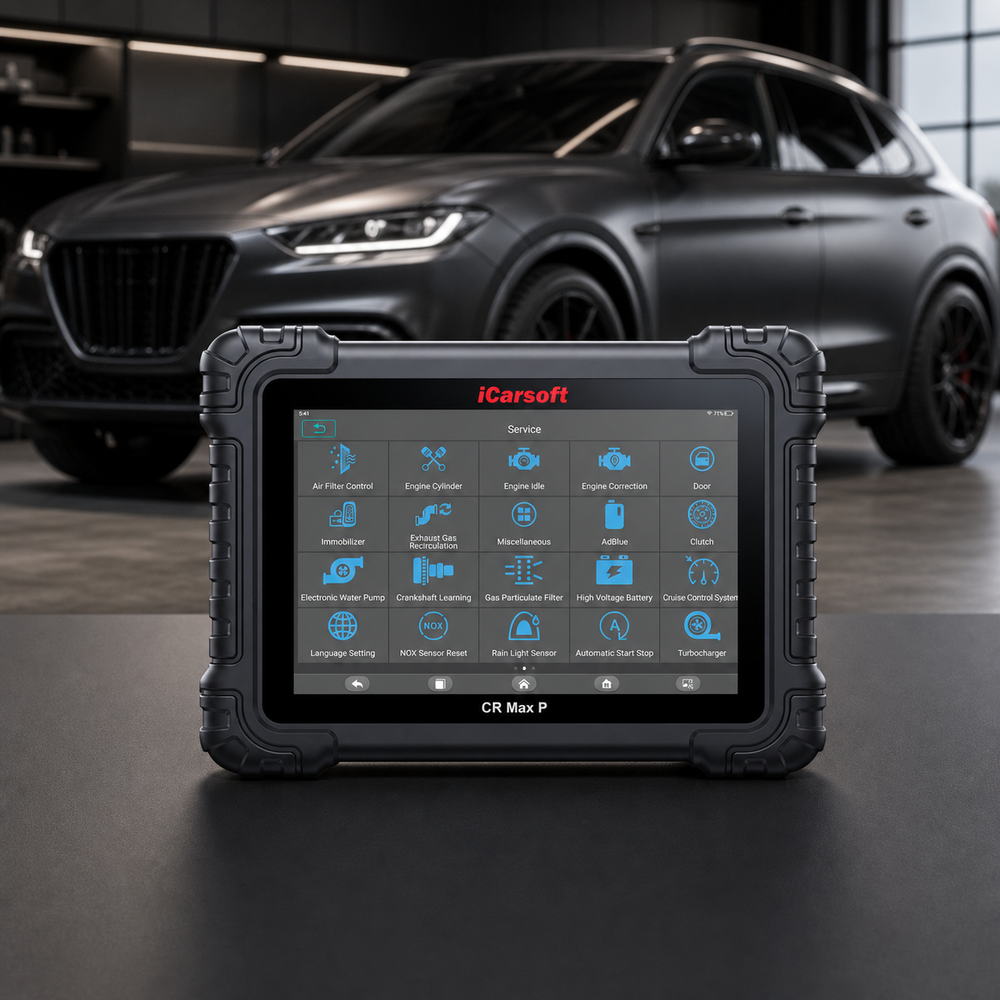
Preserve the steering-angle module and its data path evidence
iCarsoft CR Max P
Review supported codes and relevant live data together. Confirm the exact VIN, controller access, PIDs and any requested active test with iCarsoft before purchase; generic product capabilities do not guarantee a C0526-specific function.
Check current CR Max P price and availabilityCheck CR Max P compatibility by VINThe official product page describes supported full-system diagnostics, available live data, freeze frame and diagnostic reports; exact controller coverage and active tests depend on the VIN and software. Confirm the requested function by VIN before purchase. Follow OEM prerequisites and stop for abnormal operation.
Know the measurement boundary. Scan data describes ECU-provided information; it does not directly prove the physical condition of the steering-angle module and its data path. Where required, use approved steering-angle live data, scan access and the VIN-specific centering/setup procedure and compare reported values with the relevant measured evidence.
Verify the C0526 Repair
After repair, verify installation, clearance and required setup. Save the final findings and clear only erasable records as instructed. Battery disconnection is not a repair.
Run the manufacturer's applicable verification conditions in a safe workshop or route. Compare the original operating state with current data for the steering-angle module and its data path, and check current and pending faults in related modules. A clean start or idle period does not prove the repair; use the OEM functional check for the affected system.
Compare the original and final fault status. Record the functional-check result and whether the original event returned.
If C0526 returns, compare its suffix, status, failure order and operating conditions with the saved baseline before replacing another part. Revisit the failed branch and inspect anything disturbed. Confirm the prescribed affected-system functional verification separately from code clearing.
Verification follows the system involved. After saving the original evidence, use the OEM procedure to clear erasable records, complete any required calibration or functional check, and compare the final module status with the original warning and fault conditions.
Related Steering-Angle Module And Its Data Path Code Guides
Compare the related monitor families below. Shared symptoms or components do not make their repair procedures interchangeable.
C0526 Frequently Asked Questions
Does C0526 prove the named component is bad?
No. C0526 describes steering angle sensor module, not a confirmed part. It also does not prove a failed steering-angle sensor, bad alignment or a clock-spring replacement. Use the manufacturer’s test sequence to distinguish the relevant branch before replacing parts.
What should I check first for C0526?
Save every module's codes and freeze frame before clearing. Confirm the full definition, suffix and VIN architecture. Then inspect recent battery, steering-column, clock-spring, alignment or software work, connectors and shared supplies. Those facts determine whether the next test needs approved steering-angle live data, scan access and the VIN-specific centering/setup procedure or a manufacturer-specific functional procedure.
Can I drive with the C0526 code?
Safety-related steering/stability warning — assess actual operation. Follow the owner manual and current warnings. C0526 cannot establish a safe driving distance or prove that assistance is available. Stop safely if the steering warning is red, steering assist or control changes, the vehicle is unstable, or the owner manual requires stopping; obtain qualified inspection or towing.
Why did C0526 return after a part was replaced?
ISTA readiness or software correction must follow OEM prerequisites; erase success alone does not prove restored steering or stability control.
What should a C0526 repair estimate include?
Ask for the failed-test evidence and a VIN-specific breakdown of diagnosis, parts, labor, taxes, required setup and verification. A code alone cannot establish the repair price.
Can CR Max P diagnose and clear C0526?
On a supported vehicle, CR Max P can organize available faults, freeze frame, live data and reports, and can clear erasable records after repair. Confirm exact ECU coverage. It cannot replace the OEM functional procedure or physical measurements for the steering-angle module and its data path.
The iCarsoft Official Store Technical Team maintains the store's fault-code library. This guide organizes published technical references and verified product information; it does not document a hands-on test of a particular vehicle or claim an individual engineer's review.
Technical and cost references
- MINI SI M32 01 17 — Steering and Wheel Alignment. NHTSA-hosted MINI bulletin; specified 2017 F60 PHEV application only.
Product information: Official iCarsoft CR Max P page.
Editorial note: General diagnostic education, not a substitute for the owner's manual, current VIN-specific service information or professional inspection. Test limits, procedures, coverage and costs vary. Related articles provide context; apply only the specifications and repair procedures that match the vehicle. No universal failure rate, repair price or outcome is implied.


