

Quick Answer
The P00FE code means EVAP System Purge Vapor Line Restricted/Blocked. The engine controller detected a pressure or flow response consistent with a restricted fuel-vapor path. It does not identify the blocked location or prove that a hose, purge valve, canister, tank, leak-detection module or controller has failed. Save the complete scan record, then map and test the exact VIN-specific EVAP system.
1What Does the P00FE Code Mean?
The P00FE code is a powertrain emissions fault for a restricted or blocked path in the evaporative-emission system. The EVAP system stores gasoline vapor in a charcoal canister rather than releasing it to the atmosphere. Under controlled conditions, the engine draws that vapor through the purge path and burns it.
The controller can infer a restriction from tank pressure, valve commands, pump behavior or modeled flow. OEM wording may say purge vapor line, tank vapor line or EVAP control system. Identify the exact line, valves and monitor from the VIN diagram.
A restriction is different from a leak and from an electrical circuit classification. A pinched hose, clogged canister or stuck valve is possible, but so are incorrect routing, a blocked filter, an internal tank path, a control problem or application-specific software. P00FE records the monitor result, not the repair.
P00FE vs. nearby EVAP codes
| Code | General description | Key distinction |
|---|---|---|
| P00FE | EVAP purge vapor line restricted/blocked | The monitored vapor path appears restricted; the location and cause remain unproven. |
| P0441 | EVAP system incorrect purge flow | A broader purge-flow performance result, not specifically a blocked-line label. |
| P0455 | EVAP system leak detected, large leak | A sealing or leak result rather than a restriction result. |
| P0458 | EVAP purge control valve circuit low | An electrical low-state classification in the valve circuit, not low vapor flow. |
| P0496 | EVAP system high purge flow | The monitored purge result is excessive, not restricted. |
| P0497 | EVAP system low purge flow | Low purge performance may overlap in symptoms, but it is not the same DTC definition. |
OEM examples prove why VIN research matters. Volkswagen bulletin 01-21-06 requires an applicable ECM update before parts replacement on specified 2020 Jetta vehicles. VOS-19-20 corrects a Golf test plan to check the purge valve, leak-detection module and wiring. Nissan NTB18-001 instead directs fuel-tank replacement for a narrow 2017 Sentra condition. These repairs do not transfer automatically.
2P00FE Symptoms and Likely Causes
P00FE often appears during an EVAP monitor, so the vehicle may feel normal. Symptoms after refueling, tank or canister work, collision repair or underbody service can point toward a disturbed vapor path.
The MIL, pending code or failed readiness monitor may be the only visible sign.
A restricted tank-vent path can make the pump nozzle click off early or prevent the gauge from reaching full.
Hard starting after refueling, rough idle or stalling can occur when another purge or tank-pressure fault accompanies P00FE.
A strong gasoline odor or visible wetness suggests a separate leak or liquid-fuel issue needing immediate attention.
Practical cause-checking order
- Recent service or impact: pinched, swapped, disconnected or misrouted hoses; crushed tubing; loose quick connectors; or a disturbed tank, canister or shield.
- Accessible vapor-path restriction: kinked hose, debris, contamination, ice, blocked vent filter or damaged line between the tank, canister and purge connection.
- Valve or module operation: a purge, vent, shutoff, containment or leak-detection valve that is stuck, contaminated or not powered correctly.
- Canister contamination: a saturated, collapsed or debris-loaded charcoal canister, sometimes following repeated tank topping-off.
- Internal tank path: a restricted rollover valve, vapor separator, internal tube or fuel-tank assembly after external paths pass.
- Calibration and controller path: an applicable software bulletin or test-plan correction; consider controller hardware last.
A loose gas cap is not the default P00FE diagnosis. Inspect the cap and seal, but do not replace it, the purge valve or the canister solely because the code contains “EVAP.”
3How Serious Is P00FE, and Can You Drive?
When the P00FE code is the only fault, the MIL is steady, the engine runs normally, refueling is normal and there is no fuel odor or leakage, a short light-load trip to a safe diagnostic location may be reasonable if the owner’s manual permits it. Schedule service soon because the EVAP monitor may remain incomplete and tank pressure or refueling problems can worsen.
Stop and arrange a tow for liquid fuel, a strong or increasing raw-fuel odor, smoke, a burning smell, repeated stalling, unsafe power loss, a flashing MIL with severe misfire, or a pressurized tank that vents abnormally. These are not routine consequences to ignore.
Fuel vapor is flammable. Work outdoors or with approved ventilation, remove ignition sources and follow the OEM pressure-relief procedure. Never use shop air, an unapproved smoke source or improvised voltage jumps on an EVAP system. Support the vehicle at rated lift points before inspecting underbody lines, and keep clear of hot exhaust parts and automatic cooling fans.
4How to Diagnose P00FE in the Right Order
-
Save every code, status and failure clue
Scan all modules before clearing anything. Record current, pending, permanent and history status; freeze frame; failure order; readiness; calibration IDs; and related EVAP, pressure, purge, vent, fuel-level or electrical codes. Note refueling behavior, fuel level, weather, recent battery events and recent tank, canister, exhaust, collision or underbody work.
-
Identify the VIN-specific vapor architecture
Obtain the current service diagram, component locations, connector views, monitor description and bulletins. Trace the tank vapor line, canister, fresh-air filter, vent or leak-detection hardware, purge line and intake connection. Confirm whether the OEM calls the monitored path “purge,” “tank vapor,” “vent” or another name before testing the wrong hose.
-
Inspect the cool physical path end to end
Relieve pressure as directed and inspect accessible hoses, rigid lines, clips, quick connectors, filters, canister housing and tank-area fittings. Look for kinks, flattening, impact, heat damage, debris, liquid fuel, corrosion, rodent damage and swapped connections. Compare any recently serviced routing with the diagram rather than relying on appearance.
-
Prove flow, sealing and electrical support safely
Follow the OEM isolation sequence using approved EVAP pressure-vacuum equipment, smoke equipment or a hand pump only where specified. Test sections separately to locate the restriction. Verify valve power, ground, control and loaded voltage drop with a suitable meter when the procedure requires it. Never exceed the vehicle-specific test pressure or force a valve by hand.
-
Compare supported commands with actual response
When the exact ECU exposes them, watch purge command, tank pressure, valve state, pump feedback and monitor results while running the prescribed EVAP test. A command without the expected pressure change narrows the branch, but it does not distinguish a blocked line from a stuck valve, missing power, a saturated canister or inaccurate pressure feedback.
-
Confirm the failed item, bulletin and setup
Condemn a line, valve, canister, tank assembly or module only after its external paths and controls pass or fail the OEM test. Check software bulletin applicability by VIN and calibration. Perform only the required setup, adaptation or approved programming, restore every clip and seal, then verify the actual monitor before closing the repair.
Specifications are vehicle-specific. There is no universal P00FE pressure, vacuum, voltage, resistance, current, purge percentage, fuel-level window, test duration or drive cycle. Use only the limits, units, test ports and safety steps for the exact VIN and current service information.
5P00FE Repairs and Typical Costs
The correct repair follows the failed test. It may be as small as restoring a pinched hose or connector, or as involved as replacing a restricted canister, internal tank assembly or application-specific software. A part should not be selected from the code name alone.
| Possible path | Current US estimate |
|---|---|
| Check Engine light diagnosis and testing | $122–$233 |
| Purge valve replacement, only when testing proves the valve is the restriction or cannot achieve the commanded state | $207–$248 |
| Fuel evaporative canister replacement, only when the canister is proven restricted, contaminated or internally damaged | $555–$640 |
| Vapor hose, rigid line, quick connector, vent filter or local wiring repair | VIN-specific quote |
| Fuel-tank, internal vapor-path or integrated-module repair | VIN-specific quote |
| Applicable OEM software update, setup or controller diagnosis | VIN-specific quote |
RepairPal’s national estimates were last updated August 7, 2026. They exclude location, taxes, fees and related work. The rows are alternative outcomes, not amounts to add together. Canister, valve and tank designs vary widely, so request a VIN-based quote after the restriction is isolated.
6Using iCarsoft CR Eagle P for P00FE
On a supported vehicle, iCarsoft CR Eagle P can scan the relevant engine and emissions modules, preserve P00FE status and available freeze frame, display ECU-provided live data, review readiness and onboard-monitor results, and save a diagnostic report. The official page also lists bidirectional control and OBD-II EVAP system testing, but the available PIDs and active tests depend on the exact VIN, ECU and software.
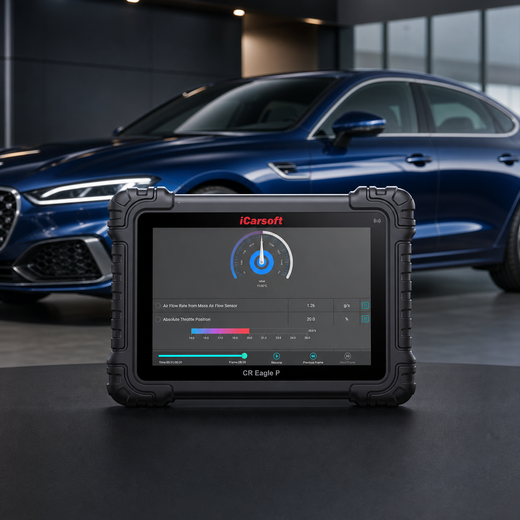
Evidence-first EVAP diagnosis
iCarsoft CR Eagle P
Save the original fault record, compare available purge commands with tank-pressure or valve feedback, review readiness and document the repair before replacing an EVAP component.
Check current CR Eagle P price and availabilityCheck CR Eagle P compatibility by VINBefore commanding a purge, vent or leak-test function, read the OEM conditions and hazards. If a menu is absent, that is a coverage limitation, not proof of component failure. A valve click or pressure-PID change also does not prove the entire path is clear.
Know the measurement boundary. iCarsoft CR Eagle P does not directly measure physical restriction, hose flow, pressure, vacuum, leakage, terminal tension, voltage drop, current, resistance, canister saturation or internal tank damage. Use approved EVAP test equipment, a multimeter and physical inspection alongside scan evidence.
7Verify the P00FE Repair
Save a post-repair scan and compare it with the original. Confirm every quick connector, hose, clip, filter and electrical connection is restored; no fuel odor or leakage remains; refueling behavior is normal; and the installed calibration matches any applicable bulletin. Clear erasable DTCs only after evidence is saved and by the OEM-approved procedure.
Run the prescribed EVAP service test or safely reproduce the monitor conditions. Verify the P00FE code does not return as current or pending, companion codes stay absent, and available command, pressure and valve feedback agree. One clean idle period is not proof because many EVAP monitors require specific fuel level, ambient temperature, soak or key-off conditions.
Finally, recheck readiness after an appropriate operating period. Do not promise a fixed number of trips, starts or miles. If the monitor will not run, diagnose the unmet enable condition rather than repeatedly clearing codes, disconnecting the battery or installing another part.
A permanent P00FE can remain immediately after a successful repair. If the vehicle stores it as a permanent DTC, a scan tool or battery disconnect cannot erase it. Once current and pending faults are absent, the OBD system removes the permanent record only after the applicable monitor reruns and passes.
8Related EVAP Code Guides
9P00FE Frequently Asked Questions
Does P00FE prove that one EVAP hose is blocked?
No. The code records a monitored result consistent with a restricted vapor path. A hose, valve, filter, canister, internal tank component, control circuit or application-specific software can produce that result. Map and isolate the exact VIN system before choosing a part.
What is the difference between P00FE and P0497?
P00FE specifically labels the purge or tank vapor path as restricted or blocked. P0497 means low purge flow. Their symptoms and possible causes can overlap, but the monitor logic and diagnostic branches are not interchangeable.
Can a loose gas cap cause the P00FE code?
A loose cap more directly causes an EVAP sealing or leak code. Inspect the cap because it is part of the system, but do not treat it as the primary P00FE repair unless the VIN-specific test proves that its condition affected the monitor.
Can I drive with P00FE?
A short, light-load diagnostic trip may be reasonable when the MIL is steady, the vehicle runs and refuels normally, and there is no fuel odor or leakage. Stop for liquid fuel, strong vapor odor, smoke, repeated stalling, unsafe power loss or a flashing MIL.
How much does P00FE cost to fix?
Current US check-engine-light diagnosis averages $122–$233. A proven purge valve replacement averages $207–$248, while a proven fuel evaporative canister replacement averages $555–$640. Lines, connectors, internal tank parts and software need VIN-specific quotes.
Can iCarsoft CR Eagle P diagnose P00FE?
On a supported vehicle, CR Eagle P can preserve codes and freeze frame, display available EVAP data, review readiness and may run a relevant system test or active command. It cannot physically measure a blockage, pressure, vacuum, leakage or electrical integrity; use the correct external equipment and OEM procedure.
Technical and cost references
- SAE J2012_202509, Diagnostic Trouble Code Definitions, revised September 1, 2025, and current J2012DA_202607 digital annex, dated July 29, 2026.
- Volkswagen TSB 01-21-06, Transaction 2062519/1, released March 3, 2021; P00FE definition and application-specific ECM update direction.
- Volkswagen ODIS Service VOS-19-20, dated July 24, 2019; corrected P00FE test-plan scope for specified Golf vehicles.
- Nissan bulletin NTB18-001, dated January 12, 2018; narrow 2017 Sentra fuel-tank example.
- RepairPal Check Engine Light Diagnosis & Testing Cost Estimate, $122–$233, updated August 7, 2026.
- RepairPal Purge Valve Replacement Cost Estimate, $207–$248, updated August 7, 2026.
- RepairPal Fuel Evaporative Canister Replacement Cost Estimate, $555–$640, updated August 7, 2026.
- California Bureau of Automotive Repair On-Board Diagnostic Test Reference for permanent-DTC behavior.
Product information: Official iCarsoft CR Eagle P page.
Editorial note: Educational information only. This guide cannot replace the service information, fuel-vapor precautions, approved test equipment or repair limits for a specific VIN. Never introduce shop air, ignition sources or unapproved smoke into the EVAP system, and never bypass an emissions component. Product coverage and repair costs vary; confirm current details before work.


