

Quick answer
P0236 means Turbocharger/Supercharger Boost Sensor “A” Circuit Range/Performance. The engine controller decided that the Sensor A pressure signal was implausible, outside an expected range or inconsistent with other pressure information. It does not prove that the sensor or turbocharger has failed, and it is not the same as an underboost or overboost code. Save the complete scan and freeze frame, identify Sensor A for the exact VIN, compare pressure data, then test the connector, circuit and charge-air system before replacing parts.

What Does the P0236 Code Mean?
P0236 is a generic OBD-II powertrain code. Its standardized description identifies a range/performance problem in the Turbocharger/Supercharger Boost Sensor A circuit. The controller is judging whether the reported pressure makes sense; it is not merely checking whether the signal wire is electrically high or low.
“Sensor A” means the manufacturer-designated Boost Sensor A path. Its physical location varies. It may be in a charge pipe, intake manifold, charge-air temperature/pressure assembly or another manufacturer-defined location. Sensor A does not identify a side of the engine, so do not treat it as Bank 1.
Pressure units matter: scan tools often display absolute pressure. With the engine off, an absolute-pressure PID normally reflects local atmospheric pressure rather than zero. Altitude and weather affect that value, so use the OEM test and units instead of assuming every healthy vehicle must show 101 kPa.
How the Boost Sensor A Monitor Works
The ECM converts the sensor signal into pressure and compares it with an expected model. Depending on the calibration, the model may use barometric pressure, manifold absolute pressure, another charge-pressure sensor, engine speed, airflow, throttle position, EGR position, requested torque or operating history.
How neighboring codes differ
| Code | General meaning | What it does not prove |
|---|---|---|
| P0236 | Boost Sensor A circuit range/performance or plausibility | Does not prove actual underboost, overboost or a bad turbo |
| P0237 | Boost Sensor A circuit low | Does not identify whether the sensor, signal or reference path caused it |
| P0238 | Boost Sensor A circuit high | Does not automatically require sensor replacement |
| P0234 | Turbocharger/supercharger overboost condition | Does not by itself identify the wastegate or actuator as failed |
| P0299 | Turbocharger/supercharger underboost condition | Does not by itself prove a charge-air leak or failed turbo |
Common P0236 Symptoms
A biased sensor may set P0236 without an obvious driving complaint. When the signal affects boost control or shares wiring with other sensors, symptoms can be more noticeable:
The MIL may be the only visible symptom, especially with an intermittent circuit or software condition.
The ECM may limit requested torque or boost when it cannot trust the pressure signal.
Acceleration may feel delayed, inconsistent or weaker than expected.
Possible on applications where the fault involves a shared reference or signal-return circuit.
A loose charge-air joint may hiss under load, but sound alone does not identify the leak.
Some vehicles restrict engine speed or boost until the condition is corrected.

Whining, metallic turbo noise, blue or heavy black smoke, abnormal oil consumption and oil-pressure warnings are not required P0236 symptoms. If present, they need separate mechanical and safety checks.
Possible P0236 Causes and OEM Examples
Use the freeze frame, companion codes and VIN-specific service information to prioritize these paths:
- Connector or wiring fault: corrosion, water, a loose or backed-out terminal, harness rub-through, a poor splice or intermittent high resistance.
- Reference, ground or signal problem: an unstable 5-volt reference, excessive low-reference voltage drop, short or open circuit can skew one or several sensors.
- Biased or contaminated pressure sensor: the sensor may drift, respond slowly or have a restricted sensing port from oil, water or deposits.
- Incorrect comparison sensor: BARO, MAP or another pressure input may be the implausible value, even though P0236 names Boost Sensor A.
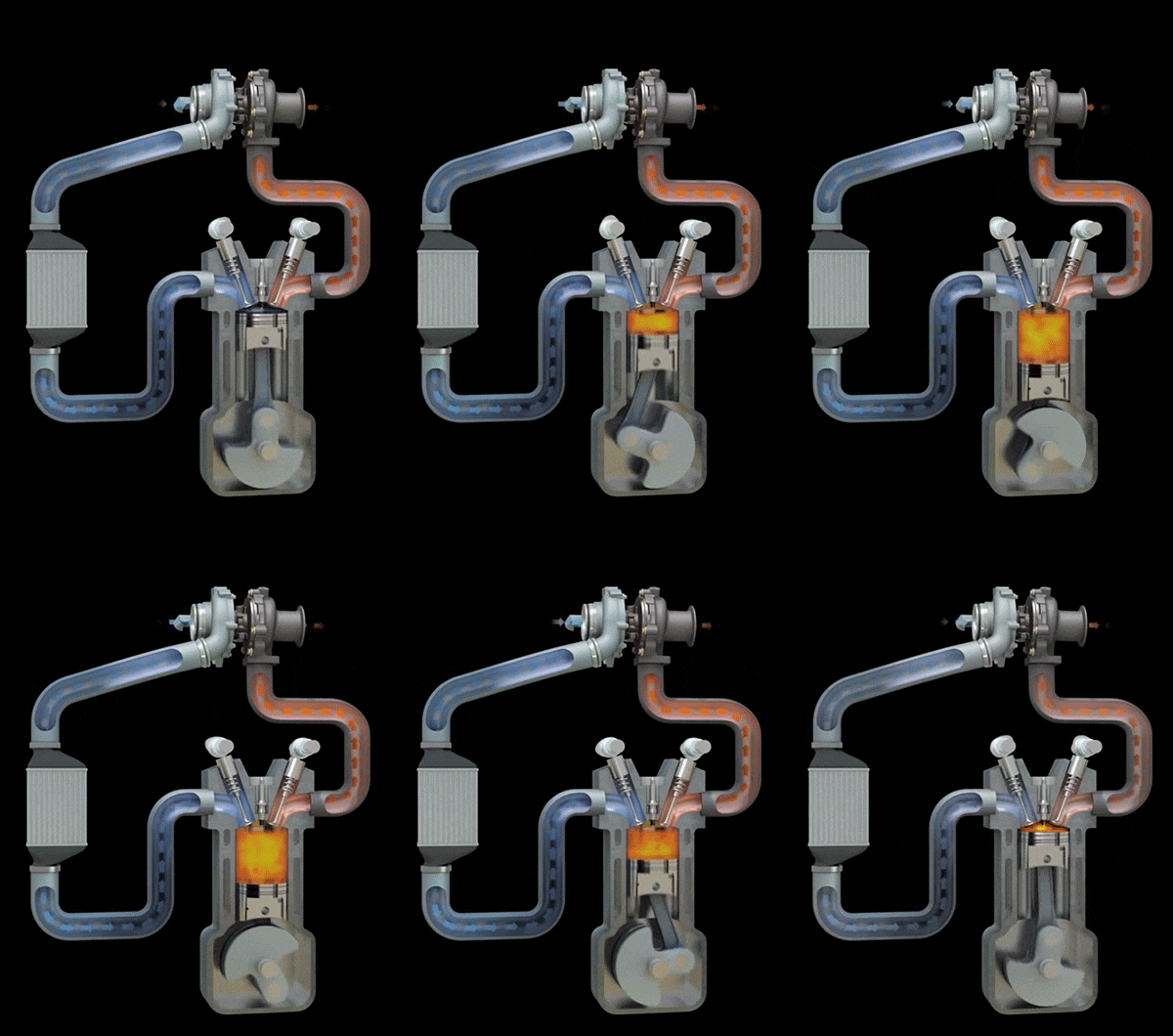
- Charge-air plumbing fault: a loose quick-connect, split hose, failed seal, intercooler leak, restriction or cold-weather icing can change the expected pressure relationship.
- Boost-control problem: a wastegate, VGT mechanism, vacuum hose, control solenoid or actuator may fail to produce the modeled response.
- Calibration condition: some narrowly defined vehicles have an OEM software update that revises P0236 detection logic.
- Mechanical turbocharger fault: possible only after circuit, sensor, plumbing, control and software checks support that conclusion.

Manufacturer examples — not universal fixes
| Application example | Documented path | Lesson |
|---|---|---|
| 2013 Ford Escape 1.6L/2.0L GTDI | Corroded TCBP/CACT/MAPT terminals or a signal-return splice concern | Graph related KOEO PIDs while checking the harness |
| 2011–2013 Ford F-150 3.5L GTDI | Harness insulation damage near the boost-sensor connector | Inspect routing and conductor damage before replacing the sensor |
| 2013–2014 Volkswagen Tiguan 2.0L | Increased resistance at a specified harness connector terminal | A small connection fault can bias a plausible-looking signal |
| Specified Acura and Hyundai models | OEM software changes address false or overly sensitive P0236 detection | Confirm VIN and calibration applicability before parts |
| 2022–2023 Wagoneer/Grand Wagoneer 3.0L | Turbo-to-charge-air-cooler quick-connect may not be fully locked | Inspect charge plumbing when pressure behavior is wrong |
| Specified Buick/Chevrolet 1.3L turbo models | Poor splice crimp retention can skew boost-sensor data | A sensor code may originate elsewhere in the harness |
How Serious Is P0236, and Can You Drive?
If the MIL is steady, engine behavior and sounds are normal, and no critical warning is present, a short, low-load trip to a repair location may be reasonable if the owner's manual permits it. Avoid towing, long climbs, high RPM and hard acceleration because the ECM may be using substitute pressure values.
Stop and arrange a tow for severe power loss, repeated stalling, a flashing MIL, uncontrolled surging, metallic turbo noise, heavy smoke, a burning-oil smell, oil-pressure warning, overheating or any condition that makes vehicle response unsafe. Do not repeatedly floor the accelerator to force a vehicle out of reduced-power mode.

How to Diagnose P0236 Step by Step
-
Save the complete scan
Record confirmed, pending, history and permanent DTCs, freeze frame, module identification and the full descriptor before clearing anything. Note P0237/P0238, P0234/P0299, P0069, P00C7 and reference-voltage codes.
-
Identify Sensor A by VIN
Use the wiring diagram and component-location information for the exact engine. Confirm whether the relevant PID is boost, charge pressure, throttle-inlet pressure, MAP or a combined temperature/pressure sensor.
-
Check OEM bulletins and recent work
Look for an applicable software update, connector campaign or charge-pipe action. Ask about sensor, turbo, intercooler, battery, engine or harness work completed before the code appeared.
-
Compare KOEO pressure values
With the engine off under the specified conditions, graph available BARO, MAP and boost/charge-pressure PIDs. They should agree within the OEM tolerance after accounting for altitude and units; do not impose a universal fixed threshold.
-
Inspect the sensor, port and harness
Check the connector seal, pin fit, corrosion, contamination, harness routing and sensing port or hose. Watch live data during a gentle wiggle test; a sudden jump is stronger evidence than appearance alone.
-
Test the circuit correctly
Use a DVOM, scope and approved back-probing method to test reference, low reference/ground and signal integrity under the required conditions. Shared-reference faults can affect several PIDs, and a static voltage check may miss intermittent resistance.
-
Inspect and test charge-air plumbing
Confirm quick-connects, seals, clamps, hoses and intercooler condition. Use an OEM-approved smoke or regulated low-pressure method where required; never apply unregulated shop air to the sensor or intake system.
-
Compare desired and actual response
If the fault appears only under load, record desired boost, actual pressure, BARO, MAP, MAF, throttle and supported actuator data in a safe environment. Have a second person operate the scanner or use a dynamometer; never manipulate a tablet while driving.
-
Test control and mechanical components last
After the sensor circuit and pressure path pass, follow the OEM procedure for the wastegate, VGT, vacuum supply, solenoid, actuator and turbocharger. Verify applicable software before replacing mechanical parts.
Hot and fast-moving parts: turbochargers and exhaust components can cause severe burns, while compressor wheels can spin at extremely high speed. Let the system cool, keep objects away from rotating parts and follow the service manual before disconnecting oil, coolant, vacuum or charge-air components.
How to Fix P0236
The repair should follow the failed test, not the code name:
- Repair connector or wiring damage: restore pin fit, splice integrity, insulation, reference, ground or signal continuity using approved methods.
- Clean or replace the proven sensor: clean a serviceable sensing port only when the manufacturer permits it; replace the sensor when its output or response fails the specified test.
- Seal the charge-air path: lock the quick-connect, replace a failed seal or hose, tighten the specified clamp or repair a tested intercooler leak.
- Restore boost control: repair a vacuum hose, control solenoid, wastegate/VGT mechanism or actuator only after the relevant test confirms it.
- Apply the correct calibration: complete an OEM software action only when the VIN, symptoms and current software match the bulletin.
- Replace or rebuild the turbocharger only with proof: confirm mechanical damage, shaft/bearing condition, oil or coolant path, control operation and root cause so a replacement does not fail again.

Avoid the parts cannon. Replacing the boost sensor, MAP sensor, wastegate solenoid and turbocharger together can hide the original cause. P0236 alone authorizes none of those parts.
Using iCarsoft CR MAX for P0236 Diagnosis
On supported vehicles, CR MAX can read P0236 and its full status, save freeze frame, scan other modules, graph available pressure and airflow PIDs, review ECU information and retain diagnostic reports. Those functions help separate an implausible signal from a real boost-control problem.

A practical CR MAX workflow
-
Run and save a full scan
Capture P0236 status, freeze frame and companion faults before changing vehicle state.
-
Create a focused graph
Select only supported PIDs that answer the diagnostic question: boost/charge pressure, MAP, BARO, desired boost, airflow, throttle and actuator data where available.
-
Check KOEO plausibility
Compare the pressure channels using the correct units and OEM tolerance. Record any offset or intermittent jump.
-
Use supported commands safely
A vehicle-specific actuator or solenoid test may assist diagnosis, but follow all on-screen and OEM conditions and confirm the physical result.
-
Save proof after repair
Repeat the original comparison and monitor conditions, then keep a post-repair scan report.

Diagnostic platform for P0236 evidence gathering
iCarsoft CR MAX
Preserve the complete scan and freeze frame, compare supported boost-related live data, and document the vehicle before and after the verified repair.
Check current price, availability & compatibility · lifetime free software updates
View CR MAXCheck CR MAX coverageCapability boundary: CR MAX cannot directly measure sensor reference voltage, physically verify boost pressure, smoke-test a charge-air system or inspect a turbocharger. Use the required DVOM, scope, regulated pressure/smoke equipment and mechanical tests. PID and active-test coverage must be confirmed for the exact VIN.
How Much Does It Cost to Fix P0236?
The final cost depends on the proven cause. These current US national figures are planning anchors, not a list of parts to replace and not a quote for a specific vehicle.
| Confirmed service path | Current US planning figure |
|---|---|
| General professional diagnosis | $122–$179 |
| Turbocharger boost-sensor replacement | $225–$261 |
| Intercooler replacement national average | $1,290–$1,448 |
| Turbocharger assembly replacement national average | $2,490–$3,068 |
| Connector, splice, hose, seal or wiring repair | Vehicle-specific quote |
| OEM software update, actuator or control repair | Vehicle-specific quote |
RepairPal's four cited estimates were last updated July 25, 2026. Figures exclude taxes, location differences and related repairs. The rows are alternative outcomes and must not be added together.
Prevention and Repair Confirmation
A scan tool can detect and document P0236, but it cannot prevent the fault. Sensible maintenance focuses on protecting the components and connections:
- Reinstall charge-pipe locks, seals, clamps, harness retainers and heat shields correctly after service.
- Repair oil, coolant and water contamination that reaches the sensor or connector.
- Inspect charge-air hoses for rubbing, swelling, collapse or loose joints during routine underhood service.
- Use the specified engine oil and service interval to protect turbocharger lubrication.
- Do not replace a pressure sensor on a schedule unless the manufacturer specifically requires it.
How to confirm the repair
- Complete the verified circuit, sensor, plumbing, control, software or mechanical repair.
- Perform required connector checks, adaptations or setup and inspect for air, oil and coolant leaks.
- After preserving the original evidence, clear repair-related non-permanent codes when directed.
- Repeat the KOEO pressure comparison and confirm that all related values are plausible and stable.
- Safely repeat the original monitor conditions and compare desired versus actual pressure within OEM limits.
- Rescan for confirmed and pending faults and verify readiness. A permanent DTC clears only after the applicable monitor confirms the repair.
A complete fix is repeatable. Pressure data is plausible at rest, responds smoothly under the permitted test, the original symptom is gone and no pending P0236 returns.
Related Boost, Pressure and Control Codes
P0236 Frequently Asked Questions
What does code P0236 mean?
P0236 means Turbocharger/Supercharger Boost Sensor A Circuit Range/Performance. The ECM judged the Sensor A pressure signal to be implausible, outside its expected range or inconsistent with other pressure information. It does not identify the failed part.
Where is Boost Sensor A located?
Sensor A is the manufacturer-designated Boost Sensor A path, not Bank 1. It may be in a charge pipe, intake manifold or combined pressure/temperature housing. Use the VIN-specific component locator and wiring diagram.
Does P0236 mean the turbocharger is bad?
No. Connector corrosion, wiring resistance, a biased sensor, a blocked sensing port, an incorrect comparison sensor, a charge-air leak, control fault or software condition can all lead to P0236. Test these paths before judging the turbocharger.
What is the difference between P0236, P0237 and P0238?
P0236 is a range/performance or plausibility fault. P0237 is a circuit-low fault, and P0238 is a circuit-high fault. The three codes require different tests, and none automatically proves the sensor itself has failed.
Why does boost pressure show a value with the engine off?
Many scan tools display absolute pressure, so a KOEO boost or MAP value normally reflects local atmospheric pressure rather than zero gauge pressure. Compare related PIDs using the correct units, altitude and OEM tolerance.
Can I drive with P0236?
If the MIL is steady and the vehicle behaves normally, limit load and arrange prompt diagnosis according to the owner's manual. Stop and tow for severe power loss, stalling, flashing MIL, abnormal turbo noise, heavy smoke, oil-pressure warning, overheating or unsafe response.
Can CR MAX help diagnose P0236?
On supported vehicles, CR MAX can read code status and freeze frame, run a full-system scan, graph available boost, MAP, BARO and related live data, and save reports. Physical electrical, pressure, leak and mechanical tests are still required, and coverage varies by VIN.
How much does it cost to fix P0236?
A current US general-diagnosis estimate is $122–$179, while confirmed boost-sensor replacement averages $225–$261. Plumbing, wiring, software, actuator, intercooler and turbocharger outcomes vary widely, so obtain a vehicle-specific written quote after testing.
Technical, product and cost references
- Standardized definition: SAE J2012 diagnostic trouble code definitions.
- Pressure-monitor example: Ford 2008 diesel OBD system operation and Audi TT quick-reference specifications, showing vehicle-specific P0236 pressure comparisons and thresholds.
- Connector and wiring examples: Ford TSB 13-7-5, Ford TSB 13-10-10, Volkswagen Bulletin 97-14-03 and GM Bulletin 21-NA-016.
- Calibration examples: Acura Bulletin 21-021 and Hyundai TSB 23-FL-001H.
- Charge-air connection example: Stellantis TSB 09-011-23.
- Diagnostic platform: official iCarsoft CR MAX product page and CR MAX compatibility lookup.
- US cost anchors: RepairPal estimates for general diagnosis, boost-sensor replacement, intercooler replacement and turbocharger replacement.
- Permanent-code behavior: California Bureau of Automotive Repair guidance.
Editorial note: This guide provides general diagnostic education and does not replace the service manual, safety instructions, wiring diagrams or hands-on tests for the exact vehicle. Sensor A location, pressure units, monitor thresholds, test pressure, driving procedure and CR MAX coverage vary by VIN. Turbochargers and exhaust parts become extremely hot, and unsafe pressure testing can damage components or cause injury.


