

Quick answer
P07B7 means Transmission Park Position Sensor/Switch “A” Circuit Intermittent/Erratic. The reporting controller detected unstable, interrupted or invalid feedback from the OEM-defined Park-position channel A under its calibrated monitor conditions. It does not prove that a stand-alone sensor has failed or that the parking pawl is mechanically damaged. Save the evidence, identify the exact VIN and transmission, inspect power, grounds, wiring and live data, then follow the OEM test plan.
Modern vehicles confirm Park in several very different ways. One may use an external range switch linked to a manual shaft. Another may use a shift-by-wire actuator and a learned position sensor. A dual-clutch transmission may encode two internal parking-lock signals as pulse width and frequency. That variation is why the five-character code is a starting point, not a component verdict.
1What Does the P07B7 Code Mean?
The standardized definition is “Transmission Park Position Sensor/Switch ‘A’ Circuit Intermittent/Erratic.” Channel A is a functional label. It is not a universal location, connector or pin number.
The controller expected a stable, valid Park-position signal during an OEM-defined test window but saw an interruption, implausible transition or encoded value outside that window. The reporting module may be a TCM, PCM, hybrid-control module, park-control module or another controller named by the manufacturer.
P07B7 is not the same as P07B3, the related A-circuit-low descriptor. In Ford's TR9070 dual-clutch example, P07B7 is specifically an input-A frequency-out-of-range result, while neighboring codes evaluate pulse width. Other vehicles may evaluate a discrete state, duty cycle, transition stability, A/B agreement or plausibility against a selector or actuator command. Never borrow another model's voltage, frequency, timing or pinout.
2How Park-Position Feedback Is Monitored
A Park request is translated into mechanical or electronic movement, and the controller checks whether the reported position agrees. The diagram keeps the architecture intentionally generic while showing the evidence path that matters for an intermittent fault.
Important: a scan-tool Park status and the dashboard P symbol are electronic observations. When the signal is unreliable, mechanically secure the vehicle with the parking brake and wheel chocks before testing.
3Common P07B7 Symptoms
The MIL or a transmission warning may appear while the current drive feels normal, especially when the dropout is brief or stored as history.
The display may flicker, show the wrong state or present a Shift to Park message even though the selector has moved.
A vehicle that requires confirmed Park or Neutral may intermittently refuse to crank or power down normally.
Some systems may enter fail-safe, restrict selector operation, or have difficulty entering or leaving Park.
These are possible effects, not promises. A feedback fault does not by itself prove that the parking pawl is broken or that the vehicle will roll. Conversely, an accurate dashboard display does not replace a mechanical safety check while P07B7 is unresolved.
4What Can Cause P07B7?
There is no trustworthy universal failure percentage because the same code covers different transmission designs. Investigate evidence-based categories rather than buying the most familiar part.
- Connector or terminal trouble: a loose lock, backed-out pin, corrosion, fretting, oil or water intrusion can interrupt a low-current or encoded signal.
- Harness damage: chafing, heat exposure, stretching, an intermittent open or short, or excessive resistance near the transmission, exhaust or moving linkage.
- Unstable electrical foundation: weak 12-volt battery, charging fault, poor controller power or ground, or an unstable shared supply/reference.
- Position mismatch: misadjusted linkage, cable, manual shaft, selector, actuator or sensor mounting can make reported Park disagree with commanded or physical position.
- Sensor or integrated electronics: an external switch may fail, but some vehicles integrate the sensing element into a park actuator, internal harness, valve body, mechatronic unit or controller.
- Mechanical contamination or binding: debris at a magnetic target, wear or a binding mechanism may disturb the expected transition on designs where those conditions apply.
- Software, calibration or learning: use only an exact-VIN bulletin or OEM test plan; a generic update or relearn is not a universal repair.
- Controller input fault: consider it only after power, ground, wiring, signal and mechanism evidence supports that conclusion.
5Is P07B7 Safe to Drive With?
Do not drive the vehicle if it cannot reliably hold Park, the displayed range does not match selector movement, it moves unexpectedly, it cannot enter or leave Park, or the manufacturer shows a red transmission warning. Apply the parking brake, chock the wheels and arrange a flatbed tow according to the owner's manual.
If the code is history-only, the signal is currently stable and Park operation is normal, move the vehicle only as necessary to reach qualified service after checking the owner's manual. There is no universal safe mileage. Intermittent electrical faults can return with heat, vibration or moisture.
Never bypass the Park/Neutral start interlock, jump a signal pin to imitate Park, or rely on a generic electronic-Park-release method. Work involving a running vehicle on a lift, internal transmission parts or a hybrid/EV high-voltage system belongs with trained personnel using the correct procedures.
6How to Diagnose P07B7 Step by Step
-
Secure the vehicle before collecting data
Work on level ground. Apply the parking brake and place wheel chocks ahead of and behind the appropriate tires. Keep the service brake applied when the OEM procedure calls for selector movement; do not trust the P display as the only restraint.
-
Save every clue before clearing codes
Perform a full-system scan. Record the reporting module, the complete code and any suffix, current/pending/history status, freeze-frame data and 12-volt system state. Note related range, Park, network, voltage and controller codes.
-
Identify the exact architecture by VIN
Use the VIN, transmission code, OEM wiring diagram, connector views and service information to determine whether channel A belongs to an external switch, shift-by-wire actuator, dual sensor, internal mechatronic assembly or another design. Confirm the signal format and enable conditions.
-
Check battery, charging, power and grounds
Intermittent module voltage or a poor loaded ground can corrupt more than one position signal. Test voltage drop and circuit loading as the manufacturer directs; an unloaded resistance check alone may miss the fault.
-
Graph command and feedback together
With the vehicle safely stationary, compare supported selector request, PRNDL/range, Park actual, sensor A and B, actuator command/status, start enable and module-voltage data. Cycle the selector only under the OEM safety procedure and look for dropouts or disagreements.
-
Inspect and wiggle-test the real circuit
Check connector locks, terminal fit, corrosion, oil or water, ground points and harness routing. Watch the graph while gently moving accessible harness sections. Stop if the vehicle state changes or the test cannot be performed safely.
-
Measure the signal with the correct instrument
Follow the exact pinout and test plan. A scope is often better for PWM or frequency signals because a digital multimeter may show only a misleading average. Disconnect or power down modules before continuity or short testing when the OEM procedure requires it.
-
Inspect alignment and mechanical operation
After the electrical path passes, verify the linkage, cable, manual shaft, sensor mounting, actuator travel and physical Park mechanism as applicable. Do not force a selector or apply power directly to an actuator.
-
Check VIN-specific bulletins and setup steps
Confirm whether a software update, calibration, coding, initialization or learn applies to the exact vehicle. Do not use programming as a guess or disconnect the battery as a universal reset.
-
Repair the proven fault and reproduce the monitor
Choose the serviceable component supported by the evidence. After repair, clear codes only when appropriate, complete the specified setup and monitor conditions, repeat key and shift cycles, graph the data again and rescan every module.
7P07B7 Repair Paths
The correct repair follows the confirmed architecture and failure evidence. The paths below are alternatives, not a checklist of parts to replace.
Repair a damaged wire, terminal, connector seal, module power or ground using approved splice and terminal methods. Correct the source of fluid or water intrusion.
Correct a cable, linkage, manual-shaft, sensor or actuator alignment problem only to the OEM marks and specifications, then perform any required initialization.
Some applications use an external park or transmission-position sensor. Confirm its signal fails while its supply, ground, target and circuit remain correct.
On other vehicles the sensing element is part of an actuator, shifter, internal harness, valve body, mechatronic unit or controller and may require fluid service, coding or programming.
A controller or complete transmission should never be the first guess. If an exact-VIN bulletin calls for software, verify the hardware and electrical prerequisites stated in that bulletin before programming.
8Using iCarsoft CR Eagle P for P07B7
A capable scan tool helps preserve the intermittent evidence that a simple code reader may miss. On supported vehicles, CR Eagle P can scan the transmission and related modules, retain freeze-frame and DTC status information, and graph the Park, selector, range, actuator or voltage PIDs the vehicle actually makes available.
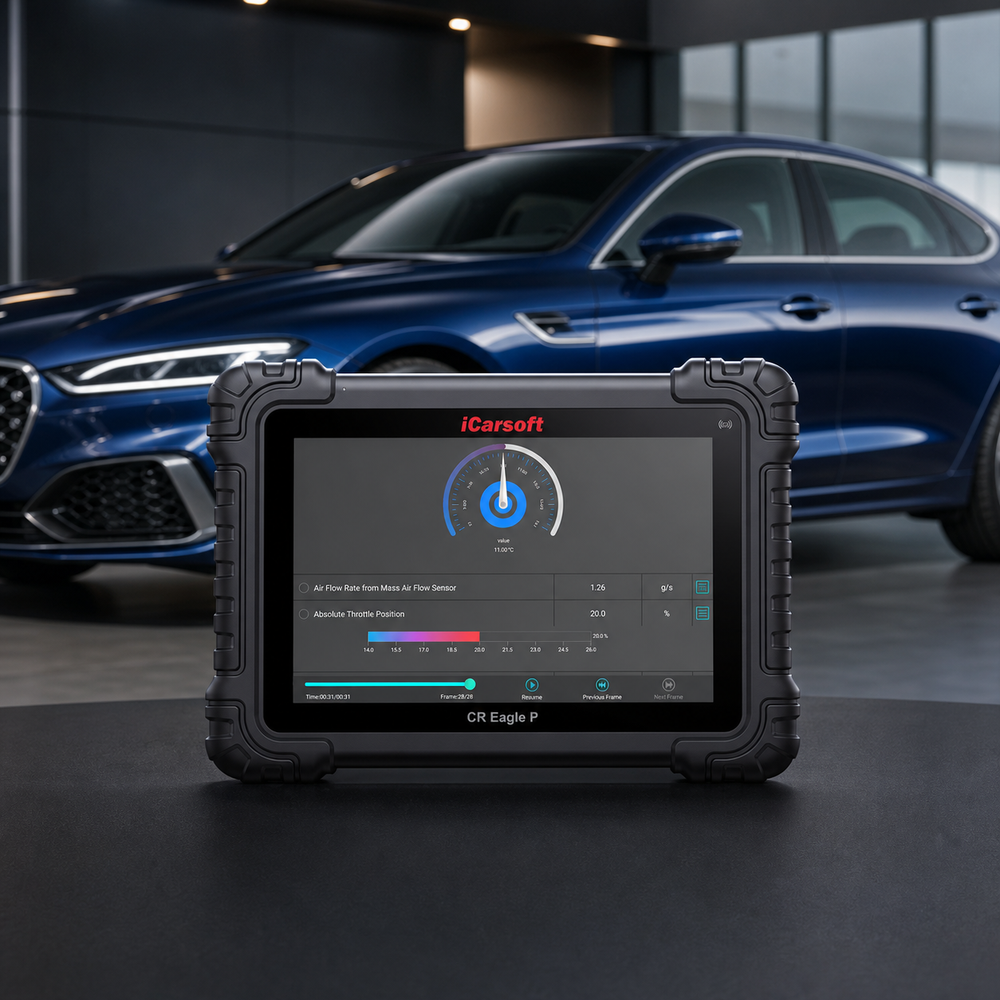
Recommended diagnostic platform for P07B7
iCarsoft CR Eagle P
Use full-system scanning, freeze frame and supported live-data graphing to compare Park request with the available position feedback. Supported active tests, adaptations and service functions vary by VIN, model year and control module.
Check current price & availability · lifetime Wi-Fi updates
View CR Eagle P Check compatibility by VINTool boundary: CR Eagle P does not replace the OEM wiring diagram, connector view or test limit, and it does not physically measure resistance, frequency or loaded voltage. Use a DVOM, oscilloscope and mechanical inspection where the service procedure requires them. A supported active test also does not prove that the parking mechanism is safe.
9How Much Does P07B7 Cost to Fix?
These 2026 US planning ranges include parts and labor but are not quotes. The actual total depends on the VIN, transmission design, sensor service level, diagnostic time, local labor, programming, fluid, taxes and related damage. The ranges are alternative outcomes; do not add them together.
| Confirmed repair path | Typical US planning range |
|---|---|
| Professional diagnosis and data capture | $120–$250 |
| Connector, pigtail or local harness repair | $150–$700 |
| Shift-linkage adjustment or cable replacement | $100–$600 |
| External Park-position sensor or switch replacement | $350–$700 |
| Transmission control module replacement and programming | $900–$1,600 |
| Integrated Park sensor or valve-body assembly | $800–$2,500 |
P07B7 alone does not authorize a sensor, valve-body or controller replacement. Ask the repairer what signal failed, whether the circuit was loaded or scoped, and whether adjustment, setup or software is required after the physical repair.
10How to Confirm the Repair
- Verify stable battery and charging voltage, clean connectors and strain-free harness routing before reassembly.
- Complete the exact sensor, selector, actuator or transmission initialization specified for the vehicle.
- Graph Park request, actual position, channel A and any paired signal through repeated, safe selector and key cycles.
- Reproduce the original heat, moisture or vibration conditions when practical without compromising vehicle restraint.
- Run the OEM monitor or road-test procedure, then rescan all modules for current, pending and history faults.
- Confirm both the electronic indication and the mechanical Park-hold check using the manufacturer procedure.
A successful repair is evidence-based: the intermittent dropout no longer appears, related data agrees, the monitor completes and Park operation is verified. A cleared dashboard light by itself is not proof.
11Related Transmission Position Codes
Companion codes can show whether the problem involves general range information, another sensor channel or a broader selector circuit. Open the page only when that exact code is present.
12P07B7 FAQ
What does code P07B7 mean?
P07B7 means Transmission Park Position Sensor/Switch "A" Circuit Intermittent/Erratic. The controller detected unstable, interrupted or invalid Park-position feedback from the OEM-defined A channel under its monitor conditions.
Does P07B7 prove the Park-position sensor is bad?
No. Wiring, terminals, power, ground, alignment, linkage, an actuator, integrated electronics, software or the controller input can produce the same result. The sensor may not even be a separately serviceable part.
Can I drive with P07B7?
Do not drive if Park cannot be verified, the range display is wrong, selector operation is restricted or the vehicle moves unexpectedly. Secure it with the parking brake and wheel chocks and use a flatbed tow when required.
What is the difference between P07B7 and P0705?
P07B7 specifically describes intermittent or erratic feedback from the Park-position A channel. P0705 is a broader transmission-range-sensor circuit code. Their components and diagnostic paths may overlap but are not interchangeable.
What scan data should I inspect for P07B7?
Depending on vehicle support, compare selector request, PRNDL or range, Park actual, sensor A and B, actuator command and status, start enable and module voltage. Use the VIN-specific data definitions and test conditions.
Can CR Eagle P fix P07B7 by itself?
No scan tool can repair a wire, sensor or mechanism. On supported vehicles CR Eagle P can help save codes and freeze frame, graph available data and run supported tests or setup functions, but physical and electrical testing is still required.
How do I know P07B7 is permanently fixed?
Complete the OEM repair and any required initialization, reproduce the original conditions, verify stable channel-A feedback through repeated Park cycles, run the monitor and confirm that current and pending faults do not return.
Technical and cost references
- Definition: BMW official SAE P-code list and SAE J2012 diagnostic trouble code standard.
- OEM monitor example: Ford 2024 OBD Operation Summary, including the TR9070 parking-lock input A frequency monitor.
- Architecture and software caution: FCA park-pawl position sensor service bulletin, an application-specific example rather than a universal P07B7 repair.
- Product capabilities: official iCarsoft CR Eagle P product page. Coverage, data, tests and service functions vary by VIN and ECU.
- US cost anchors: RepairPal national estimates for electrical diagnosis, shift-cable replacement, transmission-position sensor replacement and TCM replacement; integrated-assembly totals vary widely by application.
Editorial note: This guide provides general diagnostic education, not a substitute for the service manual, safety instructions or a hands-on inspection of the exact vehicle. Specifications, component locations, service levels and scan-tool coverage vary. Prices are illustrative US planning ranges and are not quotations.


