

 By iCarsoft Official Store Technical Team, Automotive Diagnostics Editors · Updated August 31, 2026 · OEM technical references checked
Quick Answer
The P0942 code identifies a Hydraulic Pressure Unit concern, with the detailed failure meaning determined by the vehicle and fault suffix. Do not assume it always means an automatic-transmission pump. Save the reporting module and complete description, identify the actual hydraulic system, and investigate its fluid, leakage, electrical supply, pressure generation and feedback using the VIN-specific diagnostic procedure.
What Does the P0942 Code Mean?
P0942 names a hydraulic pressure-unit fault category. The short generic label is not a complete diagnosis and cannot specify one component, fluid, or pressure threshold for every vehicle. Read the full description and suffix from the module that stored it, then locate that system in the service information.
A hydraulic unit may combine a pump, reservoir, accumulator, valves, sensors, control electronics, and connecting passages. Which of these is present depends on the application. A failure to develop or retain expected pressure can arise from leakage, fluid supply, electrical control, feedback, or mechanical problems. A code does not separate those possibilities by itself.
Toyota T-SB-0031-18, dated May 10, 2018, addresses specified 2001–2005 MR2 Spyder vehicles with sequential manual transmission. Its symptoms can include a transmission warning, buzzing, or inability to change shift state with P0942 among the listed codes. The bulletin's repair branch requires the stated conditions and relevant fluid leakage; it is not a universal pump-replacement instruction.
Jaguar Land Rover bulletin LTB00909NAS1, dated April 25, 2016, describes P0942-7A in the all-wheel-drive control module on specified Active Driveline applications. It links that failure branch to hydraulic fluid leaking internally into the power transfer unit. This separate example shows why an automatic-transmission-only diagnosis can target the wrong system.
Pressure-unit faults versus pressure-sensor and supply codes
| Code | General description | Key distinction |
|---|---|---|
| P0942 | Hydraulic pressure unit | Identify the system, reporting module, and complete failure subtype. |
| P0934 | Hydraulic pressure sensor circuit low | An electrical signal classification, not direct proof of low mechanical pressure. |
| P0935 | Hydraulic pressure sensor circuit high | A different sensor-circuit branch requiring its own tests. |
| P0868 | Transmission fluid pressure low | A transmission-pressure definition that is not interchangeable with every P0942 application. |
The module name changes the investigation. A hydraulic concern stored by an all-wheel-drive controller should not automatically trigger automatic-transmission fluid service. Record the module, full suffix, fluid system and actual warning before ordering parts or opening any reservoir.
P0942 Symptoms and Likely Causes
The symptoms of a P0942 code depend on the affected system. Gear-selection problems suggest a different operating concern from an active-driveline warning. Noise, leakage and pump behavior can help locate the issue, but they should be interpreted alongside the manufacturer's expected operating sequence and pressure information.
On applicable transmission systems, hydraulic-control failure may interfere with selecting or maintaining the intended shift state.
An affected all-wheel-drive system may restrict its function and display a warning even when normal gear selection remains available.
Frequent, prolonged or abnormal operation requires comparison with the OEM sequence; sound alone cannot prove a failed pump.
Leaks may be visible externally or occur between internal compartments. Identify the fluid and system rather than simply topping up the nearest reservoir.
Practical cause-checking order
- Fluid supply or leakage: inspect the correct reservoir, hoses, seals and connected units using the prescribed pressure state and level-check method.
- Electrical supply or motor-control problem: test the relevant fuses, relay path, connectors, grounds and commanded operation before condemning the hydraulic unit.
- Pressure-generation or retention fault: evaluate the pump, accumulator and internal leakage only where those components exist and the diagnostic evidence supports testing them.
- Control valve or pressure-feedback problem: compare the command with measured pressure and sensor plausibility rather than treating every low reading as a failed pump.
- Contamination, incorrect fluid or installation error: check service history, part application, bleeding and required initialization before considering major assembly replacement.
After hydraulic or driveline service: confirm which fluid was used, whether the correct level procedure was followed, and whether bleeding or setup was required. Do not mix hydraulic fluid with gearbox oil based on color or reservoir appearance. Repeatedly topping up a leaking system can hide evidence and does not correct the cause.
How Serious Is P0942, and Can You Drive?
Arrange prompt professional diagnosis. A fault involving gear selection or loss of drive can make continued operation unsafe. An active-driveline warning may have a different permitted response, so use the owner's manual and exact displayed instruction rather than assuming that every P0942 vehicle can be driven in the same way.
Stop and arrange a tow for loss of drive, unpredictable engagement, inability to select or hold the required gear, major fluid leakage, overheating, smoke, serious mechanical noise, or an urgent stop instruction. Secure the vehicle against movement and arrange transport appropriate to its drivetrain. Follow the owner's manual for recovery; do not assume flat towing is permitted.
Hydraulic accumulators can retain hazardous pressure after the ignition is switched off. Never loosen a line, remove a pressure sensor, or open a unit merely because the engine has stopped. Use the manufacturer's depressurization and verification procedure, appropriate protective equipment, and trained assistance. Some systems can activate unexpectedly during wake-up or door-opening events.
How to Diagnose P0942 in the Right Order
-
Record the complete code and identify the reporting module
Save P0942, its suffix, exact description, fault status and freeze frame where available. Scan all accessible modules for supply, pressure-sensor, gear-selection and communication faults. Record the dashboard message and actual symptoms. Confirm whether the concern belongs to transmission hydraulics, active driveline control, or another OEM-defined system.
-
Map the hydraulic unit and establish safe test conditions
Use the VIN-specific hydraulic and electrical diagrams to identify the reservoir, pump, valves, feedback, accumulator and controlled mechanism. Read the pressure-release and unexpected-activation precautions before physical work. Confirm the correct fluid and diagnostic procedure rather than using a generic automatic-transmission pressure test on an unrelated driveline unit.
-
Check fluid condition and leakage using the specified procedure
Inspect the identified system for external leakage, disturbed fittings, damaged lines and recent service errors. Check level only at the required temperature, pressure state and operating condition. Investigate internal fluid migration if the OEM procedure calls for it. Do not add fluid repeatedly, mix specifications, or infer a full reservoir from a different compartment.
-
Prove electrical supply and the control request
Check the pump or actuator supply, ground, relay path, connector retention and control circuits under the specified load. Compare the requested operation with the actual response. A motor sound does not establish pressure, and absent sound does not establish internal pump failure. Follow the correct circuit tests before applying external power or substituting components.
-
Separate pressure generation, retention and feedback
Use supported data and the prescribed independent pressure measurement to evaluate the system's response. Determine whether pressure fails to build, falls unexpectedly, or is reported incorrectly. Check the relevant valve, accumulator or leakage branch as directed. Avoid repeated forced pump cycles, improvised gauges, or opening pressurized fittings to assess flow.
-
Repair the proven cause and complete required setup
Correct the demonstrated leak, wiring, control, feedback or hydraulic-unit failure. Follow fluid cleanliness, sealing, filling, bleeding and initialization requirements for that application. Major assembly replacement should follow evidence rather than the short code label. Validate pressure behavior and the controlled function under the original safe conditions before returning the vehicle to service.
Specifications are vehicle-specific. Pressure thresholds, pump run times, fluid specifications, accumulator procedures and level-check conditions differ by system. Do not apply the Toyota SMT or Land Rover Active Driveline example to an unrelated vehicle. Electrical sensor readings must be distinguished from independently measured hydraulic pressure, using equipment rated for the actual system.
P0942 Repairs and Typical Costs
A successful P0942 fix restores the affected hydraulic system's intended operation and pressure behavior. That may require correcting a leak or electrical fault, repairing a proven valve or feedback problem, or replacing a confirmed failed assembly. The correct repair is determined by the module-specific test results, not by a generic parts list.
If a leak is confirmed, identify its source and any affected neighboring fluid compartments. Follow the manufacturer's contamination and cleanup requirements rather than replacing only the visibly empty reservoir. After a pump or unit is replaced, verify the reason it failed and complete the prescribed bleeding and setup so the original problem is not left in place.
| Possible path | Current US estimate |
|---|---|
| Module identification and hydraulic/electrical diagnosis | VIN-specific quote |
| Proven leak, seal, connector or harness repair | VIN-specific quote |
| Confirmed valve, sensor, pump or accumulator work | VIN-specific quote |
| Required assembly replacement, fluid service and setup | VIN-specific quote |
Request an estimate naming the affected system and failed test, with parts, labor, fluid, bleeding, setup and taxes separated. These are alternative repairs; P0942 alone does not justify a transmission rebuild.
Using iCarsoft CR Eagle P for P0942
On a supported vehicle, iCarsoft CR Eagle P can read accessible module faults, preserve available freeze frame, display live data and save reports. For P0942, accessing the actual transmission or all-wheel-drive controller and its supported hydraulic parameters is more useful than reading only a generic engine-code description.
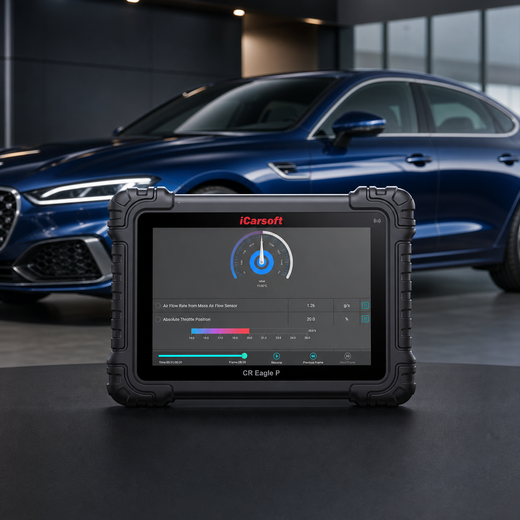
Identify the hydraulic system before choosing a repair
iCarsoft CR Eagle P
Review the full module fault, suffix and supported pressure or pump-status data. Confirm coverage for the exact VIN, controller and required routine before purchase.
Check current CR Eagle P price and availabilityCheck CR Eagle P compatibility by VINThe official page lists bidirectional functions, but pump activation, bleeding, calibration and initialization are vehicle-specific. Availability of one active test does not prove that every service operation is covered. Follow the manufacturer's safety and fluid prerequisites; do not repeatedly command a pump to compensate for a leak or inadequate fluid supply.
Know the measurement boundary. The tablet cannot physically locate an internal leak, verify accumulator safety, measure pressure independently, or determine fluid contamination by itself. Use the specified hydraulic equipment, electrical tests and mechanical inspection. Displayed pressure and command values must be checked for plausibility before they are treated as proof of physical performance.
Verify the P0942 Repair
After repair, verify the required fill and bleed process, connector locks, line routing and absence of leaks. Save the measured pressure behavior and completed setup record. Clear erasable faults only after preserving the original evidence, then recheck all affected modules using the manufacturer's procedure.
Confirm that the controlled function behaves correctly: this may mean predictable gear selection on one application or restored driveline operation on another. Check pressure generation and retention, pump behavior, current and pending faults, and the original dashboard warning. A quiet pump or extinguished lamp alone is not a complete verification.
If the code returns, compare the full suffix, reporting module and operating conditions with the earlier record. Distinguish inadequate physical pressure from misleading feedback, and inspect whether fluid loss is external or internal where relevant. Repeated clearing and topping up should not replace a documented test of the remaining failure path.
A permanent P0942 can remain immediately after a successful repair. If the vehicle stores it as a permanent DTC, a scan tool or battery disconnect cannot erase it. Once current and pending faults are absent, the OBD system removes the permanent record only after the applicable monitor reruns and passes.
Related Hydraulic Pressure and Transmission Control Code Guides
P0942 Frequently Asked Questions
Does P0942 always mean an automatic-transmission problem?
No. Manufacturer examples include sequential-manual transmission hydraulics and an Active Driveline all-wheel-drive system. Record the reporting module and full fault suffix, then identify the hydraulic circuit for the VIN. Do not select fluid or parts from the short generic label alone.
What does P0942-7A mean on the Land Rover example?
The cited bulletin describes a fluid-leak or seal-failure branch in specified Active Driveline applications. It identifies internal hydraulic leakage involving the power transfer unit. This is a limited manufacturer example, not a diagnosis for every Land Rover or every P0942 fault.
Can low fluid cause a P0942 code?
An inadequate fluid supply or leakage may be relevant, but the correct system and checking procedure must be identified first. A low reservoir is evidence to investigate, not a reason to keep topping up. Electrical control, pressure feedback and internal faults may also need testing.
Does a buzzing pump need replacement?
Not necessarily. The unit may be responding to leakage, insufficient supply, control problems or pressure that is not retained. Compare the noise and operating sequence with the manufacturer's procedure, and measure the relevant response before condemning the pump.
Can I release hydraulic pressure by switching the engine off?
Do not assume so. An accumulator may retain pressure and the system may reactivate under certain conditions. Use the OEM pressure-release and verification procedure before opening the circuit. This is work for appropriately equipped and trained personnel.
Can CR Eagle P bleed the hydraulic system?
Only if that exact routine is supported for the VIN and controller, with all manufacturer prerequisites met. General bidirectional capability does not guarantee a specific bleed or initialization function. Confirm coverage and required external equipment before beginning service.
The iCarsoft Official Store Technical Team maintains the store's fault-code library. This guide organizes published manufacturer evidence and verified product information; it does not document a hands-on test of a particular vehicle or claim an individual engineer's review.
Technical and cost references
- Toyota T-SB-0031-18 — SMT Warning Light ON, Buzzing Noise, and/or Cannot Shift Specified 2001–2005 MR2 Spyder SMT symptom and leak prerequisites; not a universal repair.
- Jaguar Land Rover LTB00909NAS1 — Active Driveline Power Transfer Unit Internal Oil Leak Specified Active Driveline P0942-7A example demonstrates an all-wheel-drive hydraulic architecture; confirm current VIN-specific instructions.
- Snap-on Diagnostic Trouble Codes (DTC) List Generic hydraulic-unit and adjacent pressure-code definitions.
- California BAR — On-Board Diagnostic Test Reference Permanent-record and monitor-verification principles.
Product information: Official iCarsoft CR Eagle P page.
Editorial note: This educational guide supports diagnostic planning and does not replace the current service manual, safety instructions, or professional diagnosis for your VIN. Source information was checked August 31, 2026. Apply only the procedures and specifications for the exact vehicle; product functions depend on vehicle, ECU, software, and access requirements.


