

 By iCarsoft Official Store Technical Team, Automotive Diagnostics Editors · Updated August 31, 2026 · OEM technical references checked
Quick Answer
The P2320 code means Ignition Coil G Secondary Circuit; some manufacturer descriptions add a specific failure such as insufficient ionization. It is not a generic coil J primary-circuit-low code. Identify coil G using the engine's own mapping, save misfire and freeze-frame evidence, and inspect the connector and complete spark-delivery path. Confirm electrical supply and the failed component before replacing the coil.
What Does the P2320 Code Mean?
P2320 concerns the monitored secondary side of ignition coil G. The secondary circuit delivers the high voltage needed for spark, but the controller may evaluate that event through a manufacturer-specific monitoring strategy. The code records an unsatisfactory monitored result; it does not independently prove that the coil assembly itself is defective.
Identify the correct component before testing. Coil letters, cylinder numbers and physical positions should be mapped using the exact engine's service information. The seventh letter of the alphabet is not a substitute for an OEM component diagram, especially when the scanner displays translated or abbreviated fault text. Save the complete manufacturer description and any suffix.
FCA case S2118000002, released March 20, 2021, lists P2320 as ignition coil 7 secondary circuit with insufficient ionization. It describes possible rough running and instructs technicians to check the corresponding coil connector's seating and locking before continuing normal diagnosis if the fault returns. This is a limited manufacturer example, not a universal coil-numbering rule or warranty authorization.
A secondary-circuit concern should be distinguished from a primary control-circuit fault and from a general cylinder-misfire code. These can occur together, but each reports a different observation. An apparently secondary problem can still require supply and connector checks because the coil cannot deliver the intended spark without correct primary-side operation.
Secondary ignition evidence and related misfire codes
| Code | General description | Key distinction |
|---|---|---|
| P2320 | Ignition coil G secondary circuit | Inspect the correct coil and spark path using the OEM monitor description. |
| P0350 | Ignition coil primary/secondary circuit | A different code family; do not assume an identical diagnostic sequence. |
| P0307 | Cylinder 7 misfire detected | Identifies a misfiring cylinder, not the cause; relevant only after engine mapping is confirmed. |
| P0300 | Random or multiple-cylinder misfire detected | Investigate shared causes and the actual pattern rather than replacing every coil. |
Insufficient ionization is an observation, not a parts order. Where the manufacturer uses that wording, determine why the expected ignition evidence is missing. A poor connector, spark-delivery problem, or related operating fault needs to be separated from a proven internal coil failure.
P2320 Symptoms and Likely Causes
A P2320 code may accompany a steady check-engine light, rough idle, hesitation, or a misfire under load. The symptom can be intermittent as temperature or moisture changes. Record whether the MIL flashes and whether other cylinders are affected; this helps establish urgency and whether a shared cause needs investigation.
An affected cylinder may contribute unevenly, but rough running alone does not establish an ignition-coil failure.
A weak or interrupted spark may be more noticeable under load; do not deliberately stress an actively misfiring engine.
A flashing warning can indicate a damaging misfire condition and requires the owner's manual's immediate response.
Connector faults, insulation problems, or contamination may appear only after heat, rain, washing, or other specific conditions.
Practical cause-checking order
- Connector retention or terminal fault: inspect the correct coil plug for incomplete locking, damaged terminals, corrosion, and harness strain, especially after service.
- Plug, boot or spark-path problem: check wear, damage, contamination, carbon tracking, incorrect parts and application-specific installation requirements.
- Coil supply or control issue: verify the required electrical inputs and grounds using the correct diagram before blaming the secondary winding.
- Internal coil or insulation failure: consider replacement when the prescribed test establishes a component fault under the relevant operating conditions.
- Other combustion or mechanical concern: if the ignition evidence passes but a misfire remains, follow the appropriate fuel, air and compression diagnostic branches.
After spark-plug, coil or engine work: confirm connector locks, boot seating, correct part numbers, harness routing and the engine's specified plug installation procedure. If oil or water is present in a plug well, identify and repair the source. Replacing a coil without correcting contamination can leave the same failure conditions behind.
How Serious Is P2320, and Can You Drive?
An isolated stored code with smooth operation still deserves prompt diagnosis. A short gentle trip may be reasonable only when the owner's manual allows it, the MIL is not flashing, and power delivery remains safe. Avoid heavy acceleration or sustained load while the cause is unknown.
An active misfire can damage the catalytic converter and make power delivery unsafe. Follow actual warnings; P2320 provides no safe mileage allowance.
Stop and arrange a tow for a flashing MIL, severe shaking, major loss of power, repeated stalling, fuel leakage or strong raw-fuel odor, smoke, overheating, or abnormal mechanical noise. Reduce load and stop safely according to the owner's manual. Arrange transport if the engine is misfiring heavily or cannot be operated predictably.
Ignition secondary voltage is hazardous. Do not hold a coil or plug lead while the engine runs, pull a coil to watch for arcing, or connect an ordinary multimeter directly to secondary high voltage. Switch off and follow the required isolation procedure for inspection. Use only the specified rated probes or spark-test equipment with trained assistance.
How to Diagnose P2320 in the Right Order
-
Save ignition and misfire evidence before clearing
Record P2320 status, suffix, exact description, freeze frame, and companion ignition, voltage, fuel or misfire faults. Save supported cylinder misfire counts and operating conditions such as load, temperature and engine speed. Note flashing-MIL events and recent plug or coil work. Do not erase the evidence before establishing the affected component.
-
Map coil G to the actual engine hardware
Use the VIN, engine identification, wiring diagram and cylinder layout to locate the correct coil and associated spark path. Confirm whether the manufacturer's wording maps it to a numbered coil, as in the cited FCA example. Check the installed parts and scan-tool vehicle selection before testing a coil based only on its apparent position.
-
Inspect connector retention and the spark-delivery path
With the engine safely isolated and cooled, inspect the identified connector lock, terminal condition, harness strain, boot, and accessible plug well. Look for oil, water, carbon tracking, cracking, or poor seating. Follow the specified removal method; do not pull on wires or disturb unrelated coils while recording the original condition.
-
Prove the required electrical inputs and control
Test supply, ground where used, and primary control using the OEM procedure and appropriate equipment. A secondary code does not exclude an upstream connection problem. Use approved probing methods and protect controller outputs. Do not apply battery voltage to an unidentified terminal or conclude that a winding is healthy from one generic resistance reading.
-
Evaluate spark performance and the misfire pattern safely
Use the prescribed rated ignition test equipment or waveform procedure to evaluate the suspected path. Compare supported misfire information with the physical evidence and operating conditions. A component swap should be performed only if the OEM procedure permits it and the parts are interchangeable; move one variable at a time and document the result.
-
Repair the demonstrated cause and check remaining combustion faults
Correct the proven connector, harness, contamination, plug, boot or coil problem using the exact application requirements. If ignition tests pass but misfire persists, investigate fuel delivery, air leakage or compression as directed. Do not replace all coils or authorize major engine work solely from P2320. Complete the original-condition verification after repair.
Specifications are vehicle-specific. Plug type, gap, tightening procedure, coil control, waveform interpretation and test loads depend on the engine. There is no single resistance or spark-gap test that proves every modern coil. Do not copy another model's scope voltage, thread lubricant, or installation rule; use the current procedure for the actual components.
P2320 Repairs and Typical Costs
A successful P2320 fix restores reliable ignition in the identified circuit and resolves any related misfire. The repair may be as limited as correcting a connector or may require a proven plug, boot, coil or wiring replacement. Use the failed test to choose the repair rather than treating the code as automatic authorization for a coil set.
If contamination or poor seating contributed, repair that cause as well as the damaged part. Confirm component application and service requirements before installation. When a new coil has not solved the fault, return to the saved evidence and test the remaining circuit and combustion conditions instead of fitting another unverified replacement.
| Possible path | Current US estimate |
|---|---|
| Scan review and ignition/misfire diagnosis | VIN-specific quote |
| Connector, wiring, boot or contamination-source repair | VIN-specific quote |
| Proven plug or coil replacement and installation | VIN-specific quote |
| Separately confirmed fuel or mechanical diagnosis | VIN-specific quote |
Request an estimate separating diagnosis, parts, labor, leak repair, taxes and verification. Access varies by engine. These are alternative outcomes, not a requirement to replace every component. Check coverage by VIN and failed part.
Using iCarsoft CR Eagle P for P2320
On a supported vehicle, iCarsoft CR Eagle P can read accessible module faults, preserve available freeze frame, display live data and save diagnostic reports. For P2320, supported cylinder misfire information and operating data can help document when the concern occurs and whether it remains after repair.
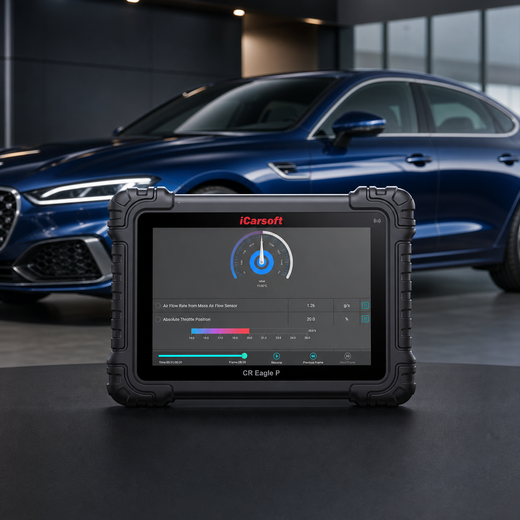
Preserve the ignition evidence before replacing parts
iCarsoft CR Eagle P
Review the full coil fault and supported misfire data alongside load and temperature. Confirm the exact VIN, ECU and required diagnostic functions before purchase.
Check current CR Eagle P price and availabilityCheck CR Eagle P compatibility by VINThe official page lists bidirectional capabilities, but cylinder contribution or other ignition-related tests depend on vehicle coverage and ECU support. Follow the manufacturer's safety prerequisites for any available routine. Do not deliberately disable coils on a running engine or prolong a damaging misfire merely to demonstrate a scan-tool function.
Know the measurement boundary. The tablet cannot directly measure secondary ignition voltage, inspect plug insulation, prove a coil's physical spark energy, or establish compression without additional equipment. A misfire counter reports the controller's observation and does not identify the failed part by itself. Use the specified ignition, circuit and mechanical tests.
Verify the P2320 Repair
After repair, confirm connector locking, boot seating, harness routing and the absence of the contamination or leakage that caused the fault. Save the repair measurements and a post-repair scan. Clear erasable faults only after preserving the initial evidence and following the vehicle manufacturer's procedure.
Recheck the engine under safe conditions relevant to the original event, including the applicable temperature and load without provoking severe misfire. Review current and pending codes, supported misfire counts, smooth operation and warning status. A brief cold idle is not enough if the failure occurred only when warm or under load.
If P2320 returns, compare the affected circuit, fault status and operating conditions with the earlier record. Separate a persistent spark-path problem from a misfire with valid ignition evidence. Verify any related fuel, mechanical or catalyst concerns independently rather than assuming that clearing the coil code has resolved every consequence.
A permanent P2320 can remain immediately after a successful repair. If the vehicle stores it as a permanent DTC, a scan tool or battery disconnect cannot erase it. Once current and pending faults are absent, the OBD system removes the permanent record only after the applicable monitor reruns and passes.
Related Ignition and Misfire Diagnosis Code Guides
P2320 Frequently Asked Questions
Does P2320 mean ignition coil J is low?
No. The generic definition is Ignition Coil G Secondary Circuit. The cited FCA example identifies coil 7 secondary insufficient ionization. Verify the exact manufacturer wording and mapping rather than using a mislabeled generic description to select a component.
Where is ignition coil G located?
Use the engine's component and cylinder-numbering diagrams. Coil G should not be assigned a universal driver-side, passenger-side or front-to-back position. Confirm the actual engine and scan-tool vehicle selection before disconnecting or replacing a coil.
Does the P2320 code prove that the coil is bad?
No. Connector seating, terminal condition, supply, spark plugs, boots, contamination and other operating faults can require investigation. The manufacturer example specifically calls for checking connector retention. Replace the coil only when the appropriate tests support that conclusion.
Can a spark plug cause a secondary-circuit concern?
A damaged, incorrect, worn or improperly installed plug can affect spark delivery, but it must be inspected using the engine's procedure. Do not assume every P2320 is a plug problem or apply a universal gap and tightening rule to all engines.
Can I drive with P2320?
A flashing MIL, severe shaking or unsafe power loss calls for stopping safely and arranging assessment. Follow the owner's manual. Even if the engine currently runs smoothly, arrange diagnosis promptly and avoid heavy load; the code provides no guaranteed safe distance.
Can CR Eagle P confirm a coil repair?
Supported code, freeze-frame and misfire data can help compare before-and-after behavior. Confirm exact vehicle coverage. Physical spark quality, high-voltage insulation, electrical load capacity and mechanical compression still require the appropriate external tests; a clear scan alone is not complete proof.
The iCarsoft Official Store Technical Team maintains the store's fault-code library. This guide organizes published manufacturer evidence and verified product information; it does not document a hands-on test of a particular vehicle or claim an individual engineer's review.
Technical and cost references
- FCA STAR S2118000002 — Secondary ignition circuit and misfire connector checks Manufacturer case lists P2320 as coil 7 secondary insufficient ionization and prioritizes connector seating; not universal coil mapping or warranty authorization.
- Snap-on Diagnostic Trouble Codes (DTC) List Official diagnostic-tool manufacturer reference cross-checks coil G secondary and related ignition/misfire definitions.
- California BAR — On-Board Diagnostic Test Reference Permanent-record and monitor-verification principles.
Product information: Official iCarsoft CR Eagle P page.
Editorial note: This educational guide supports diagnostic planning and does not replace the current service manual, safety instructions, or professional diagnosis for your VIN. Source information was checked August 31, 2026. Apply only the procedures and specifications for the exact vehicle; product functions depend on vehicle, ECU, software, and access requirements.


