

 By iCarsoft Official Store Technical Team, Automotive Diagnostics Editors · Updated August 31, 2026 · OEM technical references checked
Quick Answer
The P2413 code means the exhaust gas recirculation system did not meet the vehicle's performance-monitor requirements. It does not prove the EGR valve itself is defective. Save code status, freeze frame, and companion faults, then identify how the engine checks EGR operation. Test the relevant control, feedback, airflow, and gas passages before deciding on cleaning, wiring repair, or parts.
What Does the P2413 Code Mean?
Exhaust gas recirculation introduces a controlled amount of exhaust gas into the engine's intake under defined conditions. P2413 indicates that the system's observed performance did not satisfy its monitor. The method used to judge performance depends on the engine, emissions system, and calibration; it is not a universal valve-position or flow threshold.
Some systems assess EGR using airflow changes, pressure or temperature information, valve position, or learned values. Those are different observations. A valve-position signal may show movement without proving that the gas path is open. Similarly, an airflow discrepancy can reflect an intake leak or inaccurate supporting measurement rather than a failed EGR motor.
The Volkswagen Jetta SportWagen specification book from December 2012 associates P2413 with learning points at fuel-mass adaptation limits. The February 2014 Passat book labels a related monitor as EGR system/fuel mean-value adaptation. These OEM examples show why a generic definition must be followed by the exact vehicle's diagnostic criteria.
Identify the installed EGR arrangement before ordering parts. An engine may use a cooled circuit, multiple routes, electrically operated valves, or other architecture-specific controls. Do not assume that a fault guide for another diesel or gasoline engine provides the correct valve location, test method, or repair sequence for yours.
EGR performance, flow quantity, and circuit faults
| Code | General description | Key distinction |
|---|---|---|
| P2413 | Exhaust gas recirculation system performance | An overall performance-monitor result; use the applicable OEM interpretation. |
| P0401 | EGR flow insufficient detected | A flow-shortfall classification, not automatic proof of carbon blockage. |
| P0402 | EGR flow excessive detected | A different flow direction that must not be diagnosed as insufficient flow. |
| P0403 | EGR control circuit | Prioritize the specified electrical circuit when this companion fault is present. |
Command, position, and flow are different. Record what each PID actually represents. Commanded opening, reported valve position, and measured airflow are not interchangeable percentages, and a successful output test does not automatically validate the complete recirculation path.
P2413 Symptoms and Likely Causes
P2413 can appear with only a check-engine light, or with noticeable engine behavior if EGR control is seriously affected. Use symptoms to prioritize tests, not to select a part without evidence. Also record whether the concern began after intake, exhaust, sensor, or EGR service.
An emissions warning may be the first sign, without an immediate change in starting or normal driving.
Incorrect recirculation or associated engine faults may disturb combustion. Confirm whether the symptom matches the stored conditions.
Power response or fuel use may change, but these observations alone cannot separate EGR from airflow or fueling faults.
The warning may return only after warm-up, a defined load condition, or completion of a learning routine.
Practical cause-checking order
- Electrical and installation issues: inspect connectors, terminal fit, shared supplies, grounds, and harness routing, especially around recently serviced components.
- Supporting sensor or air-path faults: assess relevant airflow, pressure, temperature, intake leakage, and companion codes before assuming that the EGR valve caused the discrepancy.
- Restricted or leaking passages: deposits, damaged pipes, seals, or an architecture-specific cooler problem can affect flow even when the valve moves.
- Valve or actuator performance: sticking, mechanical damage, incorrect replacement parts, or feedback faults require confirmation through the specified tests.
- Learning, calibration, or controller issues: verify completed setup and relevant service information after the physical and electrical checks support that branch.
After replacing or cleaning EGR parts: check seals, pipe alignment, connector locks, sensor connections, and required adaptation. An incorrectly installed gasket or an uncompleted setup procedure can undermine a new assembly. Cleaning one visible passage does not establish that the full gas path is clear.
How Serious Is P2413, and Can You Drive?
Schedule diagnosis promptly. A short light-load trip may be reasonable when the MIL is steady, operation remains stable, and the owner's manual permits continued driving. Avoid demanding loads until the cause is established. The P2413 code does not guarantee a safe distance or predict how long a vehicle will continue to run normally.
Treat the actual engine behavior separately from the code label. A mild emissions warning and repeated stalling are different situations. Do not attempt to drive through severe rough running or power loss just because another owner reported an EGR fault without symptoms. Follow any specific warning shown by the vehicle.
Stop and arrange a tow if the engine stalls repeatedly, loses power unsafely, misfires severely, shows a flashing MIL or overheating warning, leaks fuel or coolant, or develops smoke or abnormal mechanical noise. Pull over safely and follow the owner's manual. Use professional recovery when continued operation is uncertain.
EGR pipes, exhaust parts, and coolers can stay hot after shutdown. A cooled EGR assembly may also contain pressurized coolant. Allow cooling and follow pressure-release procedures before work. Never reach into an electrically commanded valve, spray chemicals into a running intake, or bypass emissions equipment to remove the warning.
How to Diagnose P2413 in the Right Order
-
Save the EGR event and companion-code order
Scan accessible modules before clearing. Record P2413 status, freeze frame, manufacturer suffixes, engine temperature, load, and related airflow, pressure, actuator, or supply faults. Note recent service and when the warning returns. Save the original report so an induced test code is not later mistaken for the initial failure.
-
Identify how this engine monitors EGR performance
Use the VIN, engine code, and calibration to obtain the EGR diagram and monitor description. Establish which valve, cooler, passages, and sensors are involved. Identify supported commands, feedback signals, learning conditions, and current bulletins. Do not assume another engine's position percentage or airflow target applies to this architecture.
-
Inspect the connections and accessible gas path
With the engine cool and safely secured, inspect plugs, harness clips, pipes, seals, vacuum hoses if fitted, and intake connections. Look for heat damage, loose terminals, carbon traces around leaks, recent installation errors, or coolant loss. Do not force a motorized valve or dismantle an integrated assembly without the proper procedure.
-
Prove electrical and physical supporting paths
Test actuator supplies, grounds, control, and feedback circuits according to the diagram. Use appropriate voltage-drop or signal measurements. Check vacuum, pressure, leakage, or passage condition where the OEM diagnostic branch requires it. A clean connector or simple continuity result is insufficient to establish operation under load or correct exhaust-gas flow.
-
Compare EGR command, feedback, and engine response
When supported, log commanded EGR, reported position, relevant airflow or pressure, and temperature during the prescribed test. Evaluate whether the expected response occurs under valid enable conditions. If position changes without the required airflow response, investigate the path and supporting measurements. Do not repeatedly cycle the valve to try to break deposits free.
-
Confirm the repair and complete required adaptation
Repair the demonstrated wiring, leakage, restriction, sensor, or actuator fault. Use approved cleaning only for serviceable parts and replace assemblies when evidence supports it. Confirm gaskets, part application, and required adaptation or learning. Consider controller involvement after external checks pass, then repeat the monitor-based verification rather than merely clearing the warning.
Specifications are vehicle-specific. EGR position scales, airflow changes, vacuum levels, pressures, temperatures, and learning criteria differ by engine. Some displayed values are targets rather than measurements. Use the actual OEM diagnostic state and units; do not borrow a universal opening percentage or declare a valve bad because its PID differs from another vehicle.
P2413 Repairs and Typical Costs
A P2413 fix may involve a connector repair, correction of an air or exhaust leak, an approved passage cleaning, a proven supporting-sensor repair, or EGR assembly replacement. The failed test should determine which path is necessary. Replacing the valve without confirming flow and supporting measurements can leave the original fault unchanged.
If deposits are found, establish whether cleaning is permitted and whether another condition contributes to the contamination. Do not drill passages, alter stops, remove EGR components, or use an emulator. Follow the required procedure for fragile electronics, cooler access, seals, and any single-use parts.
| Possible path | Current US estimate |
|---|---|
| System diagnosis, data comparison, and circuit testing | VIN-specific quote |
| Confirmed connector, wiring, hose, or seal repair | VIN-specific quote |
| Approved cleaning or proven EGR valve/cooler replacement | VIN-specific quote |
| Supporting sensor repair, adaptation, or applicable software work | VIN-specific quote |
There is no single national price for repairing P2413 because a performance fault can lead to several different services. Ask for an itemized quote tied to the diagnosed defect, including labor, parts, coolant if disturbed, setup, and verification. Taxes, location, access, and additional faults affect the total; the table rows are alternatives.
Using iCarsoft CR Eagle P for P2413
On a supported vehicle, iCarsoft CR Eagle P can capture accessible fault codes, available freeze frame, live data, and diagnostic reports. For P2413, preserve the engine's EGR-related evidence and companion codes before component testing, then compare the same supported data after repair.
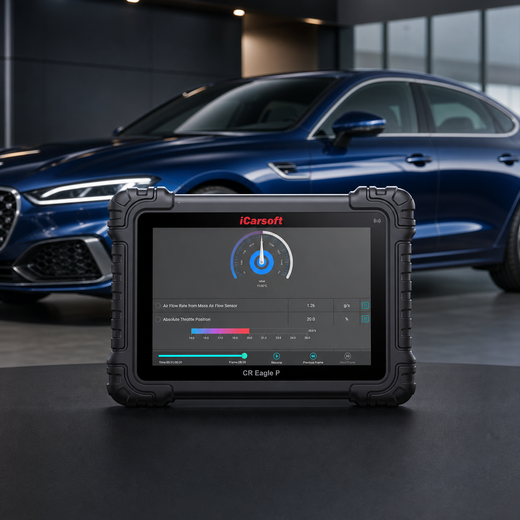
Compare the request with the system response
iCarsoft CR Eagle P
Review supported EGR, airflow, pressure, and temperature information. Confirm your VIN, engine ECU, available PIDs, and any required active test or adaptation before purchase.
Check current CR Eagle P price and availabilityCheck CR Eagle P compatibility by VINThe official product page describes bidirectional control, including EGR-related functions, but exact tests vary with the vehicle and software. An available command can help observe a response; it does not guarantee effective cleaning or confirm unrestricted gas flow. Use the manufacturer's test conditions and stop when abnormal operation occurs.
Know the measurement boundary. The scanner does not directly measure actual exhaust flow, terminal voltage drop, vacuum, pressure, leakage, deposit thickness, or internal cooler condition. Suitable external instruments and physical inspection remain necessary. ECU-reported position and calculated flow are evidence to interpret, not substitutes for the physical tests specified by the manufacturer.
Verify the P2413 Repair
After repair, inspect the finished electrical connections, gas-path seals, hose routing, and any disturbed cooling connections. Complete required adaptation or learning. Preserve repair measurements and a post-repair report, then clear erasable DTCs only through the approved procedure after the original records are saved.
Run the actual EGR monitor conditions or safely reproduce the relevant freeze-frame state. Recheck current and pending faults, command-versus-feedback behavior, and supporting airflow or pressure response. A smooth idle cannot prove success if the performance test depends on another load, temperature, or learning condition.
If P2413 returns, compare the conditions and companion codes before choosing another part. Verify that the monitor was enabled and required learning completed. Treat inspection readiness as a separate status check; a repaired component, a cleared warning, and a completed emissions monitor are not identical results.
A permanent P2413 can remain immediately after a successful repair. If the vehicle stores it as a permanent DTC, a scan tool or battery disconnect cannot erase it. Once current and pending faults are absent, the OBD system removes the permanent record only after the applicable monitor reruns and passes.
Related EGR and Airflow Code Guides
P2413 Frequently Asked Questions
Does the P2413 code prove the EGR valve is bad?
No. It reports EGR system performance. Wiring, control, supporting sensor accuracy, gas-path restriction or leakage, installation, and learning may need investigation. A replacement valve is justified only when the applicable tests or OEM procedure support that repair.
How is P2413 different from P0401?
P0401 specifically classifies EGR flow as insufficient. P2413 is a broader EGR system performance result with manufacturer-specific monitoring details. Use the correct diagnostic sequence rather than assuming both codes mean a carbon-blocked valve.
Can I drive with P2413?
A short light-load trip may be reasonable if operation is stable and the owner's manual allows it. Stop for severe rough running, repeated stalling, unsafe power loss, overheating, or a flashing MIL. The code alone cannot establish a safe distance.
Will cleaning the valve always fix P2413?
No. Cleaning cannot repair an electrical defect, inaccurate supporting sensor, damaged cooler, or incorrect setup. Only clean parts that the manufacturer permits to be serviced, after confirming a restriction. Never force the mechanism or bypass the EGR system.
What should a P2413 repair quote cover?
It should identify the failed test and include diagnosis, the confirmed parts or cleaning procedure, labor, any coolant or seals, adaptation, taxes, and verification. A generic valve price cannot represent every EGR system performance fault.
Can CR Eagle P compare EGR command and actual data?
It can display supported ECU data and may offer applicable active tests, depending on the VIN and software. Confirm coverage first. Position feedback does not physically prove gas flow, and electrical, pressure, vacuum, or leakage checks may still be needed.
The iCarsoft Official Store Technical Team maintains the store's fault-code library. This guide organizes published manufacturer evidence and verified product information; it does not document a hands-on test of a particular vehicle or claim an individual engineer's review.
Technical and cost references
- Volkswagen Jetta SportWagen Quick Reference Specification Book — P2413 DTC chart Application-specific EGR performance and adaptation monitoring example; no numerical limits transferred.
- Volkswagen Passat Quick Reference Specification Book — EGR system/fuel mean-value adaptation Shows manufacturer-specific P2413 monitor wording.
- Ford 2015 MY OBD System Operation Summary for Diesel Engines — EGR monitors Examples of EGR rate, cooler, response, and supporting sensor monitoring; not a universal test procedure.
- California BAR — On-Board Diagnostic Test Reference Permanent DTC principles and readiness distinctions.
Product information: Official iCarsoft CR Eagle P page.
Editorial note: This educational guide supports diagnostic planning and does not replace the current service manual, safety instructions, or professional diagnosis for your VIN. Source information was checked August 31, 2026. Apply only the procedures and specifications for the exact vehicle; product functions depend on vehicle, ECU, software, and access requirements.


