

 By iCarsoft Official Store Technical Team, Automotive Diagnostics Editors · Updated August 31, 2026 · OEM technical references checked
Quick Answer
The P2637 code identifies a problem with torque-management feedback signal A. It does not prove the transmission, a torque sensor, or a control module has failed. Save engine and transmission fault records together, then check the VIN-specific communication path, power supplies, companion engine faults, and applicable calibration information before deciding which component needs repair.
What Does the P2637 Code Mean?
P2637 describes a monitored torque-management feedback problem. During a shift or another torque-limiting event, the transmission controller may request a change in engine output. The engine controller's response helps coordinate that event. The exact message, circuit arrangement, receiving module, and conditions used to judge the response depend on the powertrain.
The letter A is an identifier in the fault description, not a universal connector pin or a replaceable sensor location. A vehicle can exchange torque information through its communication network rather than a separate analog feedback wire. Start with the diagram and the complete scan-tool description, including any manufacturer suffix.
A request, an acknowledgment, and calculated engine torque are different pieces of evidence. A module may remain accessible to the scanner while the expected torque response is unacceptable. Conversely, a supply interruption or network fault can prevent valid feedback from arriving. P2637 therefore needs both engine-side and transmission-side diagnosis.
An application-specific example appears in Allison TT8819EN, dated February 8, 2021. Certain Cummins EPA17 L9/X15 engines paired with Allison 3000/4000 transmissions required an engine calibration correction for P2637, without Allison hardware or TCM software changes. That narrow example is not a repair instruction or coverage claim for another vehicle.
Separate torque feedback from other controller faults
| Code | General description | Key distinction |
|---|---|---|
| P2637 | Torque management feedback signal A | Evaluate the defined feedback path and the actual response to torque requests. |
| P2638 | Torque management feedback signal A range/performance | A related but distinct monitor; use its own OEM test sequence. |
| P061B | Internal control module torque calculation performance | Focuses on torque calculation, not automatically a failed transmission. |
| U0101 | Lost communication with transmission control module | Communication loss requires its own module-power and network checks. |
Read the reporting module. Record whether the ECM, PCM, or TCM stored P2637, including the manufacturer suffix. A generic code lookup cannot select the replacement part.
P2637 Symptoms and Likely Causes
P2637 symptoms vary with the vehicle's fallback strategy and whether the fault is active. The warning may be the only obvious sign, or it may accompany an uncomfortable shift. Record when the concern appears rather than assuming every listed symptom must be present.
A check-engine or transmission warning can appear even when the vehicle initially seems to drive normally.
A shift may feel harsh, early, delayed, or inconsistent when torque coordination is disrupted; confirm that it matches the recorded event.
Some applications limit power or transmission operation. The code alone does not predict a particular gear or fixed speed limit.
The concern may follow temperature, load, a battery event, or a recent repair. Save the conditions while the evidence is available.
Practical cause-checking order
- Related engine faults: investigate faults that prevent the engine from delivering a valid torque response, using the manufacturer's priority order.
- Unstable supplies or grounds: a controller may reset or misreport when a shared feed, ground connection, or charging-system problem affects its operation.
- Connections and communication paths: inspect water intrusion, damaged terminals, harness abrasion, poor prior repairs, and any disturbed network wiring.
- Configuration or calibration: incorrect replacement-module setup or an applicable OEM software issue can produce a coordination problem with intact hardware.
- Internal controller or mechanical faults: pursue these only when the external tests and supporting engine/transmission evidence point to that branch.
Did P2637 follow other work? Record recent battery replacement, jump starting, engine or transmission repairs, software changes, and aftermarket tuning. Restore the correct installation and approved configuration before interpreting new test results. Do not assume that unplugging the battery resolves a compatibility or calibration problem.
How Serious Is P2637, and Can You Drive?
Arrange diagnosis promptly. If the warning is steady, shifting remains predictable, and the owner's manual allows continued operation, a short light-load trip to a repair facility may be reasonable. Avoid towing, hard acceleration, and demanding traffic until the behavior is understood. No code reader can establish a universally safe driving distance.
A transmission warning with normal operation still deserves attention because a torque-coordination fault may become apparent only under particular shift conditions. Tell the repairer which gear change, temperature, road gradient, or load reproduced the complaint. Do not deliberately provoke a harsh shift merely to obtain another recording.
Stop and arrange a tow if the vehicle loses drive, selects gears unpredictably, stalls repeatedly, cannot accelerate safely, slips severely, overheats, or develops smoke, fluid loss, a flashing MIL, or abnormal mechanical noise. Follow the owner's manual and arrange suitable recovery instead of trying to drive through the fault.
Keep the vehicle secured during stationary diagnosis. Transmission engagement, rotating shafts, hot exhaust components, and automatic fans can injure bystanders. Never work beneath a vehicle supported only by a jack. Network probing and powered circuit tests require the correct service information and tools; avoid piercing insulation or bridging control-module terminals.
How to Diagnose P2637 in the Right Order
-
Save engine and transmission evidence together
Run a full scan of accessible modules before clearing faults. Save P2637 wording, reporting module, suffix, status, freeze frame, and companion codes. Record supply voltage, engine load, selected gear, and available torque data. Note which warning appeared first and whether a restart changed the symptom; keep the original report for comparison.
-
Identify the request and feedback architecture
Use the VIN, engine, and transmission codes to locate the correct monitor description and wiring diagram. Identify which controller requests torque reduction, which supplies feedback, and whether that exchange uses a network or dedicated circuit. Check current calibration identifiers and applicable bulletins without assuming that a similarly named engine shares the same repair.
-
Inspect the accessible supplies and connections
With the prescribed ignition state and safety precautions, inspect battery terminals, ground straps, fuse-box connections, module plugs, and recently disturbed harness sections. Look for coolant or water entry, pin damage, corrosion, loose locks, or trapped wiring. Document findings before repair. A plug that looks clean can still have poor terminal contact under load.
-
Prove power, ground, and communication integrity
Follow OEM procedures for load or voltage-drop testing controller feeds and grounds. Diagnose companion communication codes with the specified network test method and suitable meter or oscilloscope. Do not apply a generic resistance value to every network. Isolate power as instructed before resistance checks, and never use a test light on an unidentified data circuit.
-
Compare supported requests with the actual response
When available, graph torque requests, reported engine torque, throttle/load information, gear state, and related fault status during the permitted test. A requested value does not prove that the engine achieved it. Compare the timing of the discrepancy with engine faults and supply/network results. Missing enhanced PIDs indicate a coverage limit, not a vehicle failure.
-
Confirm the repair and calibration requirements
Choose the repair branch supported by the evidence. Address wiring, supply faults, or related engine problems before condemning modules. If an applicable bulletin calls for software, verify VIN eligibility, the correct calibration, and required programming equipment. Controller replacement needs correct part identification and setup. Preserve post-repair data and perform the verification sequence below.
Specifications are vehicle-specific. There is no universal torque-error percentage, response time, network resistance, or drive cycle for P2637. Units and calculated-torque definitions can differ between controllers. Match every measurement to the exact circuit, operating state, and OEM specification rather than copying a threshold from another transmission.
P2637 Repairs and Typical Costs
The best P2637 repair corrects the reason that valid torque feedback was unavailable or unacceptable. A corroded connection, unstable feed, related engine malfunction, or confirmed calibration issue requires a different solution. An entire transmission should not be sold on this code alone without mechanical evidence supporting that recommendation.
For software-related cases, ask the repairer to document the installed and required calibration identifiers. Cummins TSB170089, for a specified B6.7 application, also illustrates why software applicability matters. Neither that bulletin nor the Allison example establishes a universal reflash fix, free repair, or warranty extension.
| Possible path | Current US estimate |
|---|---|
| Initial diagnosis across engine, transmission, supplies, and network | VIN-specific quote |
| Confirmed connector, ground, supply, or harness repair | VIN-specific quote |
| Applicable OEM calibration update and required setup | VIN-specific quote |
| Proven module or mechanical repair after fault isolation | VIN-specific quote |
No single national P2637 repair price is quoted because these are alternative diagnostic outcomes, not one standardized service. Ask for an itemized estimate covering diagnostic time, parts, labor, programming access, and verification. Local rates, taxes, vehicle architecture, and any applicable warranty change the total; the table's rows should not be added together.
Using iCarsoft CR Eagle P for P2637
On a supported passenger vehicle, iCarsoft CR Eagle P can retrieve accessible engine and transmission codes, available freeze frame, live data, and diagnostic reports. For P2637, saving evidence from both controllers is more useful than erasing the warning and waiting for it to return.
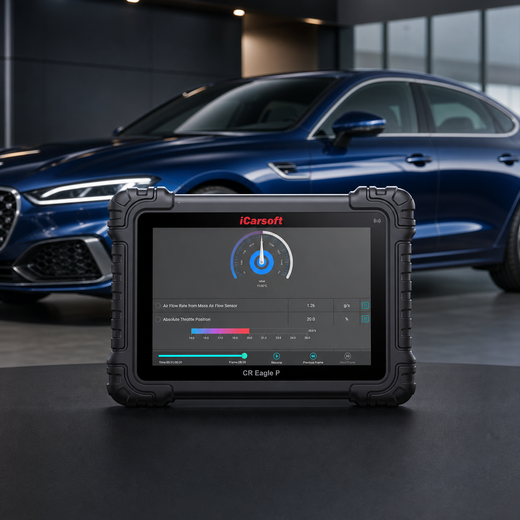
Connect the engine and transmission evidence
iCarsoft CR Eagle P
Review supported torque, gear, and supply information together. Confirm the exact VIN, transmission, module access, and requested data functions before purchase; the heavy-duty Allison example does not establish this tablet's commercial-truck coverage.
Check current CR Eagle P price and availabilityCheck CR Eagle P compatibility by VINThe official product page describes bidirectional functions, but a torque-management test or every manufacturer-specific PID is not guaranteed. Ask support about the exact ECU and task. Do not infer that a coding feature authorizes or supplies the OEM calibration procedure discussed in a bulletin; programming needs separate compatibility and service verification.
Know the measurement boundary. The scanner reports information supplied by the vehicle. It does not directly measure delivered crankshaft torque, network waveform quality, terminal voltage drop, fluid pressure, or internal clutch condition. Use the specified electrical or mechanical tests alongside scan evidence, and distinguish a commanded action from a confirmed physical result.
Verify the P2637 Repair
After repair, verify connector retention, harness routing, controller supply stability, and any required configuration. Save a post-repair scan before clearing erasable records through the approved procedure. Do not disconnect the battery simply to hide the warning; that can remove useful context and reset readiness information without correcting the cause.
Run the manufacturer's applicable verification conditions, using a safe route or prescribed workshop procedure. Compare the original shift event with current behavior and supported torque information. Check all relevant modules for current and pending faults. A smooth idle or one uneventful gear selection does not show that a shift-dependent monitor has passed.
If P2637 returns, compare the new module status, fault order, and operating conditions with the saved baseline. A changed companion fault may point to a different branch. Keep diagnosis separate from inspection readiness: clearing the MIL, completing a monitor, and meeting local emissions-test requirements are different outcomes.
A permanent P2637 can remain immediately after a successful repair. If the vehicle stores it as a permanent DTC, a scan tool or battery disconnect cannot erase it. Once current and pending faults are absent, the OBD system removes the permanent record only after the applicable monitor reruns and passes.
Related Torque Management and Controller Code Guides
P2637 Frequently Asked Questions
Does the P2637 code mean the transmission is bad?
No. P2637 identifies torque-management feedback trouble, not a confirmed failed transmission. Related engine faults, power or network problems, incorrect configuration, and application-specific software can all require investigation. A mechanical replacement needs additional test evidence.
Where is torque management feedback signal A located?
There is no universal sensor location. A can identify a feedback channel or function, and the information may travel between controllers over a network. Use the exact vehicle's diagram, reporting module, and fault description before looking for a component.
Can I keep driving with P2637?
Only consider a short, light-load trip when operation is predictable and the owner's manual permits it. Stop for unsafe shifting, loss of drive, repeated stalling, serious slipping, overheating, or other urgent warnings. The code does not provide a safe mileage allowance.
Will a software update always fix P2637?
No. Some OEM bulletins describe calibration fixes for particular engine/transmission combinations. Verify the VIN, current calibration, symptoms, and prerequisites first. Do not replace normal circuit diagnosis with a reflash based solely on a matching code number.
How much does a P2637 repair cost?
A VIN-specific estimate is needed. Diagnosis may lead to a connection repair, a supply correction, approved software work, or a more involved fault. Ask which failed test supports the proposed work and whether diagnosis, setup, taxes, and verification are included.
Can iCarsoft CR Eagle P diagnose P2637?
On a supported vehicle it can organize available codes, freeze frame, live data, and reports. Confirm engine and transmission coverage for the exact VIN. It cannot independently prove delivered torque, circuit integrity, or internal transmission condition, and the bulletin examples do not guarantee programming coverage.
The iCarsoft Official Store Technical Team maintains the store's fault-code library. This guide organizes published manufacturer evidence and verified product information; it does not document a hands-on test of a particular vehicle or claim an individual engineer's review.
Technical and cost references
- Allison TT8819EN — Diagnostic Trouble Code P2637 in Vehicles with Cummins EPA17 L9 and X15 Engines Application-specific torque-response and engine-calibration example; not a universal repair.
- Cummins TSB170089 — Allison Transmission Control Module Setting Diagnostic Trouble Code P2637 Specified B6.7 calibration example; verify current applicability with the manufacturer.
- Snap-on Diagnostic Trouble Codes (DTC) List Generic terminology cross-check; individual OEM monitor definitions take priority.
- California BAR — On-Board Diagnostic Test Reference Explains why permanent records are not erased by a scan tool or battery disconnect.
Product information: Official iCarsoft CR Eagle P page.
Editorial note: This educational guide supports diagnostic planning and does not replace the current service manual, safety instructions, or professional diagnosis for your VIN. Source information was checked August 31, 2026. Apply only the procedures and specifications for the exact vehicle; product functions depend on vehicle, ECU, software, and access requirements.


