

 By iCarsoft Official Store Technical Team, Automotive Diagnostics Editors · Updated August 31, 2026 · OEM technical references checked
Quick Answer
The P0599 code means Thermostat Heater Control Circuit High. The engine controller detected a high electrical fault state in the thermostat heater control circuit. It does not prove overheating or a failed thermostat. Save codes and freeze frame first, then inspect the cool connector and wiring before testing the circuit against the exact vehicle's service procedure.
1What Does the P0599 Code Mean?
P0599 identifies an electrical monitoring result, not a measurement of how hot the engine has become. An electrically heated, or map-controlled, thermostat combines a temperature-sensitive mechanism with a heater that lets the controller influence cooling for operating conditions. The heater circuit is different from the coolant temperature sensor circuit.
Find the thermostat housing and heater connector using the engine-specific component diagram. There is no universal front, rear, left, or right location. Some assemblies combine several cooling components, so identify each connector before unplugging anything. A nearby temperature sensor must not be mistaken for the controlled heater.
The word “high” must be interpreted through the manufacturer's monitor. Depending on the design, testing may involve circuit voltage, current, and commanded state. A short to another supply, a damaged connection, an internal heater fault, or a control-stage problem can require different tests. The code alone cannot choose the replacement part.
P0599 versus P0597, P0598, and P0128
| Code | General description | Key distinction |
|---|---|---|
| P0597 | Thermostat heater control circuit/open | Investigate the OEM open-circuit fault branch. |
| P0598 | Thermostat heater control circuit low | Investigate the low electrical-state branch. |
| P0599 | Thermostat heater control circuit high | Investigate the high electrical-state branch. |
| P0128 | Coolant below thermostat regulating temperature | A warm-up performance result, not the same circuit fault. |
OEM examples explain why the VIN matters. Kia ENG 171 / SA299, August 2017, lists these thermostat codes for certain 2017 Cadenza vehicles and requires an affected-VIN check. Audi's September 2013 specification book includes a current-based P0599 criterion. Neither document supplies a universal test limit or repair instruction for other vehicles.
2P0599 Symptoms and Likely Causes
A P0599 code may appear with little noticeable change in how the vehicle drives. Record what actually happened rather than assuming every cooling complaint comes from the heater. These observations help decide which evidence to collect next.
The warning may be the only obvious sign. Record whether the code is current, pending, or historical.
Fan operation or warm-up behavior may change with the vehicle's fallback strategy. Neither proves the thermostat failed.
Unstable temperature, a warning, or coolant loss needs separate evaluation even when an electrical code is present.
Heat, moisture, vibration, or recently disturbed wiring may help explain when the warning returns.
Practical cause-checking order
- Connector and terminals: check locking tabs, seals, corrosion, coolant contamination, pushed-back terminals, and poor terminal tension.
- Harness damage: look for heat exposure, insulation rubbing on brackets, trapped wiring, or an unsuitable earlier repair.
- Supply and control paths: identify shared feeds, connections, shorts between circuits, and the actual driver arrangement before testing.
- Heater or thermostat assembly: investigate an internal electrical fault or incorrect replacement only with the correct component specification.
- Controller or calibration: consider these after the external circuits, load, part application, and relevant OEM information have been checked.
Did P0599 start after a repair? Recheck the part number, connector engagement, seals, and harness routing. Low coolant or a sticking thermostat also matters, but neither alone establishes the cause of a circuit-high code.
3How Serious Is P0599, and Can You Drive?
Arrange diagnosis promptly. A short, light-load trip to a nearby repair facility may be reasonable only when the owner's manual permits it, the cold coolant level is correct, temperature stays normal, and there is no leak or urgent warning. P0599 does not establish a universally safe distance.
Avoid trailer towing, heavy loads, and prolonged operation until the cooling behavior is understood. If the gauge or sensor readings are unreliable, do not use a seemingly normal display to justify continued driving. A cooling-system fault can become urgent even when the original electrical warning seemed minor.
Stop and arrange a tow if the vehicle overheats, shows an urgent temperature warning, releases steam or coolant, loses power unsafely, or develops smoke, a burning smell, or a flashing check-engine light. Pull over safely and follow the owner's manual. Do not continue merely because P0599 is an electrical code.
Never remove the pressure cap from a hot cooling system. Electric fans can start unexpectedly, and belts remain a moving-part hazard. Keep hands, clothing, and test leads clear. Leave energized circuit testing, inaccessible connectors, and any work around high-voltage hybrid components to qualified personnel.
4How to Diagnose P0599 in the Right Order
-
Save the complete fault record
Scan accessible modules before clearing codes or disconnecting the battery. Record full wording, suffixes, status, freeze frame, coolant temperature, supply voltage, engine load, and companion faults. Note whether P0599 returns at key-on, during warm-up, or under load. Save the report so later tests can be compared with the original event.
-
Identify the VIN-specific circuit and monitor
Use the VIN and engine code to obtain the wiring diagram, connector views, monitor conditions, and current bulletins. Identify the heater load, feed, control driver, and shared circuits. Check service-action eligibility directly with the manufacturer; the existence of an old bulletin does not establish coverage or justify replacing every similar thermostat.
-
Inspect the cool system and connections
Following the owner's manual, check the cold coolant level and visible leaks. Inspect the housing, connector seals, terminal fit, harness clips, and recently disturbed areas. Photograph damage before repair. If coolant entered the plug, correct the leak and assess the affected wiring; cleaning the connector alone may leave the cause in place.
-
Prove the supply, control path, and heater
Follow OEM instructions for protected voltage checks, voltage-drop or load testing, and any specified isolated resistance test. Switch power off and isolate components before measuring resistance. Use the required multimeter, current clamp, or oscilloscope. Never bridge a module pin to power or ground, or repeatedly replace a blown fuse without finding the fault.
-
Compare supported commands with measured response
When the exact ECU supports them, record coolant temperature and thermostat command or feedback during the prescribed test. Compare scan data with the physical electrical measurements. A command percentage is not heater current, valve position, or proof of coolant flow. Missing scan coverage is not evidence that the thermostat or controller has failed.
-
Confirm the repair path and required setup
Replace a heater or housing only after testing or an applicable VIN-specific service action supports it. Confirm the correct part, seals, coolant, fill procedure, and any required setup. Investigate a controller last, after its powers, grounds, wiring, and load pass the relevant tests. Complete the verification sequence below before calling the P0599 repair successful.
Specifications are vehicle-specific. Do not borrow a resistance, voltage, current, duty-cycle, or warm-up limit from another engine. Connector state, command state, temperature, and test point can change what a valid measurement means. A continuity beep alone does not prove a terminal carries the required load.
5P0599 Repairs and Typical Costs
The correct P0599 fix follows the failed test. A damaged terminal needs an approved connector repair; a proven heater fault may require an integrated thermostat assembly. Restore the reason for the damage, including leaks or incorrect routing. Replacing an unrelated coolant sensor or pump without evidence adds cost without confirming the circuit repair.
| Possible path | Current US estimate |
|---|---|
| Fault isolation, terminal repair, or local harness repair | VIN-specific quote |
| Confirmed thermostat replacement: broad national service benchmark, not a P0599 quote | $609–$709 |
| Integrated cooling assembly, extensive harness work, or additional leak repair | VIN-specific quote |
| Confirmed calibration or controller work, with required setup | VIN-specific quote |
RepairPal's Thermostat Replacement Cost Estimate displays $609–$709, with estimates last updated August 7, 2026; checked August 31, 2026. This national benchmark applies only when thermostat replacement is the confirmed repair. It is not an estimate for every electrically heated housing.
The range excludes taxes and fees, does not reflect your unique location, and may not cover related work. The rows are alternative outcomes, not amounts to add together. Request an itemized local estimate showing diagnosis, parts, coolant, labor, and setup. Confirm any warranty or service-action eligibility before authorizing work.
6Using iCarsoft CR Eagle P for P0599
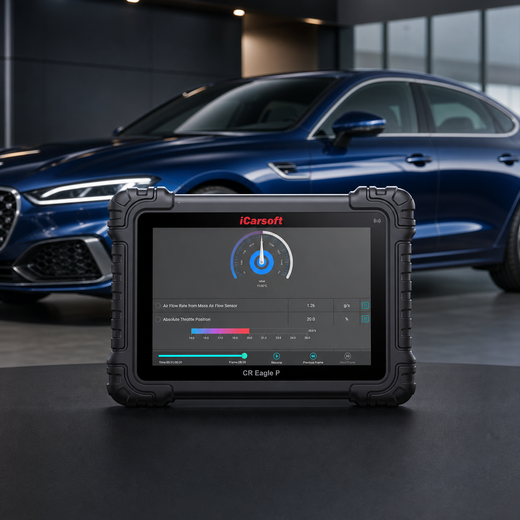
On a supported vehicle, iCarsoft CR Eagle P can read relevant module faults, capture available freeze frame, display ECU-provided live data, and save diagnostic reports. For P0599, use that evidence to separate the original electrical event from additional cooling or supply faults before moving to component tests.
Keep the evidence before clearing
iCarsoft CR Eagle P
Review supported codes, coolant-temperature data, and diagnostic reports. Confirm the exact vehicle and required functions before purchase; thermostat-specific data and tests depend on the ECU and software.
Check current CR Eagle P price and availabilityCheck CR Eagle P compatibility by VINThe official product page describes bidirectional functions, but that does not guarantee a thermostat-heater output test for every VIN. Ask support to confirm the particular ECU and requested test. Follow the manufacturer's conditions if it is supported; do not improvise repeated heater commands to force a mechanical response.
Know the measurement boundary. The scanner does not directly measure terminal voltage, heater current or resistance, terminal tension, leakage, or thermostat opening. A multimeter, current clamp, scope, or cooling-system inspection may be required. Data displayed by an ECU is evidence to interpret alongside those checks, not a substitute for them.
7Verify the P0599 Repair
After repair, check connector locks, terminal seating, and harness clearance. If the cooling system was opened, use the specified coolant and fill/bleed process, inspect for leaks, and recheck the cold level as directed. An electrical repair does not by itself prove that the system was filled correctly.
Save post-repair findings, then use the OEM clearing procedure for erasable codes after preserving the original records. Run the applicable monitor conditions or safely reproduce the relevant freeze-frame conditions. Check current, pending, and companion faults, supported heater response, and coolant behavior. One clean idle period does not prove that the monitor has completed.
If P0599 returns, compare its status and operating conditions with the original event before replacing another part. Revisit the failed test branch rather than repeatedly clearing the record. Keep inspection-readiness requirements separate from the mechanical repair assessment; local inspection rules and vehicle monitor behavior can differ.
A permanent P0599 can remain immediately after a successful repair. If the vehicle stores it as a permanent DTC, a scan tool or battery disconnect cannot erase it. Once current and pending faults are absent, the OBD system removes the permanent record only after the applicable monitor reruns and passes.
8Related Thermostat and Cooling Code Guides
9P0599 Frequently Asked Questions
Does the P0599 code mean I need a new thermostat?
No. It describes a heater control circuit fault, not a confirmed failed assembly or an engine-temperature reading. Check the connector, wiring, supply/control paths, and heater using the vehicle procedure. Replace the thermostat only when evidence supports that repair.
What is the difference between P0598 and P0599?
P0598 is the low electrical-state fault; P0599 is the high-state fault in the thermostat heater control circuit. P0597 addresses circuit/open, while P0128 concerns warm-up performance. The correct voltage or current interpretation depends on the exact engine and monitor.
Can I drive with P0599 if the temperature gauge looks normal?
A short, light-load diagnostic trip may be reasonable only when the owner's manual permits it and there is no coolant loss, overheating, urgent warning, or unsafe running. A normal gauge does not prove the circuit is healthy. Stop safely if warning signs appear.
Why did P0599 return after thermostat replacement?
The original terminal or wiring fault may remain, the part may be incorrect, or a connector may be incompletely seated. Compare fresh codes with the saved evidence and recheck installation details. Clearing the P0599 code again does not prove that the replacement or wiring is correct.
How much does a P0599 repair cost?
The price depends on the diagnosed fault and vehicle. RepairPal's broad thermostat-replacement benchmark is $609–$709, updated August 7, 2026, but it is not a universal P0599 estimate. Wiring, integrated assemblies, diagnosis, and setup require a VIN-specific quote; taxes, fees, location, and related work can change the total.
Can CR Eagle P test and clear the P0599 code?
On supported vehicles, it can read codes, available freeze frame, and live data, and clear erasable codes after repair. Thermostat output tests require exact ECU coverage. It cannot measure the physical circuit directly or force-clear a permanent code; the vehicle's OBD system must complete its verification.
The iCarsoft Official Store Technical Team maintains the store's fault-code library. This guide organizes published OEM evidence and verified product information; it does not document a hands-on test of a particular vehicle or claim an individual engineer's review.
Technical and cost references
- Kia ENG 171 / SA299: Service Action — Electric Thermostat Assembly Replacement, August 2017. Code definitions and an affected-VIN requirement for certain 2017 Cadenza vehicles.
- 2014 Audi A8/A8L/S8 Quick Reference Specification Book, September 2013, printed page 267. An application-specific current-based P0599 monitor example.
- RepairPal Thermostat Replacement Cost Estimate: $609–$709; estimates last updated August 7, 2026. Checked August 31, 2026.
- California Bureau of Automotive Repair: On-Board Diagnostic Test Reference, permanent diagnostic trouble code standards. Permanent records clear through vehicle verification, not a scan-tool erase command.
Product information: Official iCarsoft CR Eagle P page.
Editorial note: General diagnostic education, not a substitute for the owner's manual, current VIN-specific service information, or professional inspection. Test limits, coolant procedures, coverage, and costs vary. Related articles provide context; apply only the specifications and repair procedures that match the vehicle. No universal failure rate or repair outcome is implied.


