

 By iCarsoft Official Store Technical Team, Automotive Diagnostics Editors · Updated August 31, 2026 · OEM technical references checked
Quick Answer
The P2682 code means the engine coolant bypass valve control circuit has been classified as low. It does not by itself prove low coolant temperature, a stuck valve, or a failed thermostat. Save the fault record, check the cold cooling system safely, and identify the exact valve, wiring, and OEM monitor before testing or replacing parts.
1What Does the P2682 Code Mean?
P2682 identifies a low condition in the coolant bypass valve's monitored control circuit. Current generic descriptions may include valve A. This label selects a defined circuit or valve function; it does not locate the component on every engine. The valve may be separate or integrated into a larger thermal-management assembly.
Coolant routing and coolant temperature are related, but they are not the same measurement. A control-circuit fault describes what the electronics detected. It cannot establish whether the coolant is actually cold, whether circulation is adequate, or whether the valve reached its intended position. Those questions need additional data and physical checks.
The distinction matters when a parts catalog calls an assembly a thermostat, bypass valve, or thermo control valve. Names can overlap without making the diagnostic procedures interchangeable. Use the VIN, engine code, wiring diagram, connector views, and component information to establish exactly which assembly the P2682 code concerns.
Subaru bulletin 09-80-21, dated February 28, 2022, describes a revised thermo control valve for specified Legacy, Outback, Forester, and Crosstrek applications. It discusses internal durability and sensor-waterproofing changes associated with P2682/P26Ax faults. It is an application-specific example, not proof that every P2682 requires that assembly or qualifies for coverage.
P2682 low versus high, open, and thermostat faults
| Code | General description | Key distinction |
|---|---|---|
| P2681 | Engine coolant bypass valve control circuit/open | Use the open-circuit diagnostic branch for the identified valve. |
| P2682 | Engine coolant bypass valve control circuit low | A low electrical classification; not a coolant-temperature reading. |
| P2683 | Engine coolant bypass valve control circuit high | The high-circuit code must not be substituted for P2682. |
| P0128 | Coolant below thermostat regulating temperature | A temperature-performance result, distinct from the bypass control circuit. |
Correct the low/high mix-up before ordering. P2682 is the low-circuit fault. If a generic lookup labels it high, compare the complete OEM code description and manufacturer suffix. Testing the wrong branch can make good components appear faulty.
2P2682 Symptoms and Likely Causes
Some vehicles show only a steady check-engine light. Others change coolant routing or enter a protective strategy. Symptoms depend on the valve design and the actual failure, so record both the fault status and what the vehicle does during warm-up and normal operation.
A check-engine light or thermal-management warning can appear before any visible leak or obvious temperature change.
Warm-up may differ from normal, but a temperature trend alone does not identify a failed bypass valve.
Heater output or fan operation may change on some applications; interpret these observations with the actual coolant and control data.
Water entry, heat, vibration, or a disturbed connector can make the warning return only in particular conditions.
Practical cause-checking order
- Connector condition: inspect seals, terminal retention, corrosion, moisture, coolant contamination, and the locking mechanism before replacing the valve.
- Harness integrity: look for rubbing, pinching, heat damage, chafing against brackets, and incorrect wiring repairs near the cooling assembly.
- Feed, ground, or control path: identify the driver arrangement and shared supplies, then test the circuit under the conditions specified by the manufacturer.
- Valve assembly or internal electronics: an electrical failure is possible, but confirm the actual test result and correct replacement application first.
- Configuration or controller: review relevant service information after external circuits and component suitability have been proved; a code name is not a controller diagnosis.
After coolant or thermostat work: recheck connector engagement, trapped wiring, the exact replacement part, hose routing, and filling/bleeding. Correct an external leak and assess any contaminated terminals. Do not treat topping up coolant as proof that a control-circuit fault has been repaired.
3How Serious Is P2682, and Can You Drive?
Get P2682 assessed promptly. A short, light-load trip may be reasonable only when the owner's manual permits it, cold coolant level is correct, no leak is visible, and temperature and driveability remain normal. Avoid heavy loads or towing until coolant control is understood. The code does not establish a safe driving distance.
Stop and arrange a tow if the engine overheats, shows an urgent temperature warning, releases steam, loses coolant, or develops unsafe power loss, smoke, a burning smell, or a flashing MIL. Pull over safely and follow the owner's manual. Never open a hot pressure cap to check whether enough coolant remains.
Let the system cool before inspecting the reservoir or valve area. Electric fans can start automatically, and belts or pumps can move unexpectedly. Keep test leads away from moving parts. Cooling-system pressure, hot liquid, and hybrid high-voltage components require the relevant safety procedure; leave inaccessible or energized testing to a qualified technician.
4How to Diagnose P2682 in the Right Order
-
Save the original circuit and cooling evidence
Scan accessible modules before clearing anything. Record the complete P2682 description, suffix, reporting module, current or pending status, freeze frame, supply voltage, coolant temperature, and companion codes. Note whether the fault returns at key-on, during warm-up, or under load. Save photographs of warnings and any recent work details.
-
Identify the exact bypass valve and monitor
Use VIN-specific service information to locate the valve, its feed and control circuits, any shared connections, and the monitor's required conditions. Distinguish a simple solenoid from a motorized or integrated thermal module. Confirm current part supersessions and bulletin applicability directly; a model name alone does not establish the correct repair or warranty.
-
Inspect the cold system and electrical connections
Following the owner's manual, inspect cold coolant level, visible leaks, reservoir condition, and hose routing. Check the valve connector and adjacent harness for water, coolant, damaged insulation, loose pins, or broken clips. Photograph a leak path before cleaning it. Restore the source of contamination as well as the affected electrical connection.
-
Prove the supply, return, and control circuits
Follow the exact diagram for protected voltage checks, load tests, and voltage-drop measurements. Perform resistance checks only with the circuit isolated and de-energized as directed. Use the required multimeter, current clamp, or oscilloscope. Never bridge a controller pin to battery or ground, and do not assume every coolant valve uses the same driver design.
-
Compare supported commands with measured response
If the exact ECU supports them, observe bypass-valve commands, position feedback, and coolant-temperature trends during the prescribed test. Compare those data with electrical measurements. A displayed command does not prove valve movement or coolant flow. Missing active-test coverage is a tool or vehicle limitation, not evidence that the component failed.
-
Confirm the failed part and finish the service procedure
Select a connector repair, wiring correction, or valve replacement only when testing supports it. Confirm seals, coolant specification, part application, and any initialization or bleed routine. Reassess controller involvement only after external paths pass. If the system was opened, verify filling and leakage separately from the original electrical failure.
Specifications are vehicle-specific. Do not use another engine's resistance, current, voltage, pin assignment, duty cycle, or warm-up limit. Test results depend on connector state, command, temperature, and circuit design. A continuity beep cannot establish that a corroded terminal carries the required load, and a low scan value is not automatically low physical temperature.
5P2682 Repairs and Typical Costs
The P2682 fix should follow the failed test: repair a damaged connection, restore a proven circuit defect, or replace the confirmed valve assembly. If contamination caused the fault, stop the leak and inspect its effect on the harness. Replacing a pump or temperature sensor without evidence may leave the control fault unchanged.
An integrated thermal assembly can require different labor, seals, one-time-use parts, and service procedures from a standalone valve. Ask the repairer to identify the correct part by VIN and explain the result that supports replacement. A historical bulletin is useful context, but current applicability and coverage must be checked separately.
| Possible path | Current US estimate |
|---|---|
| Electrical diagnosis and cooling-system assessment | VIN-specific quote |
| Approved terminal, connector, or local harness repair | VIN-specific quote |
| Confirmed bypass valve or integrated thermal assembly replacement | VIN-specific quote |
| Additional leak repair, fill/bleed, or required initialization | VIN-specific quote |
No generic thermostat price is substituted for a coolant bypass valve repair. The assemblies and access requirements differ too much for that to be a reliable P2682 estimate. Request parts, diagnosis, labor, coolant, setup, and taxes as separate line items. These rows describe possible outcomes, not charges that automatically apply together.
6Using iCarsoft CR Eagle P for P2682
On a supported vehicle, iCarsoft CR Eagle P can preserve accessible fault status and available freeze frame, display ECU-provided live data, and save a report. For P2682, compare the original circuit event with coolant-temperature and supply information before clearing codes or disconnecting the valve.
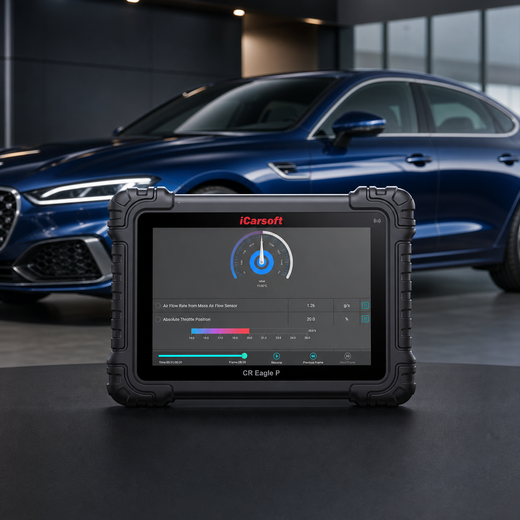
Keep the circuit and coolant evidence together
iCarsoft CR Eagle P
Review supported cooling-system data and fault records. Ask about your exact VIN, ECU, bypass-valve PID, and requested active test before purchase; functions and access vary with the vehicle and software.
Check current CR Eagle P price and availabilityCheck CR Eagle P compatibility by VINThe product page describes bidirectional capabilities, but a specific coolant-valve test is not guaranteed for every vehicle. Use an available output test only under the manufacturer's conditions. Do not repeatedly command the valve in an attempt to free a mechanical restriction or treat a completed scan-tool command as a confirmed repair.
Know the measurement boundary. The tablet does not directly measure valve current, terminal voltage drop, winding resistance, connector tension, coolant flow, leakage, or internal mechanical movement. Appropriate electrical instruments and cooling-system checks are still required. A position or temperature value supplied by the ECU must be checked for plausibility before it is used as proof.
7Verify the P2682 Repair
After the repair, inspect connector locks, harness clearance, hose connections, and the cold coolant level. If the system was opened, use the correct coolant and specified fill/bleed procedure, then check for leaks. A cleared electrical code does not establish that the cooling system is free of air or properly sealed.
Save the repair findings and clear only erasable records through the OEM procedure. Run the actual monitor enable conditions or safely reproduce relevant freeze-frame conditions. Recheck current and pending P2682, companion circuit faults, supported valve response, and temperature behavior. One clean start is not enough if the original failure occurred later in warm-up.
If the code returns, compare its timing and data with the original event. Avoid replacing another assembly without revisiting the failed circuit branch. Keep monitor completion and emissions readiness separate from whether the component behaves normally; the vehicle and local inspection requirements determine the remaining verification work.
A permanent P2682 can remain immediately after a successful repair. If the vehicle stores it as a permanent DTC, a scan tool or battery disconnect cannot erase it. Once current and pending faults are absent, the OBD system removes the permanent record only after the applicable monitor reruns and passes.
8Related Cooling and Thermostat Code Guides
9P2682 Frequently Asked Questions
Does P2682 mean the coolant bypass circuit is high?
No. P2682 is the low-circuit code; P2683 identifies the high-circuit condition. Confirm the complete OEM description and suffix if a lookup disagrees. The word low refers to the monitored circuit, not necessarily coolant level or temperature.
Is the P2682 code proof of a bad thermostat?
No. Some thermal-management functions share an assembly, but wiring, connectors, supply paths, and internal electronics must be distinguished. Identify the actual bypass valve and follow its diagnostic procedure before deciding that a thermostat or integrated module needs replacement.
Can I drive with P2682 and normal temperature?
Only consider a short light-load trip if the owner's manual permits it and coolant level, leakage, temperature, and driveability are satisfactory. Stop for overheating, steam, coolant loss, or urgent warnings. A normal gauge cannot guarantee that every coolant path is functioning.
Will adding coolant or clearing the code fix P2682?
Correct low coolant safely and find the leak if one exists, but that does not prove the circuit fault is repaired. Clearing removes evidence and may temporarily hide the warning. Save the records, test the electrical path, and verify the monitor after repair.
What should a P2682 repair estimate include?
Ask for diagnosis, the exact valve or assembly, required seals, labor, coolant, filling/bleeding, setup, and taxes. Connector repair and integrated assembly replacement are different outcomes. A VIN-specific quote is more useful than borrowing a generic thermostat replacement price.
Can CR Eagle P test the coolant bypass valve?
It may provide relevant data or active tests on supported vehicles. Confirm the exact VIN and ECU function with iCarsoft support. Scan commands and feedback do not physically prove current, resistance, leakage, or coolant flow; those require separate tests.
The iCarsoft Official Store Technical Team maintains the store's fault-code library. This guide organizes published manufacturer evidence and verified product information; it does not document a hands-on test of a particular vehicle or claim an individual engineer's review.
Technical and cost references
- Subaru 09-80-21 — DTC P2682 and P26Ax / Thermo Control Valve Design Change Specified vehicle applications and design changes; verify current VIN applicability.
- Audi Q5/SQ5 Quick Reference Specification Book — DTC chart Distinguishes P2682 circuit low from P2683 circuit high; application-specific thresholds are not transferred here.
- Snap-on Diagnostic Trouble Codes (DTC) List Generic code terminology, including coolant bypass valve A wording.
- California BAR — On-Board Diagnostic Test Reference Permanent DTC behavior and the distinction between repair and readiness.
Product information: Official iCarsoft CR Eagle P page.
Editorial note: This educational guide supports diagnostic planning and does not replace the current service manual, safety instructions, or professional diagnosis for your VIN. Source information was checked August 31, 2026. Apply only the procedures and specifications for the exact vehicle; product functions depend on vehicle, ECU, software, and access requirements.


