

Quick Answer
P2433 means the powertrain control module detected a high electrical input from the Bank 1 secondary air injection air-flow/pressure sensor circuit. The P2433 code does not prove that air pressure is too high or that the sensor, pump, or valve has failed. Save every code and freeze frame first, then inspect the exact VIN-specific circuit before replacing parts.
1What Does the P2433 Code Mean?
The standardized P2433 description is Secondary Air Injection System Air Flow/Pressure Sensor Circuit High, Bank 1. The secondary air injection system sends fresh air into the exhaust during selected operating conditions, commonly around a cold start, to help the catalyst reach effective operation and reduce emissions. A pressure or air-flow sensor gives the controller feedback about that process.
“Circuit High” describes the controller's electrical classification of the sensor input. Depending on the design, a high input may come from a signal shorted toward a reference or power circuit, an open or poor low-reference path, terminal trouble, internal sensor electronics, or a controller input fault. It does not automatically mean excessive physical pressure.
Bank 1 is the cylinder bank containing cylinder 1. An inline engine has one bank, while the physical side on a V-engine is vehicle-specific. The sensor may be separate, attached to a pressure hose, or integrated with an air switching valve. Confirm the location, connector, and pinout from the service information for the exact VIN.
P2433 versus nearby secondary-air codes
| Code | General description | Key distinction |
|---|---|---|
| P2430 | Bank 1 air-flow/pressure sensor circuit | General circuit or feedback fault without the specific high direction. |
| P2431 | Bank 1 sensor range/performance | The signal or response is implausible for expected conditions, not simply classified high. |
| P2432 | Bank 1 sensor circuit low | Electrical input is below the calibrated range; it is the low-direction counterpart. |
| P2433 | Bank 1 sensor circuit high | Electrical input is above the calibrated range; physical pressure is not proven high. |
| P2434 | Bank 1 sensor circuit intermittent/erratic | The signal is unstable or drops in and out rather than remaining consistently high. |
| P2438 | Bank 2 sensor circuit high | Same general electrical direction, but for the Bank 2 circuit where fitted. |
Application-specific example: Volkswagen Technical Bulletin 26-19-02 covers certain 2.5L vehicles with P2431, P2432, or P2433 and identifies foreign-particle contamination of the pressure sensor as one possible cause. That bulletin does not apply to every vehicle and cannot replace a VIN check.
2P2433 Symptoms and Likely Causes
A steady check-engine light is often the only obvious P2433 symptom. Because the secondary-air system normally operates during limited monitor conditions, the vehicle may drive normally between tests. Companion codes and recent repair history provide more useful direction than the MIL alone.
P2433 may appear as current, pending, history, or permanent and can command the MIL after the applicable confirmation logic.
An active emissions fault or incomplete secondary-air monitor may prevent an OBD inspection from passing.
Many circuit-high faults cause no obvious acceleration or idle complaint outside the monitor window.
A noisy or continuously running pump, rough operation, or related power-supply codes point to a broader fault that needs separate attention.
Practical cause-checking order
- Connector and terminal faults: incomplete seating, water, corrosion, spread terminals, damaged seals, or recent service that pulled the connector or harness.
- Harness and shared-circuit faults: chafing near hot exhaust or brackets, a signal short toward power/reference, an open low-reference, or a shared reference problem affecting other sensors.
- Sensor and pressure-path faults: contaminated sensor electronics, a blocked pressure port, a split or restricted hose, or a sensor integrated into a faulty valve assembly.
- System-operation faults: only with supporting evidence, consider pump, relay/driver, switching/check valve, air leak, or exhaust backflow that has damaged or confused the feedback system.
- Calibration or controller faults: check applicable bulletins and software before condemning the module; internal controller failure is uncommon.
If P2433 appeared immediately after work, recheck every disturbed connector, ground, hose, bracket, and harness clip before buying a sensor. A backed-out terminal or pinched low-reference wire can create a high input with a healthy component.
3How Serious Is P2433, and Can You Drive?
With a steady MIL and normal vehicle operation, a short, light-load trip for diagnosis is often reasonable when the owner's manual permits it. Schedule service promptly because P2433 can block readiness, increase cold-start emissions, and hide damage to a connector, hose, valve, or pump circuit. Do not clear the code just before an emissions test because readiness monitors will reset.
Stop and arrange a tow if the MIL flashes, the engine misfires badly, power loss is unsafe, the vehicle stalls, an oil-pressure or temperature warning appears, smoke or a burning odor develops, or the air pump runs continuously with harsh mechanical noise. These signs are more serious than the base P2433 circuit classification.
Let exhaust and secondary-air hardware cool before touching it. Electric pumps can draw high current and automatic fans can start unexpectedly. Do not bypass emissions hardware, repeatedly replace a fuse, or jump controller terminals to battery power or ground.
4How to Diagnose P2433 in the Right Order
-
Save every code, status, and freeze frame
Scan all modules before clearing anything. Record P2433 as current, pending, history, or permanent; capture freeze frame, battery voltage, engine temperature, engine speed, and the failure order. Note shared reference, pump, relay, valve, or airflow codes because they can change the diagnostic branch.
-
Identify the exact VIN architecture and monitor
Use the correct wiring diagram, connector views, component location, OEM test plan, and applicable bulletins. Determine whether the pressure sensor is separate or valve-integrated, how Bank 1 is arranged, which circuits are shared, and whether the OEM defines setup or relearn work after replacement.
-
Inspect the cool system and recent-work area
With the ignition off and hot parts cooled, inspect the connector lock, terminal fit, seals, harness routing, grounds, pressure hose, port, switching valve, and pump plumbing. Look for water, debris, heat damage, abrasion, pinching, exhaust backflow, or a connector that is not fully seated.
-
Prove reference, ground, and signal paths
Follow the OEM procedure with a digital multimeter, approved breakout leads, and load or voltage-drop testing where specified. Test the circuit at both ends instead of trusting unloaded voltage alone. Use pressure or vacuum equipment only when the service procedure calls for it; never apply battery voltage to a sensor or controller pin.
-
Compare supported command and feedback data
On a supported vehicle, graph the ECU-reported secondary-air pressure or voltage with related reference, barometric, pump-command, and valve-command data. If the ECU exposes an active test, use it only under safe OEM conditions. A scan value can show what the controller reports, but it cannot prove terminal tension or physical pressure by itself.
-
Confirm the failed part and required setup
Condemn a sensor, integrated valve, pump, or controller only after the external circuit and physical path pass the specified tests. Check whether the replacement is serviced separately and whether programming, coding, or relearn is required. Repair the proven cause, restore harness routing and seals, then verify the actual monitor.
Specifications are vehicle-specific. Do not transfer voltage, resistance, pressure, timer, temperature, trip-count, or drive-cycle numbers from another make or engine. Even two vehicles that store P2433 can use different sensors and monitor logic.
5P2433 Repairs and Typical Costs
The correct P2433 code repair follows the failed test. It may be a terminal repair, harness restoration, pressure-hose or port service, sensor replacement, an integrated valve assembly, or an application-specific software update. Pump replacement belongs on the list only when separate current, pressure/flow, command, and physical checks prove that the pump is part of the failure.
| Possible path | Current US estimate |
|---|---|
| Professional check-engine-light diagnosis and testing | $122–$233 |
| Connector, wiring, pressure hose, standalone sensor, or software work | VIN-specific quote |
| Air injection control valve replacement, only if the proven failed sensor/valve architecture matches this service | $586–$732 |
| Air pump replacement, only if independent testing proves pump failure | $572–$700 |
RepairPal displayed these US national ranges as last updated August 7, 2026. They exclude taxes, fees, location differences, and related repairs. The rows are alternative outcomes, not amounts to add together, and neither valve nor pump pricing means the P2433 code has identified that part.
6Using iCarsoft CR Eagle P 2026 Car Diagnostic Tool for P2433
On a supported vehicle, the iCarsoft CR Eagle P 2026 Car Diagnostic Tool can scan the relevant engine module, preserve P2433 status and available freeze frame, display ECU-provided live data, review readiness, and save a diagnostic report. Useful secondary-air pressure PIDs or pump/valve active tests may be available when the exact VIN, ECU, software, and access level expose them.
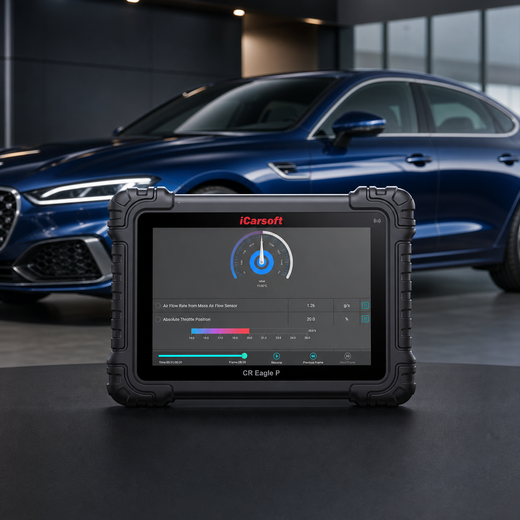
Evidence-first full-system diagnostics
iCarsoft CR Eagle P 2026 Car Diagnostic Tool
Save codes and reports, graph supported live data, review readiness, and access VIN-dependent bidirectional tests from one professional platform.
Check current CR Eagle P price and availabilityCheck CR Eagle P compatibility by VINAn active test is useful only when the vehicle supports the function and the OEM procedure allows it under current conditions. Compare the command with pressure feedback and physical results; do not repeatedly cycle a pump or valve to “free” it. Missing PIDs or test menus indicate coverage limits, not a failed vehicle component.
Know the measurement boundary. CR Eagle P reports what the ECU sees and commands. It does not directly measure circuit voltage, current, resistance, voltage drop, terminal tension, pressure, vacuum, leakage, or internal mechanical condition. Use a digital multimeter, approved test leads, and the specified pressure/vacuum equipment alongside scan evidence.
7Verify the P2433 Repair
After the repair, reconnect every seal and clip, restore heat protection, and save a post-repair scan. Confirm the Bank 1 sensor value is electrically plausible under the OEM test conditions and that supported command-versus-feedback behavior follows the application specification. Recheck all modules for current and pending companion codes.
Use the OEM clearing procedure for erasable DTCs only after evidence is saved. Then run the specified secondary-air monitor or safely reproduce the recorded enable conditions. A clean idle alone is not proof if the monitor needs a cold start or another controlled condition. Verify readiness before an inspection and retain the before/after report.
A permanent P2433 can remain immediately after a successful repair. If the vehicle stores it as a permanent DTC, a scan tool or battery disconnect cannot erase it. Once current and pending faults are absent, the OBD system removes the permanent record only after the applicable monitor reruns and passes.
8Related Secondary Air Injection Code Guides
9P2433 Frequently Asked Questions
Does P2433 mean the pressure sensor is bad?
No. The P2433 code identifies a high electrical input, not a guaranteed failed sensor. A signal short toward power/reference, open or weak low-reference, damaged terminal, contaminated sensor, shared-circuit fault, or rare controller issue can create the same result. Test the exact circuit before ordering parts.
What is the difference between P2432 and P2433?
P2432 is the low-input counterpart; P2433 is the high-input classification for the Bank 1 secondary-air pressure/flow sensor circuit. Neither description alone proves physical pressure is low or high. Use the VIN-specific wiring diagram and OEM thresholds to interpret the signal direction.
Where is the Bank 1 secondary-air pressure sensor?
Location varies by vehicle. It may be a standalone sensor connected to a pressure hose, mounted on a switching valve, or integrated into a valve/sensor assembly. Bank 1 contains cylinder 1; it is not universally the left or right side. Confirm the service diagram for the VIN.
Can I drive with the P2433 code?
A short, light-load trip is often possible with a steady MIL and normal operation when the owner's manual allows it. Diagnose P2433 promptly. Stop for a flashing MIL, severe misfire, unsafe power loss, smoke, burning odor, overheating warning, repeated stalling, or a continuously running and distressed pump.
How much does P2433 cost to fix?
Diagnosis currently averages $122–$233 in US RepairPal data. A proven control-valve repair averages $586–$732, while an independently confirmed air-pump repair averages $572–$700. Wiring, connector, sensor, hose, and software work need a VIN-specific quote. These are alternatives, not a single combined estimate.
Can iCarsoft CR Eagle P diagnose P2433?
On a supported vehicle, CR Eagle P can read P2433 and companion codes, save freeze frame and reports, display available secondary-air data, check readiness, and run supported active tests. Confirm VIN coverage first. The scan tool cannot physically measure voltage drop, terminal tension, pressure, vacuum, or leakage.
Technical and cost references
- General Motors, 11 OBDGS2 Engine Diagnostics: application-specific secondary-air pressure sensor circuit monitoring for P2431/P2432/P2433.
- Volkswagen Technical Bulletin 26-19-02, April 24, 2019: P2431/P2432/P2433 pressure-sensor contamination example for listed 2.5L applications.
- RepairPal Check Engine Light Diagnosis & Testing Cost Estimate: $122–$233; estimates last updated August 7, 2026.
- RepairPal Air Injection System Control Valve Replacement Cost Estimate: $586–$732; estimates last updated August 7, 2026.
- RepairPal Air Pump Replacement Cost Estimate: $572–$700; estimates last updated August 7, 2026.
- US EPA vehicle and engine tampering policy: emissions-control systems must not be disabled or defeated.
Product information: Official iCarsoft CR Eagle P 2026 Car Diagnostic Tool page.
Editorial note: This guide provides general educational information, not a substitute for OEM service instructions, safety procedures, wiring diagrams, and specifications for a specific VIN. Secondary-air components may be hot, electric pumps can draw high current, and automatic fans can start unexpectedly. Confirm product coverage, repair procedures, and local pricing before work.


