

Quick Answer
The P2179 code means Fuel Control System “A” Too Lean Off Idle (Bank 2). The controller detected lean feedback on the cylinder bank without cylinder 1 during an OEM-defined region above idle. P2179 does not prove the oxygen sensor, MAF sensor, injector, or fuel pump failed. Save codes and freeze frame before clearing, compare banks, then test air, fuel, exhaust, and electrical paths.
1What Does the P2179 Code Mean?
P2179 is a generic powertrain DTC. The current standardized wording is Fuel Control System “A” Too Lean Off Idle (Bank 2); many scanners shorten it to “System Too Lean Off Idle Bank 2.” “Lean” means the control system saw more oxygen than expected or had to add more fuel correction than the calibration permits. It does not reveal why that result occurred.
Bank 2 is the cylinder bank that does not contain cylinder 1. It is not universally the driver or passenger side, and an inline engine normally has only one bank. Use the firing order and VIN-specific engine diagram before inspecting a bank-specific injector, sensor, gasket, or exhaust branch.
“Off idle” separates this monitor from an at-idle fuel-control code, but it is not a universal RPM, throttle, speed, or load threshold. Diagnose the P2179 code with the exact OEM monitor description.
How P2179 differs from nearby fuel-control codes
| Code | General description | Key distinction |
|---|---|---|
| P2179 | Fuel control system A too lean off idle, Bank 2 | The target code: lean correction or feedback on Bank 2 in an off-idle region. |
| P2177 | Fuel control system A too lean off idle, Bank 1 | Same operating label and lean direction on the cylinder-1 bank. |
| P2180 | Fuel control system A too rich off idle, Bank 2 | Same bank and operating label, but the monitored direction is rich. |
| P2189 | Fuel control system A too lean at idle, Bank 2 | Bank 2 lean result in the OEM-defined idle region, not off idle. |
| P0174 | Fuel system too lean, Bank 2 | A broader bank-specific lean classification without the off-idle label. |
| P2197 | O2 sensor signal biased or stuck lean, Bank 2 Sensor 1 | A sensor-signal behavior code, not the same fuel-control adaptation result. |
OEM example, not a universal limit: the Volkswagen 2014 CC Quick Reference Specification Book lists P2179 and P2189 with different application-specific adaptive criteria. That confirms why values from one vehicle must not be transferred to another VIN.
2P2179 Symptoms and Likely Causes
The P2179 code may appear with only a steady MIL or may accompany hesitation, roughness, and a bank-specific misfire. Symptoms depend on whether the cause affects one or both banks.
A steady MIL may be the only obvious sign. Stored and pending status matters before clearing.
The engine may stumble, surge, or feel weak as airflow rises from idle into light load.
A severe lean condition can produce roughness, stalling, or cylinder misfire counts on Bank 2.
Fuel correction, incomplete combustion, or a misleading input may increase consumption or emissions.
Practical cause-checking order
- Recent work and accessible leaks: loose intake clamps, split ducts, disconnected PCV or vacuum hoses, purge plumbing, intake-gasket leaks, and an exhaust leak ahead of the controlling sensor.
- Connector and harness faults: heat damage, water, corrosion, terminal spread, poor grounds, or wiring disturbed during intake, exhaust, sensor, or battery service.
- Airflow and pressure evidence: a contaminated or biased MAF/MAP input, restricted air or fuel path, incorrect fuel quality, or fuel pressure/volume that cannot follow demand.
- Bank 2 delivery or combustion: restricted injector flow, injector control faults, ignition misfire, compression loss, valve timing, or another mechanical imbalance that leaves oxygen in the exhaust.
- Feedback and installation: a biased air-fuel/O2 sensor, exhaust leak, wrong sensor, damaged connector, or non-OE installation that makes the reported mixture disagree with reality.
- Calibration or controller path: applicable software, setup errors, and rare module faults only after external causes pass OEM tests.
If P2179 followed recent work, start there. Recheck every opened clamp, seal, hose, connector, ground, sensor orientation, injector connection, and exhaust joint before ordering another part.
3How Serious Is P2179, and Can You Drive?
A steady MIL with smooth operation may allow a short, light-load trip for diagnosis when the owner’s manual permits it. Avoid hard acceleration, towing, or extended highway load until the cause is known. A real lean condition can produce hesitation, misfire, high combustion temperature, and catalyst stress; a false lean signal can also drive unnecessary fuel correction.
Stop and arrange a tow if the MIL flashes, the engine misfires severely, stalls repeatedly, loses power unsafely, overheats, shows an oil-pressure or charging warning, emits smoke or a burning smell, leaks fuel, or develops new knocking or mechanical noise.
Let the engine and exhaust cool before inspection. Keep ignition sources away from fuel, expect automatic cooling fans to start without warning, support a raised vehicle correctly, and follow the OEM procedure for fuel-pressure or smoke testing. Hybrid high-voltage areas require trained service and approved isolation steps.
4How to Diagnose P2179 in the Right Order
-
Save the complete fault record
Scan every module and record confirmed, pending, and permanent codes, failure order, readiness, freeze frame, and available fuel-control data before clearing anything. Note load, temperature, speed, and whether P2177, P0174, P2189, misfire, purge, pressure, MAF/MAP, or O2 codes are present. Those companions can show whether P2179 is bank-specific, shared, or secondary.
-
Identify the exact VIN monitor and architecture
Confirm engine code, cylinder-1 location, Bank 2, fuel-system type, air-metering strategy, controlling sensors, purge and PCV routing, and OEM enable criteria. Review current bulletins and recent repairs. Do not assume “off idle” means the same test window or that the same PID names and units apply across manufacturers.
-
Inspect the cool air, fuel, exhaust, and wiring paths
Check the airbox, ducting, clamps, brake-booster and vacuum lines, PCV and purge hoses, manifold seals, Bank 2 exhaust joints, injector connectors, sensor connectors, grounds, and heat-exposed harness routing. Look for contamination, pin fit, chafing, water, or parts left loose after service. Correct visible defects before powered testing.
-
Prove physical delivery and circuit integrity
Use the OEM diagram and correct instruments. A smoke machine can reveal intake leaks; an approved gauge or transducer can verify fuel pressure and volume; a multimeter or scope can prove powers, grounds, signal integrity, voltage drop, and injector control. Follow fuel-system safety rules and compare findings with VIN-specific specifications, not internet thresholds.
-
Compare supported command and feedback data
Graph both-bank short- and long-term correction, upstream mixture feedback, MAF/MAP, purge command, requested and actual pressure, and misfire data when the ECU exposes them. Compare idle with the original off-idle region safely. A difference between banks helps prioritize Bank 2; equal movement on both banks points toward a shared air, fuel, purge, or measurement cause.
-
Confirm the failed path and complete setup
Condemn a component only after its electrical, physical, and plausibility tests fail. Check whether an injector, sensor, pump, or harness is separately serviceable and whether replacement requires adaptation, coding, or relearn. Treat software or controller replacement as a last path, then perform the prescribed setup and repeat the actual P2179 monitor.
Specifications are vehicle-specific. There is no universal fuel-trim percentage, oxygen-sensor voltage, fuel pressure, vacuum, RPM, timer, or drive cycle that proves the P2179 cause on every vehicle. Use the current service procedure for the exact VIN.
5P2179 Repairs and Typical Costs
The correct repair follows the failed test. It may be a hose or a proven MAF sensor, Bank 2 injector, fuel-delivery fault, exhaust leak, or mixture sensor. Do not add the estimates: each row is a different possible outcome, and P2179 authorizes none by itself.
| Possible path | Current US estimate |
|---|---|
| Professional diagnosis before parts replacement | $122–$179 |
| Proven mass airflow sensor replacement | $274–$380 |
| Proven oxygen or air-fuel sensor replacement where the estimator applies | $438–$523 |
| Proven fuel pump replacement | $1,330–$1,501 |
| Intake/exhaust leak, hose, connector, wiring, injector, calibration, or bank-specific mechanical repair | VIN-specific quote |
RepairPal lists these national parts-and-labor ranges with estimates last updated August 7, 2026. They exclude location, taxes, fees, and related work. Each price applies only after that component fails its test; other repairs need a VIN-specific quote.
6Using iCarsoft CR Max P for P2179
On a supported vehicle, iCarsoft CR Max P can scan the engine and related modules, preserve P2179 status and available freeze frame, display ECU-provided live data, and save a diagnostic report. Useful fuel-trim, mixture, airflow, pressure, purge, and misfire PIDs may be available when the exact VIN, ECU, and software expose them.
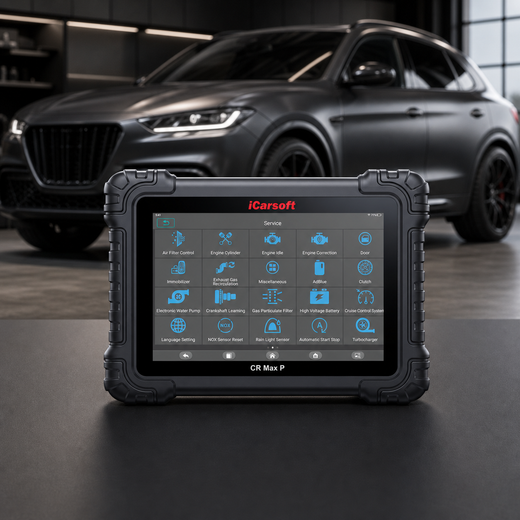
Evidence before replacement
iCarsoft CR Max P
Capture the fault context, compare supported Bank 1 and Bank 2 data, and document the result before and after repair. Coverage varies by vehicle.
Check current CR Max P price and availabilityCheck CR Max P compatibility by VINWhen supported, an active test may command a purge valve, fuel pump, throttle, or another relevant output. A response is useful evidence, but it does not prove flow, pressure, sealing, or mechanical health. Confirm the required PIDs, active tests, and setup functions for the exact VIN before purchase.
Know the measurement boundary. CR Max P does not directly measure voltage, current, resistance, fuel pressure, injector flow, intake or exhaust leakage, terminal tension, compression, or mechanical condition. Use a multimeter or scope, approved fuel-pressure equipment, smoke machine, and mechanical tests alongside scan evidence and the OEM procedure.
7Verify the P2179 Repair
Save the post-repair scan and physical measurements. After the original evidence is protected and the proven fault is corrected, use the OEM clearing procedure for erasable codes and complete any required fuel-trim reset, sensor adaptation, injector setup, or module relearn. Do not disconnect the battery merely to hide the result.
Run the manufacturer’s monitor-enable procedure or safely reproduce the recorded off-idle conditions. Confirm that both banks respond plausibly, the original Bank 2 correction no longer diverges, requested and actual data agree where supported, and no current or pending P2179 or companion code returns. One smooth idle period is not proof of an off-idle repair.
A sound verification is repeatable: the symptom is gone, the P2179 monitor completes, readiness progresses normally, and scan and physical evidence remain stable. If the code returns, compare the new freeze frame with the original rather than replacing the next item on a generic list.
A permanent P2179 can remain immediately after a successful repair. If the vehicle stores it as a permanent DTC, a scan tool or battery disconnect cannot erase it. Once current and pending faults are absent, the OBD system removes the permanent record only after the applicable monitor reruns and passes.
8Related Lean Fuel-Control Code Guides
9P2179 Frequently Asked Questions
Does the P2179 code mean the Bank 2 oxygen sensor is bad?
No. P2179 reports a lean fuel-control result off idle on Bank 2. An O2 or air-fuel sensor can be biased, but unmetered air, exhaust leakage, fuel delivery, injector, ignition, mechanical, wiring, installation, or calibration faults can create the same evidence. Test the complete path first.
What is the difference between P2179 and P2189?
P2179 applies to a Bank 2 lean result in an OEM-defined off-idle region. P2189 applies to a Bank 2 lean result at idle. Their causes can overlap, but their enable conditions and diagnostic value are not interchangeable.
Where is Bank 2 for P2179?
Bank 2 is the cylinder bank that does not contain cylinder 1. It is not always the left, right, driver, or passenger side. Confirm the firing order and engine diagram for the exact VIN before replacing a bank-specific part.
Can I drive with P2179?
A short, light-load diagnostic trip may be reasonable with a steady MIL and normal operation when the owner’s manual allows it. Avoid heavy load. Stop and tow for a flashing MIL, severe misfire, stalling, unsafe power loss, overheating, smoke, fuel leakage, or abnormal noise.
How much does it cost to fix P2179?
Diagnosis currently averages $122–$179 nationally. A proven MAF replacement averages $274–$380, an applicable oxygen-sensor replacement $438–$523, and a proven fuel pump $1,330–$1,501. Leak, wiring, injector, calibration, and mechanical repairs need a VIN-specific quote.
Can CR Max P diagnose P2179?
On supported vehicles, CR Max P can save codes and available freeze frame, graph ECU-provided fuel-control data, compare banks, and run available output tests. It cannot physically prove voltage, fuel pressure, injector flow, air leakage, compression, or terminal fit; external tools and OEM procedures remain necessary.
Technical and cost references
- SAE J2012_202509, Diagnostic Trouble Code Definitions.
- SAE J2012DA_202607, Digital Annex of Diagnostic Trouble Code Definitions and Failure Type Byte Definitions, revised July 29, 2026.
- Volkswagen 2014 CC Quick Reference Specification Book, application-specific P2179/P2189 monitor example.
- RepairPal General Diagnosis Cost Estimate, $122–$179; updated August 7, 2026.
- RepairPal Mass Airflow Sensor Replacement Cost Estimate, $274–$380; updated August 7, 2026.
- RepairPal Oxygen Sensor Replacement Cost Estimate, $438–$523; updated August 7, 2026.
- RepairPal Fuel Pump Replacement Cost Estimate, $1,330–$1,501; updated August 7, 2026.
Product information: Official iCarsoft CR Max P page.
Editorial note: This guide provides general diagnostic education and does not replace the service manual, safety information, or hands-on inspection for the exact vehicle. Bank 2 location, monitor criteria, PID names, specifications, repair procedures, and scan-tool coverage vary. Fuel, hot-exhaust, moving-component, and hybrid high-voltage work should be performed by trained personnel with approved equipment.


