

 By iCarsoft Official Store Technical Team, Automotive Diagnostics Editors · Updated September 27, 2026 · Technical sources checked
Quick Answer
The C0031 code names the left front wheel speed sensor in the cited chassis-code reference. Confirm the OEM description and failure-type suffix. The code identifies a monitored signal path, not a proven bad sensor. Preserve the event, inspect the wheel-end wiring and match electrical or signal tests to the installed sensor type.
What Does the C0031 Code Mean?
NHTSA Appendix K lists C0031 as Left Front Wheel Speed Sensor with a subfault. Apply that reference label only when the complete VIN-specific OEM wording agrees. The full fault record determines the test branch.
Wheel-speed information reaches the brake controller through a sensor and its electrical path. The controller then uses that information alongside other inputs. A sensor-related fault can describe a missing, implausible or electrically abnormal input, depending on the complete OEM code. It does not establish which connector, wire, sensor element or rotating reference caused the observation.
Classify the full event before comparing parts. An electrical-circuit suffix requires different evidence from an erratic-signal or comparison suffix. Write down the reporting ABS module, status and suffix exactly as displayed, then confirm the OEM interpretation. A generic reader that omits the suffix leaves an important diagnostic gap; an internet code label cannot fill it reliably.
Ford TSB 22-2118 applies to certain 2021 F-150 vehicles built on or before June 14, 2021 with front rubbing noise and/or C0031 or C0034. It directs attention to front brake-flexible-hose routing. This is a limited application example: check the current bulletin and matching condition instead of treating every C0031 as either a hose fault or a failed sensor.
A warning after brake service should prompt a record of which parts were moved and when the symptom began. A cable can be connected yet routed incorrectly or held under tension. Equally, a service date near the warning is only a clue. Preserve the original fault and inspect the affected area before removing evidence by replacing the sensor immediately.
Preserve the module wording and suffix before clearing.
Separate C0031 from adjacent fault families
| Code | General description | Key distinction |
|---|---|---|
| C0031 | Left Front Wheel Speed Sensor | Sensor-related record; the suffix selects the branch. |
| C0030 | Left Front Tone Wheel | Rotating-reference label in the cited mapping. |
| C0032 | Left Front Wheel Speed Sensor Supply | Supply fault has its own electrical checks. |
| C0034 | Right Front Wheel Speed Sensor | Opposite front wheel; verify physical side. |
Record the complete C0031 description. Use the exact module, suffix and OEM procedure to select the test path.
C0031 Symptoms and Likely Causes
Record C0031 symptoms and fault status; symptoms alone cannot identify a failed part.
Check whether companion faults share a proven cause.
The controller may report unavailable assistance or store a wheel-speed fault. Record the exact message and current versus history status; a lamp does not identify a failed sensor.
An observed left-front dropout can narrow the investigation when the recording conditions are suitable. A single still image without wheel movement or time context is insufficient.
Recent hose, brake, bearing or suspension service can provide useful inspection context. Review cable clips, connector seating and component routing without assuming the last repair caused the fault.
Physical contact, wheel looseness, dragging, pulling or abnormal pedal behavior requires a safety assessment. Stop the test if a mechanical or braking concern develops.
Practical cause-checking order
- Decode the full suffix: Confirm that the left-front sensor description matches the vehicle, then follow the circuit, signal or comparison branch specified by the suffix.
- Inspect the actual signal path: Inspect the relevant connectors and harness for damage, poor retention, strain and contact with surrounding components, especially where recent work occurred.
- Identify the sensor architecture: Use the wiring diagram to identify the sensor type and permitted electrical tests. Do not apply one resistance specification to every wheel-speed sensor.
- Check the rotating counterpart: Inspect the specified mounting and tone wheel or encoder when signal evidence points there. A good-looking external sensor does not prove a correct rotating reference.
- Prove any controller conclusion: Consider the ABS input stage only after its required supplies, wiring and input evidence have passed the prescribed checks. A fault label alone cannot condemn a controller.
Did C0031 appear after recent left-front brake, hose, wheel-bearing or suspension work? Recheck the documented connections, parts and setup steps affected by that work. Record battery and software history; a post-repair code does not prove the new part is defective.
How Serious Is C0031, and Can You Drive?
Arrange prompt brake diagnosis and follow the owner manual. Do not assume ABS or stability assistance remains available. Abnormal pedal effort, pulling, fluid loss, dragging or a red brake warning requires stopping safely and arranging recovery. The code cannot establish a safe driving distance.
Record brake warnings, pedal changes, fluid loss and recent service. Do not induce wheel slip or emergency braking to test assistance on public roads; warning-state assessment comes before any functional verification.
Stop and arrange a tow if braking changes, pedal effort or travel is abnormal, a wheel drags, fluid leaks or a red brake warning appears.
Follow the exact shutdown and pressure-release procedure before accessing brake components. Support a raised vehicle securely, keep clear of moving parts and never energize unidentified circuits. Do not perform public-road emergency-stop experiments.
How to Diagnose C0031 in the Right Order
-
Save C0031 with its complete failure type
Read the ABS controller and preserve C0031, its suffix, status and available event records. Record whether the warning appeared before movement, at low speed, after a turn or after service. Save related communication and supply faults as well. Do not clear the records simply to see whether the warning disappears before the original event has been documented.
-
Confirm left-front identity and the test architecture
Identify the vehicle, brake-system variant and left-front sensor from the correct service information. Confirm the connector and wiring path rather than assuming an illustration for another model matches. Determine the allowed signal and electrical tests for the fitted architecture. If the scanner’s description disagrees with the OEM record, resolve that discrepancy before choosing a component or measuring a circuit.
-
Inspect routing before unplugging the evidence
With the vehicle secured and safe access established, document the connector, clips and cable route. Look for a trapped or stretched lead, loose retention or contact with a moving or hot component. Keep brake-hose inspection distinct from electrical testing. Any damaged hose, leak or unsafe wheel-end condition requires the appropriate brake repair procedure before further operational testing.
-
Compare supported wheel-speed channels safely
Use supported ABS live-data channels to compare the left-front input with the other wheels under an approved safe test. Save the conditions along with the trace. Do not demand identical readings while turning, and do not provoke ABS intervention on public roads. If the event cannot be reproduced safely, retain that limitation rather than claiming a clean graph proves the system sound.
-
Test the branch identified by the suffix
Follow the OEM branch selected by the complete fault type. An electrical problem needs specified circuit measurements; a signal-pattern concern also needs the relevant sensor mounting and rotating-reference inspection. Use approved test adapters and record the result at the specified location. Do not pierce a sealed lead, inject battery voltage or use an improvised load on an unidentified sensor circuit.
-
Verify the repair under the approved conditions
Repair the demonstrated fault, restore the prescribed routing and complete any required setup. Reassess mechanical and braking safety before the confirmation procedure. Compare the post-repair fault status and recorded wheel-speed behavior with the baseline. A cleared warning at rest is not the same as a completed confirmation check; record any condition that could not be tested safely.
Specifications are vehicle-specific. Use the exact VIN specifications, approved test points and required operating state. No generic value or drive cycle can replace the applicable procedure. Manufacturer examples here do not establish specifications for other applications.
C0031 Repairs and Cost Planning
A C0031 repair must address the demonstrated failure. Do not replace an assembly from the code alone.
Recheck installation and required setup after repair. The scan-tool graph is the controller’s interpretation of an input, not a direct oscilloscope trace from the sensor. Record the wheel-speed channels together with the test conditions and the tool’s capture settings. A missing update, a stopped wheel on a lift and a true signal dropout can look similar when the context is missing. Use a suitable, safe test procedure to resolve that uncertainty.
Ask the shop to name the failed branch and the measurement supporting each proposed repair.
Authorize diagnosis before parts while the cause remains uncertain.
| Possible path | Quote basis |
|---|---|
| Repair the connector or harness after a documented circuit failure | VIN-specific quote |
| Correct the demonstrated physical or installation fault | VIN-specific quote |
| Replace only the component that fails its prescribed test | VIN-specific quote |
| Complete required setup and safe functional verification | VIN-specific quote |
Request an itemized, VIN-specific quote for the proven repair, setup and verification. Check warranty coverage.
Using iCarsoft CR Pro S for C0031
On a supported vehicle, iCarsoft CR Pro S can save accessible faults, available freeze frame, live data and diagnostic reports. Preserve the C0031 evidence before clearing.
Compare available brake-controller records before and after repair. The report supports diagnosis but cannot replace the OEM physical and functional checks.
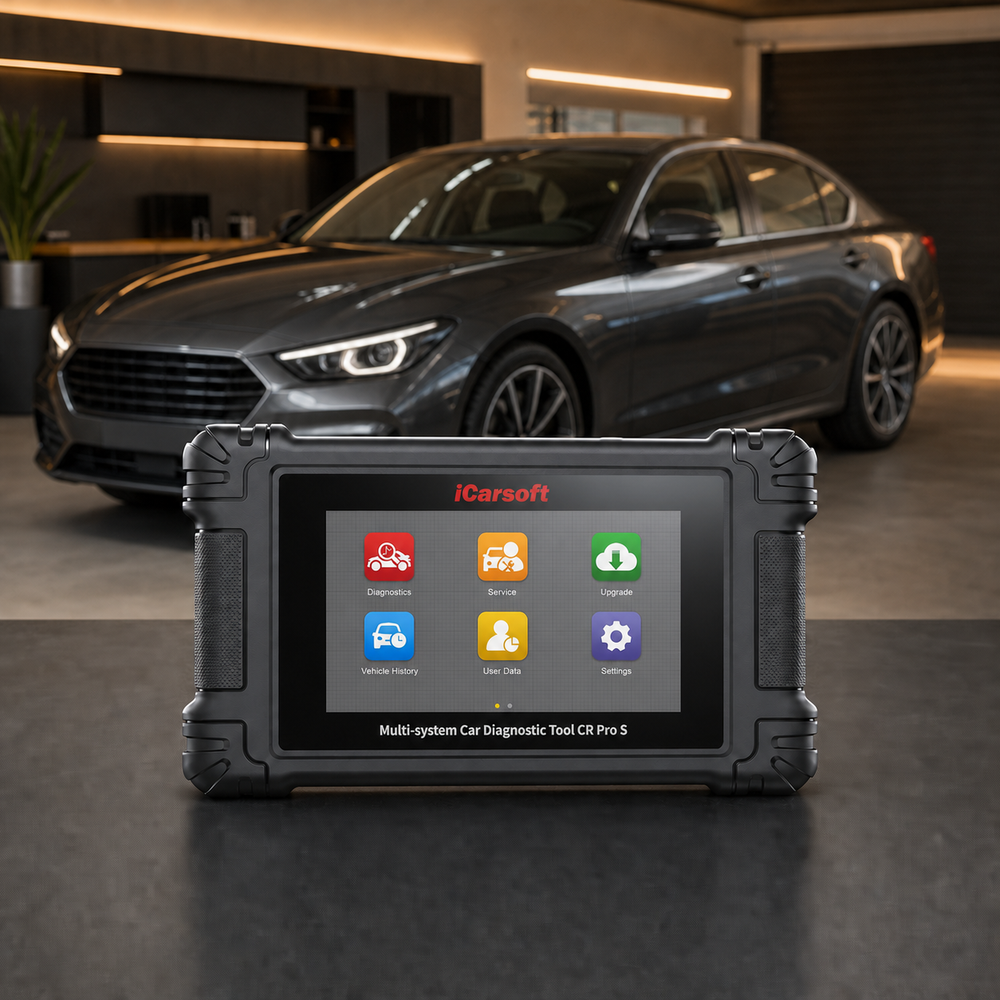
Preserve the left-front wheel-speed signal diagnosis evidence
iCarsoft CR Pro S
Review supported codes and relevant live data together. Confirm the exact VIN, controller access, PIDs and any requested active test with iCarsoft before purchase; generic product capabilities do not guarantee a C0031-specific function.
Check current CR Pro S price and availabilityCheck CR Pro S compatibility by VINThe official product page describes supported full-system diagnostics, available live data, freeze frame and diagnostic reports; exact controller coverage and active tests depend on the VIN and software. Confirm the requested function by VIN before purchase. Follow OEM prerequisites and stop for abnormal operation.
Know the measurement boundary. Scan data describes ECU-provided information; it does not directly prove the physical condition of the left-front wheel-speed signal diagnosis. Where required, use the specified multimeter, oscilloscope and approved brake-system test equipment and compare reported values with the relevant measured evidence.
Verify the C0031 Repair
After repair, verify connectors, harness clearance, setup and controller supply. Save post-repair findings, then clear only erasable records through the approved procedure. Battery disconnection is not a repair.
Run the manufacturer's applicable verification conditions in a safe workshop or route. Compare the original operating state with current data for the left-front wheel-speed signal diagnosis, and check current and pending faults in related modules. One clean start or idle period does not prove that every conditional monitor has completed.
Compare baseline and final scans, required setup and fault confirmation. Record whether the original event returned.
If C0031 returns, compare its suffix, status, failure order and operating conditions with the saved baseline before replacing another part. Revisit the failed branch and inspect anything disturbed. Confirm the prescribed brake-system verification separately from code clearing.
Stored and Active brake-control faults require different decisions. Preserve the original record and follow the OEM confirmation procedure. A cleared display does not prove restored assistance or safe braking.
Related Left-Front Wheel-Speed Signal Diagnosis Code Guides
Use each related code's own diagnostic procedure.
C0031 Frequently Asked Questions
Does C0031 prove the left front ABS sensor is bad?
No. The reference names the left front wheel speed sensor, but the full OEM failure type can point to the circuit, signal behavior or a related physical condition. Confirm the reporting module and suffix, then document the failed test before replacing the sensor.
What should I check first for C0031?
Save every module's codes and freeze frame before clearing. Confirm the full definition, suffix and VIN architecture. Then inspect recent left-front brake, hose, wheel-bearing or suspension work, connectors and shared supplies. Those facts determine whether the next test needs the specified multimeter, oscilloscope and approved brake-system test equipment or a manufacturer-specific functional procedure.
Can I drive with the C0031 code?
Arrange prompt brake diagnosis and follow the owner manual. Do not assume ABS or stability assistance remains available. Abnormal pedal effort, pulling, fluid loss, dragging or a red brake warning requires stopping safely and arranging recovery. The code cannot establish a safe driving distance.
Why did C0031 return after a part was replaced?
Replacing a sensor may disturb the connection and temporarily change an intermittent fault without addressing its cause. Keep the failed measurement and the original routing observations with the job record. If the same condition returns, compare the exact suffix and vehicle state, then investigate the demonstrated branch rather than using the second warning as proof that another replacement sensor is needed.
What should a C0031 repair estimate include?
Request failed-test evidence and itemized diagnosis, parts, labor, setup and verification costs. The code cannot determine the price.
Can CR Pro S diagnose and clear C0031?
On a supported vehicle, CR Pro S can organize available faults, freeze frame, live data and reports, and can clear erasable records after repair. Confirm exact ECU coverage. It cannot establish safe braking from an erase command or replace physical measurements for the left-front wheel-speed signal diagnosis.
The iCarsoft Official Store Technical Team maintains the store's fault-code library. This guide organizes published technical references and verified product information; it does not document a hands-on test of a particular vehicle or claim an individual engineer's review.
Technical and cost references
- NHTSA DOT HS 812 574 — Hydraulic Braking System Appendices. March 2018; Appendix K, Table K-2 provides selected chassis-code labels. It does not replace current VIN-specific service information.
- Ford TSB 22-2118 — May 3, 2022. Specific 2021 F-150 build-date and condition limits; brake-hose routing example, not a universal sensor replacement.
Product information: Official iCarsoft CR Pro S page.
Editorial note: General diagnostic education, not a substitute for the owner's manual, current VIN-specific service information or professional inspection. Test limits, procedures, coverage and costs vary. Related articles provide context; apply only the specifications and repair procedures that match the vehicle. No universal failure rate, repair price or outcome is implied.


