

Quick Answer
The P228B code means Fuel Pressure Regulator 2 Control - Forced Engine Shutdown. The controller recorded a protection-level fuel-pressure-control result involving the OEM-designated regulator 2 path. It does not prove the regulator or pump has failed. Save all code status and freeze frame, identify the VIN-specific system, and check wiring, supply fuel, feedback and bulletins before buying parts.
1What Does the P228B Code Mean?
P228B is the standardized powertrain description “Fuel Pressure Regulator 2 Control - Forced Engine Shutdown.” It says the engine controller recorded a fuel-pressure-control condition serious enough for its protective strategy to request or force shutdown. The wording does not state that pressure was universally high or low, and it does not identify one failed part.
“Regulator 2” is an OEM designation. Depending on the VIN, it may be a pump-mounted metering valve, rail valve or another commanded path. It is not “Bank 2.” Use the exact component description, wiring and fuel-system diagram.
The controller judges command, pressure feedback and operating inputs. A biased sensor, lost supply, restricted feed, contamination, sticking valve, pump problem or calibration error can reach the shutdown limit. Read companion codes and failure order before naming the primary fault.
P228B compared with nearby fuel-pressure codes
| Code | General description | Key distinction |
|---|---|---|
| P228A | Fuel Pressure Regulator 1 Control - Forced Engine Shutdown | The same shutdown class, but for the OEM-designated regulator 1 path. |
| P228B | Fuel Pressure Regulator 2 Control - Forced Engine Shutdown | The subject code; it names regulator 2 and a protective shutdown result. |
| P228C | Fuel Pressure Regulator 1 Control Performance - Low Pressure | A regulator 1 performance result specifically associated with low pressure. |
| P228D | Fuel Pressure Regulator 1 Control Performance - High Pressure | A regulator 1 performance result specifically associated with high pressure. |
| P2293 | Fuel Pressure Regulator 2 Performance | A regulator 2 performance fault without the forced-shutdown wording. |
| P0087 | Fuel Rail/System Pressure Too Low | A rail/system pressure result; it does not select regulator 2. |
OEM examples prove that P228B is not a parts verdict. GM Bulletin 20-NA-197 links it on listed diesels to fuel-pressure-sensor connector damage. Bulletin 18-NA-361 (May 2024) covers contamination checks; Bulletin 24-NA-094 (April 2025) covers a software anomaly on specified LZ0 trucks. Apply only the bulletin that matches the VIN.
2P228B Symptoms and Likely Causes
Symptoms of the P228B code depend on whether it is current, pending, history or permanent and on why the controller entered protection. A vehicle may show only a stored record after an intermittent event, but an active fault can make continued driving unreliable.
The Check Engine light, a fuel-system message or torque limitation may appear before shutdown.
The engine may stop by design, stall during operation or crank without restarting while the fault is active.
Slow pressure build, unstable control or false feedback can cause hesitation, surging, smoke or uneven running.
P0087, P0089, P0191, P2293 or regulator circuit codes can reveal the failing path and event order.
Practical cause-checking order
- Connector or harness: corrosion, loose terminals, water, heat or rubbing at the pressure sensor, regulator, pump or ECM path.
- Power, ground or control: an open, short, voltage drop, weak supply or driver-load problem in regulator 2 control.
- Low-side supply: a restricted filter, weak feed pump, air ingress, applicable diesel gelling or another factory-defined supply fault.
- Fuel quality: water, gasoline in diesel, Diesel Exhaust Fluid or debris that changes pump and regulator behavior.
- Biased feedback: a pressure sensor or its reference, signal or low-reference circuit can report implausible pressure.
- Control or mechanical path: a sticking valve, injector return, return restriction, pump wear or applicable drive problem.
- Calibration or controller: check bulletins first; condemn the ECM only after external circuits, loads and fuel paths pass.
Recent-work clue: if P228B appeared after a filter, sensor, pump, injector, battery or harness repair, recheck connector locks, pin fit, grounds, hose routing, filter installation, priming and the exact part application before replacing another component.
3How Serious Is P228B, and Can You Drive?
Treat an active P228B code as high priority because it records forced-engine-shutdown control. The event can repeat and remove power without useful warning. Avoid commuting, towing, heavy acceleration and traffic exposure until the fault is understood.
A short, light-load trip may be reasonable only when P228B is history or intermittent, the engine runs normally, no leak or odor exists, no critical warning is present and the owner's manual permits it. Otherwise arrange diagnosis or towing.
Stop and arrange a tow if the engine stalls or will not restart, power loss is unsafe, the MIL flashes, the engine misfires severely, fuel leaks or smells strongly, smoke appears, a high-pressure leak is suspected, or overheating, oil-pressure or abnormal mechanical-noise warnings occur.
High-pressure fuel can remain hazardous after shutdown. Never loosen a rail pipe, injector line, sensor or pump fitting to “see whether fuel comes out.” Keep ignition sources away, allow hot components to cool, and follow the OEM depressurization, containment and personal-protection procedure. Diesel common-rail and gasoline direct-injection hardware require approved equipment and trained handling.
4How to Diagnose P228B in the Right Order
-
Save every code, status and freeze-frame record
Scan all modules before clearing. Record whether P228B is current, pending, history or permanent; save failure order, engine speed, load, voltage, exposed pressure data, fuel temperature and companion codes. A restart may erase the operating clue.
-
Identify the exact VIN architecture and service path
Use the VIN and engine to find regulator 2 in the OEM description, diagram and connector view. Confirm fuel type, pressure layout, control direction, sensor names, monitor conditions, safety steps, bulletins and calibration. Never transfer another vehicle's threshold.
-
Inspect the cool system before opening it
Secure and cool the vehicle. Check accessible connectors, terminal tension, locks, grounds, harness routing, heat shields, abrasion, water and external leakage. On applicable diesels, review filter history and gather fuel-quality evidence only by the OEM procedure.
-
Prove electrical loads and physical fuel paths
Use the diagram, digital multimeter, load tool and approved pressure equipment. Test powers, grounds, references, signals, voltage drop and specified current. Separately prove supply, restriction, air ingress, fuel quality and permitted return flow. A scan PID is not a gauge.
-
Compare command, feedback and active response
Graph supported regulator command with desired and actual pressure, speed and voltage during the recorded state. If the VIN exposes a safe active test, watch command and feedback. Missing data or an unsupported test is a coverage limit, not a failed part.
-
Confirm the failed part, setup and monitor result
Repair only the path that failed a documented test. Confirm serviceability and required priming, learn, coding or calibration. After leak inspection and setup, clear erasable codes by the OEM procedure and reproduce monitor conditions safely; leave the controller for last.
Specifications are vehicle-specific. Regulator duty cycle, pressure, sensor voltage, resistance, current, return volume, temperature, time and shutdown limits vary by VIN, units and operating state. Use only the factory specification for the identified system.
5P228B Repairs and Typical Costs
The correct P228B code fix follows the failed test: repair wiring; correct supply, restriction, air or contamination; replace a proven sensor, serviceable filter, control valve or pump; complete setup; or install an applicable calibration. Complete high-pressure-system replacement is not the default.
On a bulletin vehicle, follow that bulletin. GM's contamination, connector and software examples are application-specific alternatives, not permission to flush, open or program another vehicle.
| Possible path | Current US estimate |
|---|---|
| Professional diagnosis and evidence capture | $122-$179 |
| Serviceable fuel filter replacement, if restriction or contamination is confirmed | $251-$315 |
| Fuel pressure sensor replacement, only after circuit and pressure proof | $413-$513 |
| Fuel pump replacement, when the tested pump is the failed assembly | $1,330-$1,501 |
| Connector, harness, regulator 2 valve, high-pressure pump or contamination repair | VIN-specific quote |
| ECM calibration, setup or controller work | VIN-specific quote |
RepairPal's General Diagnosis, Fuel Pressure Sensor Replacement and Fuel Pump Replacement estimates were each updated August 7, 2026; its national Fuel Filter Replacement estimate was updated July 25, 2026. The displayed ranges exclude location, taxes, fees and related work. These rows are alternative outcomes, not amounts to add together, and integrated diesel or direct-injection hardware can require a very different VIN-specific quote.
6Using iCarsoft CR Max P for P228B
On a supported vehicle, iCarsoft CR Max P can scan the relevant engine module, preserve P228B code status and available freeze frame, display ECU-provided live data and save a diagnostic report. Useful items may include desired and actual fuel pressure, regulator command, fuel-pressure-sensor data, engine speed, load, voltage and fuel temperature, but names and availability vary by VIN, ECU and software.
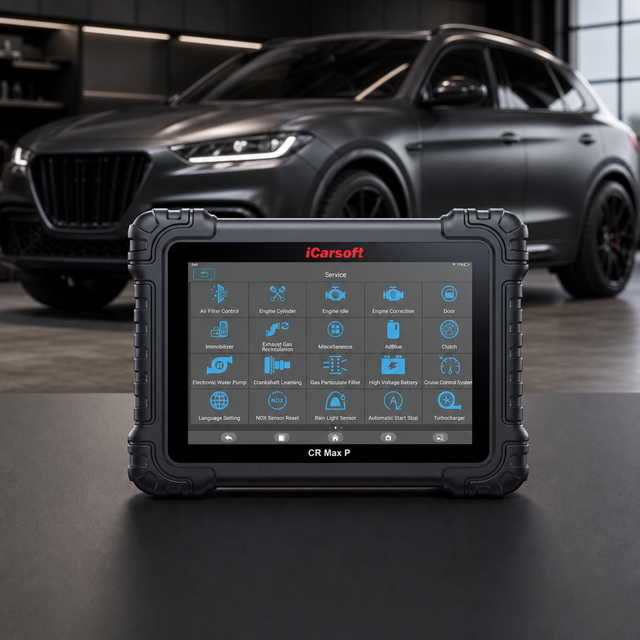
Evidence before parts
iCarsoft CR Max P
Use supported scan data to preserve the shutdown event and compare control with feedback, then confirm the physical fuel and electrical paths with OEM procedures and external instruments.
Check current CR Max P price and availabilityCheck CR Max P compatibility by VINWhen the VIN and ECU expose a relevant active test, CR Max P may command an available pump or control function while feedback is watched. Run only the OEM-approved test safely. Never force a valve or treat an unsupported command as a failed component. Confirm coverage by VIN.
Know the measurement boundary. CR Max P does not directly measure terminal tension, physical voltage drop, current under load, hydraulic pressure, filter restriction, injector return, fuel contamination, leakage, mechanical travel or internal pump condition. Use a digital multimeter, load tool, approved pressure equipment, fuel-quality test and physical inspection required by the OEM procedure.
7Verify the P228B Repair
After the confirmed repair, inspect every opened connection for leakage using the OEM method, complete priming and any required learn or calibration, and save a post-repair scan. Clear only erasable DTCs after the original evidence is stored. Recheck P228B code status, companion pressure codes, voltage and supported command-versus-feedback data.
Run the actual monitor enable conditions from service information or safely reproduce the original freeze-frame state. One clean idle or immediate restart is not proof when the fault occurred under cranking, load, temperature or deceleration conditions. Finish with a leak check, stable operation and a report showing that the relevant monitor passed without current or pending recurrence.
A permanent P228B can remain immediately after a successful repair. If the vehicle stores it as a permanent DTC, a scan tool or battery disconnect cannot erase it. Once current and pending faults are absent, the OBD system removes the permanent record only after the applicable monitor reruns and passes.
8Related Fuel-Pressure Code Guides
9P228B Frequently Asked Questions
Does P228B mean fuel pressure regulator 2 is bad?
No. Wiring, supply fuel, contamination, pressure feedback, control hardware, pump mechanics or calibration can make regulator 2 control reach shutdown. Test the VIN-specific path before replacing a regulator.
What is the difference between P228B, P228C and P228D?
P228B names regulator 2 and forced engine shutdown. P228C and P228D name regulator 1 control performance with low-pressure and high-pressure direction, respectively. They are related but do not describe the same monitor result or automatically share one repair.
Can I drive with the P228B code?
Not normally while it is active; shutdown can recur. Tow for a stall, no-start, unsafe power loss, severe misfire, fuel leak or odor, smoke or another critical warning. A history code still needs prompt diagnosis.
Where is fuel pressure regulator 2 located?
There is no universal location. The OEM may use “2” for a pump-mounted metering valve, rail valve or another control path. It is not Bank 2. Use the VIN-specific component description, fuel diagram, wiring diagram and connector view to identify it.
How much does a P228B repair cost?
Current national planning ranges run from $122-$179 for diagnosis to $1,330-$1,501 for a confirmed fuel-pump replacement. A filter or pressure sensor falls between those anchors. Regulator, high-pressure pump, wiring, contamination and programming work need a VIN-specific quote.
Can iCarsoft CR Max P diagnose P228B?
On a supported VIN, iCarsoft CR Max P can save evidence, graph exposed pressure and control data, create a report and run approved active tests. It cannot physically prove pressure, wiring load, contamination, leakage or internal condition.
Technical and cost references
- GM Bulletin 18-NA-361 (May 2024), Diagnostic Tip for Diesel Fuel System Contamination — lists P228B and application-specific contamination checks.
- GM Bulletin 20-NA-197 (December 2021) — identifies fuel-pressure-sensor connector corrosion or damage on listed diesel applications.
- GM Bulletin 24-NA-094 (April 2025), LZ0 Engine Control Module Update — includes P228B in an application-specific software-anomaly correction.
- GM Bulletin 18-NA-103 (September 2022), diesel fuel gelling information — shows a low-temperature supply condition associated with P228B on covered vehicles.
- RepairPal General Diagnosis Cost Estimate and Fuel Pressure Sensor Replacement Cost Estimate — $122-$179 and $413-$513, updated August 7, 2026.
- RepairPal Fuel Pump Replacement Cost Estimate — $1,330-$1,501, updated August 7, 2026.
- RepairPal Fuel Filter Replacement Cost Estimate — $251-$315, updated July 25, 2026.
- California Bureau of Automotive Repair permanent-DTC guidance — explains that repair and a successful monitor, not a scan-tool clear or battery disconnect, remove a permanent record.
Product information: Official iCarsoft CR Max P page.
Editorial note: This article provides general diagnostic education, not a substitute for the service information, safety instructions and specifications for a specific VIN. High-pressure fuel can cause severe injury or fire. Costs are current US planning ranges and can change; confirm local quotes, product coverage and approved procedures before work.


