

Quick Answer
On many GM applications, C0899 means Device Voltage Low. The reporting module detected inadequate voltage for reliable operation, but the base code alone does not identify the failed circuit or prove the battery, alternator, or brake controller is bad. Save the full code, suffix, module name, status, and companion faults before clearing anything.
1What Does the C0899 Code Mean?
C0899 is not a universal promise that every vehicle uses the same controller or diagnostic path. In General Motors service information, the familiar description is Device Voltage Low. A module has decided that the voltage available to it is too low for dependable operation. On many GM vehicles the electronic brake control module (EBCM) reports the code, which is why ABS, traction-control, and stability-control warnings often appear.
The exact monitored feed depends on the vehicle, brake system, module, and two-digit suffix. A capable scanner may display C0899:00, C0899:03, or another application-specific form. Record that result. A reader showing only C0899 may hide detail needed to select the correct wiring diagram and test.
“Voltage low” is a monitored electrical result, not a diagnosis. The battery may be discharged, a charging component may be weak, or a high-resistance connection may cause a local loss at one module while battery-post voltage looks acceptable. A history entry may also preserve a past jump-start, storage discharge, or interrupted repair even though the system now operates normally.
Do not confuse these low-voltage and power codes
| Code | General description | Key distinction |
|---|---|---|
| C0899 | Device Voltage Low on many GM applications | The module and suffix determine which supply and diagnostic procedure apply. |
| C0800 | Control Module Power Circuit on many GM applications | Points to a module power-circuit classification; the suffix and reporting module are essential. |
| P0562 | System Voltage Low | A standardized powertrain code; note which controller stored it and whether several modules report low voltage. |
Application example, not a universal shortcut: archived GM service information for one 2009 Silverado application says its EBCM monitors available battery-positive voltage. Other vehicles may monitor a different feed, use another controller, or assign a different threshold. Use the service information for the VIN.
2C0899 Code Symptoms and Likely Causes
C0899 symptoms range from a stored history record with no current complaint to several safety-system warnings and a vehicle that will not restart. The status and companion codes help separate a past low-voltage event from an active module-specific supply problem.
The ABS lamp, traction/stability message, or an amber brake-system warning may appear when the affected controller disables functions.
Slow cranking, a no-start, dim lamps, accessory resets, or a charging warning suggest a wider low-voltage condition.
Warnings may follow a bump, wet weather, cold start, heavy electrical load, recent battery work, or aftermarket accessory installation.
A history-only C0899 may remain after storage, transport, jump-starting, battery discharge, or an earlier connection problem.
Practical cause-checking order
- Battery state and health: a discharged, deteriorated, incorrect, or poorly connected 12-volt battery can let one or many modules fall below their operating range. Recharge and test it before deciding on replacement.
- Connections and grounds: loose posts, damaged cable crimps, corroded ground eyelets, paint under a ground, overheated junctions, fretting terminals, or water intrusion can create load-dependent voltage loss.
- Charging-system operation: an alternator, regulator, belt drive, battery sensor, control circuit, or hybrid/EV DC/DC converter may not support the vehicle under the conditions recorded with the fault.
- Module-specific feed: an open or high-resistance fuse path, relay, splice, connector, power wire, or ground can affect the reporting controller without creating the same reading at the battery.
- Discharge or recent work: a parasitic draw, repeated short trips, interrupted programming, battery replacement, collision work, or aftermarket equipment may explain when the event began.
- Controller fault: internal EBCM or other module failure is possible, but it belongs late in the test plan after external powers, grounds, terminals, and applicable bulletins pass.
Recent-work clue: if C0899 began after a battery, intake, audio, remote-start, body, or wiring job, recheck disturbed grounds, fasteners, cable routing, fuse-block connections, and accessory attachment points before buying another component.
3How Serious Is C0899, and Can You Drive?
Treat an active C0899 as moderate to high severity. If the vehicle starts normally, the red brake warning is off, pedal feel and steering assist are normal, and the owner’s manual permits operation with the displayed amber warning, a short light-load trip to a nearby repair facility may be reasonable. Avoid high speed, poor weather, towing, steep grades, and situations likely to demand ABS or stability intervention.
Stop and arrange a tow if the red brake or charging warning is on; brake pedal travel or effort changes; steering assist drops out; the engine stalls or repeatedly will not restart; lamps become too dim for safe travel; multiple modules shut down; or you notice smoke, a burning smell, a hot cable/fuse block, leaking brake fluid, or damaged battery casing.
Wear eye protection around batteries and keep sparks and flame away. Do not disconnect the battery while the engine is running as an alternator test. Follow high-voltage disable procedures on hybrids and EVs, support the vehicle correctly if access underneath is required, and remember that ABS hydraulic work can require professional pressure-control and bleeding procedures.
4How to Diagnose the C0899 Code
-
Save every module's evidence
Run a complete vehicle scan before clearing codes or disconnecting the battery. Record C0899 exactly as displayed, including suffix, reporting module, current/history status, failure order, available snapshot data, and companion P-, C-, B-, and U-codes. A cluster of low-voltage and lost-communication faults suggests a different path from one current EBCM code.
-
Identify the VIN-specific architecture
Use the VIN, options, brake-system RPO information, and the module name to select the correct OEM description, connector views, ground locations, power distribution, test conditions, and service bulletins. Confirm whether the vehicle uses a conventional alternator, smart charging, or a DC/DC converter. Do not transfer a threshold or pin number from another model year.
-
Inspect the cool, powered-down system
With the vehicle secured and the required shutdown procedure complete, inspect the battery case and posts, cable crimps, fuse and junction blocks, accessible grounds, module connectors, harness routing, prior splices, water paths, heat damage, and aftermarket attachments. Do not repeatedly replace a blown fuse; find the overload or short.

Compare the affected module's supply and ground path with the VIN-specific diagram and loaded-test procedure. -
Prove the supply and ground under load
First establish battery state of charge and health with equipment suitable for the battery type. Then use the OEM procedure and a properly rated digital multimeter, load tool, current clamp, battery tester, or scope to test the charging source, positive path, and ground path under the relevant load. Measure from actual posts and specified test points. An unloaded ohmmeter check alone may miss a poor connection.
-
Compare scan data with physical measurements
Watch the reporting module's voltage PID, code status, and related data while safely reproducing the event conditions. Compare ECU-reported voltage with a simultaneous external measurement at the specified circuit. A PID follows what the controller sees; it does not independently prove battery capacity, cable integrity, terminal tension, alternator current, or ground quality.
-
Confirm the failed path and service requirements
Only after external power, ground, connector, and charging tests pass should controller software or internal failure move up the list. Confirm whether a repaired ground, new battery, alternator/DC-DC repair, wiring service, or module replacement requires battery registration, setup, programming, coding, calibration, ABS bleeding, or another OEM procedure. Finish with the verification sequence below.
Specifications are vehicle-specific. Do not publish or apply a universal resting voltage, cranking minimum, charging range, resistance limit, voltage-drop limit, fuse rating, timer, or trip count. Use the exact OEM value, test load, temperature, operating mode, and meter connection for the VIN.
5C0899 Code Repairs and Typical Costs
The correct C0899 fix follows the failed test. It may be as simple as restoring a terminal or ground, but a battery or charging component should be replaced only after it fails the applicable test. Likewise, an EBCM should not be condemned because it stored a low-voltage code. GM communication PIC5988 specifically warns against replacing or programming a component when listed history faults, including C0899 on the covered vehicle, cannot be duplicated.
| Possible path | Current US estimate |
|---|---|
| Electrical-system diagnosis before parts approval | $122–$179 |
| Battery replacement, only if the battery fails testing | $449–$486 |
| Alternator replacement, only if the alternator is proven faulty | $806–$1,087 |
| Clean/repair a ground, terminal, fuse path, connector, cable, or harness | VIN-specific quote |
| DC/DC converter, EBCM, or other controller diagnosis, setup, programming, or replacement | VIN-specific quote |
RepairPal's national estimates shown above were displayed as updated August 7, 2026. They exclude location, taxes, fees, and related work. Vehicle-specific battery type, access, programming, and labor can change the total. These rows are alternative outcomes, not amounts to add together; wiring, controller, and electrified-vehicle work require a quote tied to the VIN and confirmed failure.
6Using iCarsoft CR MAX for C0899
On a supported vehicle, iCarsoft CR MAX can scan the relevant chassis and brake modules, preserve the complete C0899 entry and status, show ECU-provided voltage or charging data when exposed, and save a diagnostic report. A full-system scan helps because widespread low-voltage codes, network faults, and one isolated module fault tell different stories.
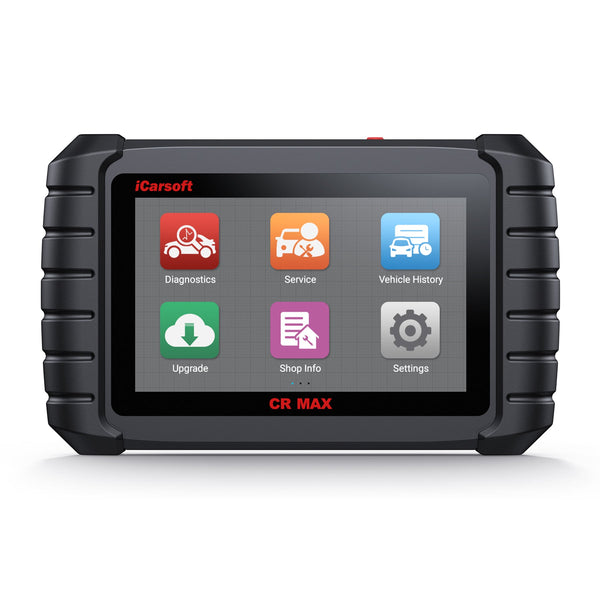
Evidence before parts
iCarsoft CR MAX
Use supported full-system scans, module access, live data, active tests, and saved reports alongside the OEM electrical procedure. Coverage and functions vary by VIN, model year, ECU, and software.
Check current CR MAX price and availabilityCheck CR MAX compatibility by VINUseful PIDs and bi-directional tests are supported-vehicle dependent. Do not command an ABS pump, perform a bleed routine, or program a controller while supply voltage is unstable. An output test can show that a controller issued a command and received feedback; it cannot prove the quality of the power feed, hydraulic pressure, or the internal condition of every component.
Know the measurement boundary. CR MAX does not directly measure physical voltage, current, resistance, voltage drop, battery capacity, alternator ripple, terminal tension, or ground integrity. Use the required external instrument and OEM procedure alongside scan evidence.
7Verify the C0899 Repair
Save the pre-repair report, measurements, and confirmed finding. Complete required battery registration, module setup, programming, coding, calibrations, or ABS procedures before judging the result. With stable power, use the OEM method to clear erasable faults, then rescan every module.
Reproduce the original conditions safely: cold start, key-on, cranking, electrical load, road vibration, or another event supported by the saved record. Compare the controller's voltage PID with the appropriate external measurement, confirm current and pending/status faults stay absent, and verify that brake, stability, steering, charging, and communication warnings do not return. One clean idle period is not proof of an intermittent repair.
Current and history status matter. A history C0899 immediately after repair does not by itself prove the fault remains active. Follow the vehicle's documented clearing or aging rules, retain the post-repair scan, and investigate again if the code becomes current, resets under the enable conditions, or the warning returns.
8Related Voltage and ABS Code Guides
9C0899 Frequently Asked Questions
Is C0899 the same on every vehicle?
No. On many GM applications it means Device Voltage Low, but the reporting module, two-digit suffix, vehicle options, and OEM service information determine the actual circuit and test. Save the complete scan result rather than relying on the base code alone.
Does C0899 mean the ABS or EBCM module is bad?
No. The EBCM may be the module that noticed low voltage, not the cause. A discharged battery, charging fault, poor ground, terminal issue, fuse path, connector, or wiring loss must be tested before controller replacement.
What is the difference between C0899, C0800, and P0562?
C0899 commonly describes device voltage low on GM applications. C0800 commonly classifies a control-module power-circuit fault on GM applications. P0562 is the standardized System Voltage Low powertrain code. The module, suffix, status, and companion faults separate their test paths.
Can I drive with the C0899 code?
Only conditionally. A short light-load trip may be reasonable when the vehicle starts normally, pedal and steering feel are normal, only an amber warning is present, and the owner's manual permits it. Tow the vehicle for a red brake/charging warning, changed pedal effort, lost steering assist, stalling, smoke, heat, or burning odor.
How much does it cost to fix C0899?
National estimates displayed August 7, 2026 were $122–$179 for electrical diagnosis, $449–$486 for battery replacement, and $806–$1,087 for alternator replacement. Only the proven repair applies; wiring, grounds, controllers, programming, and DC/DC work need a VIN-specific quote.
Can iCarsoft CR MAX diagnose C0899?
On a supported vehicle, CR MAX can scan the reporting module, preserve code details and status, display available live data, and save reports. It cannot physically test battery capacity, voltage drop, current, resistance, terminal tension, or ground quality, so use external test equipment and the OEM procedure.
Technical and cost references
- Archived 2009 Chevrolet Silverado service information — C0899 Device Voltage Low (third-party archive; application-specific).
- GM PIC5988, May 2014 — History DTCs Leading to Misdiagnosis or Needless Component Replacement (2014 Cadillac ELR only).
- GM TechLink, January 29, 2016 — Poor Ground Connection at G110 (third-party mirror; 2009–2015 Cadillac CTS-V only).
- RepairPal Electrical System Diagnosis Cost Estimate — $122–$179; updated August 7, 2026.
- RepairPal Battery Replacement Cost Estimate — $449–$486; updated August 7, 2026.
- RepairPal Alternator Replacement Cost Estimate — $806–$1,087; updated August 7, 2026.
Product information: Official iCarsoft CR MAX page.
Editorial note: This educational guide cannot replace the wiring diagram, service information, safety instructions, and specifications for the exact VIN. C0899 usage varies by manufacturer and module. Diagnose current symptoms and the complete scan record before authorizing parts or driving the vehicle.


