

 By iCarsoft Official Store Technical Team, Automotive Diagnostics Editors · Updated August 31, 2026 · OEM technical references checked
Quick Answer
The P0028 code means Intake Valve Control Solenoid Circuit Range/Performance on Bank 2. It is an intake-side fault, not an exhaust-solenoid definition. Save the scan evidence, identify the engine's valve-control system, and compare the commanded state with its feedback. Check oil condition and the applicable electrical and hydraulic paths before choosing a replacement part.
What Does the P0028 Code Mean?
P0028 reports that the monitored Bank 2 intake valve-control behavior did not meet the controller's expected range or performance. It does not identify one failed part. The exact monitor may depend on electrical command, oil-operated movement, feedback, or a combination of these. Read the manufacturer's definition for the installed engine before ordering components.
Bank 2 is the bank that does not contain cylinder 1. Its physical location must come from the engine's own cylinder-numbering diagram, not a universal driver-side or passenger-side rule. Intake and exhaust hardware can look similar, and nearby camshaft-control components may belong to a different function. Confirm connector and component identities separately.
An archived Subaru service-manual example, available through Operation CHARM, describes variable valve lift monitored through an oil-pressure switch. The controller compares lift commands with the expected switch state. That example explains how a feedback or oil-delivery problem can produce a performance code even when the solenoid's electrical winding has not failed.
Variable valve lift changes how far a valve opens; variable camshaft timing changes when the valve event occurs. An engine can use one or both arrangements. The Subaru example is not a universal description of every vehicle, and P0028 should not automatically be treated as a camshaft-position correlation fault or an instruction to replace the timing chain.
Intake, exhaust, lift and timing: keep the codes separate
| Code | General description | Key distinction |
|---|---|---|
| P0026 | Intake valve control range/performance, Bank 1 | Similar generic function on the other bank; confirm the actual system. |
| P0028 | Intake valve control range/performance, Bank 2 | The subject of this guide; not an exhaust-control definition. |
| P0029 | Exhaust valve control range/performance, Bank 2 | Different valve side; do not select its component from P0028 alone. |
| P0021 | Intake camshaft timing over-advanced/system performance, Bank 2 | A cam-timing branch that must not be confused with a valve-lift diagnosis. |
A command is not proof of movement. A scanner may show that the controller requested a valve-control state without proving that oil pressure, mechanical operation, or the feedback switch responded correctly. Diagnose the point where the expected sequence fails.
P0028 Symptoms and Likely Causes
A P0028 code may accompany a warning light without an obvious driving change, or it may appear with hesitation and reduced performance when the valve-control system changes state. Symptoms help define the test conditions, but they cannot establish whether the fault is electrical, hydraulic, or mechanical.
The warning may appear only after the relevant operating conditions enable the valve-control monitor.
Performance may change around a commanded valve-control transition, depending on the engine and fallback strategy.
Low oil level, leakage, incorrect service history, or an oil warning requires separate investigation rather than a guessed solenoid repair.
Temperature, oil behavior, connector movement, and operating load can affect a fault that is absent during a cold stationary scan.
Practical cause-checking order
- Oil level, specification, or supply: confirm the correct checking procedure, required lubricant, service history, and any evidence of leakage or inadequate pressure.
- Feedback-switch or circuit problem: on a system that uses pressure-switch feedback, test the switch and its wiring rather than assuming the commanded hydraulic state occurred.
- Solenoid connection or control fault: inspect terminal retention, contamination, harness damage, supply, ground, and the command path specified for the engine.
- Restricted oil passage or sticking control mechanism: consider this when electrical tests pass but the required hydraulic response is not demonstrated.
- Incorrect installation or internal problem: confirm component application and recent repairs before considering internal engine work or a controller fault.
After an oil change or valve-control repair: verify the oil specification, level, filter application, electrical connections, and exact replacement part. A normal oil level does not prove adequate pressure at every operating condition. Do not add engine flush, thicker oil, or an aftermarket additive as a substitute for finding the failed test.
How Serious Is P0028, and Can You Drive?
Arrange diagnosis promptly. If the engine runs smoothly, the oil level is correct, no urgent warning is present, and the owner's manual permits operation, a short gentle trip for service may be reasonable. Avoid heavy acceleration or deliberately forcing a valve-control transition to see whether the warning returns.
Treat an oil-pressure warning or abnormal mechanical noise as a different and more urgent concern than an isolated check-engine light. A restart that temporarily removes a symptom does not show that lubrication is safe.
Stop and arrange a tow for an oil-pressure warning, knocking or severe rattling, major oil loss, overheating, repeated stalling, severe misfire, or unsafe loss of power. Shut down safely when instructed by the owner's manual and arrange professional assessment or transport. Do not keep running the engine to complete a scanner test when lubrication may be inadequate.
Oil-system work can involve hot surfaces, pressurized fluid, moving belts, and automatic fans. Let the engine cool for inspections and follow the manufacturer's isolation procedure. Do not remove switches or solenoids with the engine running, probe unidentified terminals with battery power, or reach into the engine bay during a commanded test.
How to Diagnose P0028 in the Right Order
-
Preserve the fault and its operating conditions
Save P0028 status, full description, suffix, freeze frame, and companion oil-pressure, valve-control, cam-timing, or misfire faults. Record engine speed, load, temperature, and available command/feedback data. Ask when the problem started and whether oil service, wiring work, a replacement engine, or valve-control repairs preceded it.
-
Confirm Bank 2 and the actual valve-control architecture
Use the VIN, engine identification, component map, and current service information to locate Bank 2 intake control. Determine whether the monitor uses valve-lift switching, timing control, a pressure switch, or other feedback. Identify the correct connector and test chart before touching similar-looking intake or exhaust components.
-
Establish the oil and mechanical baseline
Check oil level using the specified method, then verify grade, service interval, filter suitability, leakage, and contamination evidence. Follow the OEM pressure-test branch if symptoms or the diagnostic chart require it. Do not conclude that pressure is correct merely because the dashboard lamp is off or the dipstick reads normally.
-
Test the relevant solenoid and feedback circuits
Inspect plugs and harnesses for oil entry, corrosion, loose terminals, heat damage, and repair errors. Test supply, ground, control, and feedback using the engine's schematic and specified equipment. A pressure switch and a solenoid require different checks. Do not substitute a generic resistance specification or jumper a controller output.
-
Compare the commanded state with its measured response
Under safe manufacturer-approved conditions, observe available command and feedback values together. If the command changes but feedback does not, determine whether the hydraulic action failed or the feedback path is misleading. Use a mechanical pressure measurement or additional circuit test where directed. Do not assume matching scanner labels prove correct physical movement.
-
Repair the proven failure and repeat the relevant transition
Correct the demonstrated wiring, switch, solenoid, oil-supply, or mechanical issue and verify proper installation. Use the specified sealant, seals, tightening procedure, and any required setup. Investigate internal engine or controller failure only after external tests are complete. Reproduce the original safe operating conditions and check the monitor outcome.
Specifications are vehicle-specific. Oil pressure, switch logic, solenoid resistance, duty cycle, test temperature, and tightening requirements depend on the engine. There is no single P0028 voltage or pressure threshold for every vehicle. Opposite-bank comparison is useful only where the OEM confirms equivalent components and conditions; it does not replace the correct specification.
P0028 Repairs and Typical Costs
A successful P0028 fix restores the expected relationship between intake-control command and response. Depending on the evidence, that may involve repairing a connector, correcting oil service, replacing a proven feedback switch or solenoid, or addressing a hydraulic restriction. The code alone cannot distinguish these alternatives.
If a replacement part has already failed to solve the problem, return to the missing measurement. Verify its exact application and installation, then check wiring and oil delivery under the conditions that trigger the code. Repeatedly fitting another solenoid or camshaft actuator without evidence can leave the actual feedback or supply fault untouched.
| Possible path | Current US estimate |
|---|---|
| Initial scan, oil checks and command/feedback diagnosis | VIN-specific quote |
| Connector, wiring, or proven feedback-switch repair | VIN-specific quote |
| Confirmed solenoid or accessible oil-control repair | VIN-specific quote |
| Separately proven oil-supply or internal mechanical work | VIN-specific quote |
Ask for the failed test and a written estimate separating diagnosis, parts, labor, oil service, seals, taxes, and verification. Access and component integration vary by engine. The table describes alternative repair paths, not a parts-replacement checklist.
Using iCarsoft CR Eagle P for P0028
On a supported vehicle, iCarsoft CR Eagle P can preserve available freeze frame, read accessible module faults, display live data, and save reports. For P0028, relevant valve-control command and feedback parameters can help organize the evidence before and after a physical test.
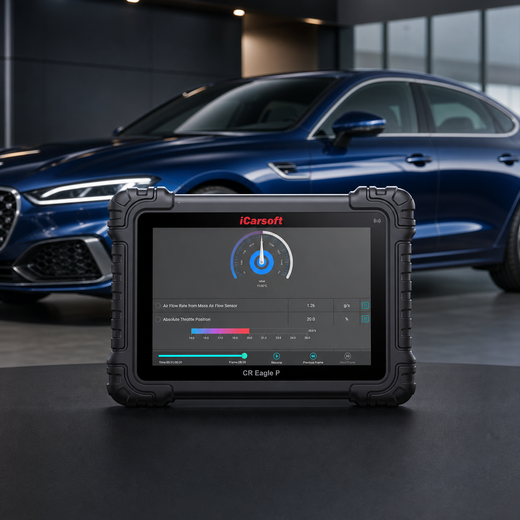
Compare intake-control command with feedback
iCarsoft CR Eagle P
Review available valve-control data alongside engine temperature and operating conditions. Confirm the exact engine, ECU, PIDs and required tests before purchase.
Check current CR Eagle P price and availabilityCheck CR Eagle P compatibility by VINThe official product page lists bidirectional capabilities, but a specific valve-control routine is not guaranteed on every engine. Check VIN and ECU coverage first. Run an available test only when the manufacturer's oil, temperature, safety, and operating prerequisites are satisfied; never use repeated commands to compensate for suspected low oil pressure.
Know the measurement boundary. The scanner cannot directly measure local oil pressure, prove an oil passage is clear, inspect internal valve hardware, or establish wiring load capacity. Use the prescribed pressure gauge, meter, oscilloscope, and mechanical inspection. A supported PID is evidence from the controller, not an independent physical measurement of every part.
Verify the P0028 Repair
After repair, inspect for leaks and confirm connector locks, oil level, part installation, and any required setup. Save the completed measurements and repair details. Clear erasable faults only after preserving the initial record, then follow the applicable verification procedure instead of using battery disconnection as a repair.
Allow the engine to reach the conditions needed for the relevant monitor without excessive load or unsafe testing. Compare the supported command and feedback states and recheck current and pending faults. A cold idle without a warning is not enough if the original problem occurred only after a warm valve-control transition.
If the fault returns, compare its new freeze frame and feedback behavior with the original evidence. A valid electrical command with missing hydraulic response requires a different branch from a false switch indication. Confirm that related oil-pressure, misfire, and cam-timing concerns were evaluated separately rather than hidden by clearing the scan.
A permanent P0028 can remain immediately after a successful repair. If the vehicle stores it as a permanent DTC, a scan tool or battery disconnect cannot erase it. Once current and pending faults are absent, the OBD system removes the permanent record only after the applicable monitor reruns and passes.
Related Intake Valve Control and Cam Timing Code Guides
P0028 Frequently Asked Questions
Is P0028 an intake or exhaust fault?
The generic definition is Intake Valve Control Solenoid Circuit Range/Performance, Bank 2. P0029 identifies the corresponding exhaust-side performance branch. Check the manufacturer definition and component map before selecting a part; similar-looking solenoids are not automatically interchangeable.
Which side of the engine is Bank 2?
Bank 2 is the bank without cylinder 1. Use the engine's cylinder-numbering and component-location diagrams to find it. Driver-side and passenger-side descriptions are not reliable universal rules, especially across different engine layouts and vehicle markets.
Does the P0028 code always mean the solenoid is bad?
No. Wiring, supply, oil delivery, feedback, and mechanical response can all require testing. On applicable valve-lift systems, a pressure-switch problem may misrepresent the commanded state. Prove the failed component using the correct diagnostic chart before replacement.
Can changing the oil fix P0028?
It may help only when incorrect level, specification, or service condition is part of the demonstrated fault. Correct oil service does not repair damaged wiring, a failed switch, or an internal restriction. Do not use additives or thicker oil as an unverified shortcut.
Is P0028 the same as a camshaft timing code?
Not necessarily. Valve lift and camshaft timing describe different functions, and the monitored architecture depends on the engine. Applicable Subaru documentation uses valve-lift command and pressure-switch feedback. Do not replace a cam phaser or timing chain simply because the code concerns intake control.
Can CR Eagle P test the intake valve-control system?
It can display supported data and may offer relevant active tests on covered engines. Confirm exact ECU and function support. A hydraulic-pressure check, circuit load test, or mechanical inspection still needs the specified external equipment and safe manufacturer procedure.
The iCarsoft Official Store Technical Team maintains the store's fault-code library. This guide organizes published manufacturer evidence and verified product information; it does not document a hands-on test of a particular vehicle or claim an individual engineer's review.
Technical and cost references
- Archived Subaru service-manual P0028 detecting criteria — Operation CHARM mirror Third-party mirror of manufacturer material, not an OEM-hosted current service portal. Used only for the limited valve-lift command and oil-pressure-switch feedback example; no numerical specifications transferred.
- Snap-on Diagnostic Trouble Codes (DTC) List Official diagnostic-tool manufacturer list cross-checks intake Bank 2 and adjacent-code terminology.
- California BAR — On-Board Diagnostic Test Reference Permanent-record and monitor-verification principles; not a vehicle-specific valve-control repair procedure.
Product information: Official iCarsoft CR Eagle P page.
Editorial note: This educational guide supports diagnostic planning and does not replace the current service manual, safety instructions, or professional diagnosis for your VIN. Source information was checked August 31, 2026. Apply only the procedures and specifications for the exact vehicle; product functions depend on vehicle, ECU, software, and access requirements.


