

Quick answer: P0217 means the engine control module detected an engine coolant over-temperature condition. It records an overheating event, not the reason for it. Low coolant from a leak, a cooling-fan fault, a drive-belt or water-pump problem, a stuck thermostat, restricted airflow or coolant flow, combustion gas entering the cooling system, or an inaccurate temperature signal can all lead to this code.
What P0217 means
The control module monitors engine temperature using the engine coolant temperature sensor and, on some vehicles, other modeled inputs. When temperature crosses the manufacturer's limit under the required conditions, it stores P0217 and may protect the engine by reducing power, changing fan operation, disabling air conditioning, or entering a fail-safe strategy.
Because the code describes the result, it cannot distinguish a genuine overheating engine from a sensor or circuit that reports an implausibly high temperature. Freeze-frame data, the driver's observations, coolant condition, and an independent temperature check help separate those cases. Treat the warning as real until testing shows otherwise.
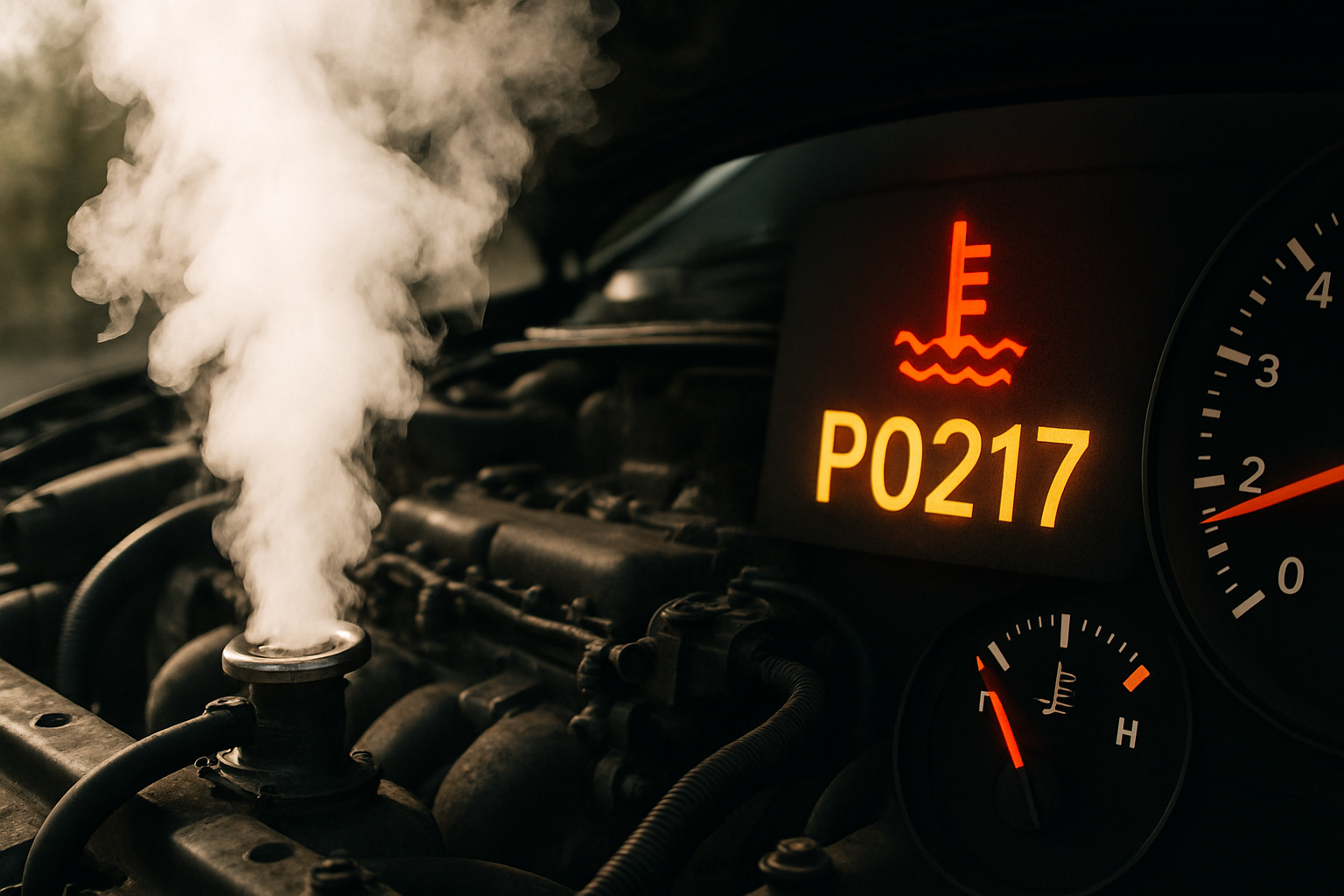
What to do when P0217 appears
- Reduce load and stop safely. Turn off air conditioning, avoid hard acceleration, and pull over as soon as traffic conditions permit.
- Shut down if temperature remains high. Do not keep driving to see whether it improves. Aluminum cylinder heads, gaskets, pistons, and turbochargers can be damaged by excess heat.
- Keep clear of steam and pressurized coolant. Do not remove the cap, reach near a running fan, or pour cold water into a hot engine.
- Allow a complete cool-down. Check coolant only as described by the owner's manual and only when the system is cold. If coolant is empty, a belt is missing, a leak is active, or the engine runs poorly after overheating, arrange transport.
Common causes of an engine over-temperature condition
| Fault area | Typical clues |
|---|---|
| Low coolant or external leak | Low cold level, residue, odor, wet hose or radiator, leaking reservoir, heater core, pump, or pressure cap |
| Cooling-fan system | Temperature rises in traffic or at idle, fan command without fan operation, fuse, relay, control-module, wiring, or motor fault |
| Thermostat or coolant-flow restriction | Rapid warm-up, uneven hose or radiator temperatures, poor circulation, or manufacturer test failure |
| Water pump or drive system | Noise, leakage, damaged belt or tensioner, loose impeller, or pump-speed control fault |
| Radiator airflow or heat transfer | Blocked fins, damaged shutters, debris, internal restriction, or incorrect coolant concentration |
| Internal engine leak | Repeated coolant loss, combustion gas in the cooling system, misfire after start, contaminated oil, or abnormal pressure rise |
| Temperature sensor or circuit | Cold-start reading inconsistent with ambient temperature, sudden data jumps, connector damage, or wiring-test failure |
Step-by-step diagnosis after the engine is cold
- Save the scan record. Capture P0217 status, freeze-frame coolant temperature, engine speed, load, vehicle speed, fan command, voltage, and all companion codes. A related code can identify the subsystem that failed first.
- Inspect before running the engine. With the system cold, verify the specified coolant level and concentration. Look for damaged hoses, loose clamps, stains, radiator impact, a missing belt, fan damage, or leaks. Pressure-test only to the manufacturer's limit.
- Validate temperature data. Before a cold start, coolant and intake-air temperatures should be reasonably close to ambient conditions. Compare scan data with a suitable external temperature measurement as the engine warms.
- Check fan operation and command. Confirm the conditions under which each fan speed should operate. Test fuses, relay or module control, power, ground, voltage drop, and motor current using the wiring diagram.
- Evaluate coolant circulation. Follow service procedures for thermostat opening, pump output, electric-pump commands, air bleeding, radiator temperature distribution, and active grille shutters if fitted.
- Test for an internal leak when evidence points there. A cooling-system pressure loss, combustion-gas test, cylinder leak-down test, spark-plug inspection, or oil analysis may be appropriate. Do not diagnose a head gasket from white vapor on a cold day alone.
- Review vehicle-specific information. Official bulletins have tied P0217 to a retained assembly pin in a belt tensioner and to EGR-cooler leakage on particular Ford applications. These examples show why year, engine, build date, and symptoms must match before applying a bulletin.
Repair and verify the cooling system
The repair may be a hose, cap, connector, sensor, fan circuit, thermostat, water pump, radiator, belt drive, EGR cooler, or internal engine repair. Replace only the component that failed inspection or testing, use the specified coolant, and correct the original leak before refilling.
After repair and bleeding, monitor temperature from a cold start through thermostat opening and fan operation. Check cabin heat, leaks, pressure behavior, and temperature stability at idle and under a controlled road load. Rescan for pending codes after the manufacturer's drive cycle. Recheck the cold coolant level only after the engine cools again. If another timing-related code is present, treat the linked P0216 guide as a separate diagnostic path rather than assuming it caused the overheat.

Using CR MAX BT for P0217 diagnosis
The iCarsoft CR MAX BT can help save whole-vehicle codes and freeze-frame data, then graph supported coolant-temperature, intake-air, fan-command, and engine-load PIDs. On compatible vehicles, CR MAX BT may provide fan or electric-pump active tests that help separate a command problem from a power, ground, or component fault.
Available module access, data, active tests, adaptations, and bleed functions vary by make, model, year, engine, ECU, and installed software. Confirm exact-vehicle coverage in the CR MAX BT product and coverage information. The tool supports diagnosis but does not make a hot cooling system safe to open.
P0217 FAQ
Can I drive after the temperature returns to normal?
A falling gauge does not prove the cause has disappeared. If coolant was lost, steam appeared, the warning returns, or the engine runs abnormally, shut it down and arrange inspection.
Can a bad coolant-temperature sensor set P0217?
Yes, if its signal falsely reports excessive temperature, but real overheating must be ruled out first. Compare cold-start data, external temperature, wiring integrity, and signal behavior.
Why does the car overheat only at idle?
Low road speed reduces natural airflow, so a fan-control fault becomes more noticeable. Low coolant, pump problems, blocked airflow, and other faults can produce the same pattern, so test rather than assume.


